Xu Fei, Tang Qianqian, Wang Yejinpeng, Wang Gang, Qian Kaiyu, Ju Lingao, Xiao Yu
Department of Laboratory Medicine, Zhongnan Hospital of Wuhan University, Wuhan, China.
Department of Breast and Thyroid Surgery, Zhongnan Hospital of Wuhan University, Wuhan, China.
Front Genet. 2021 Dec 6;12:758612. doi: 10.3389/fgene.2021.758612. eCollection 2021.
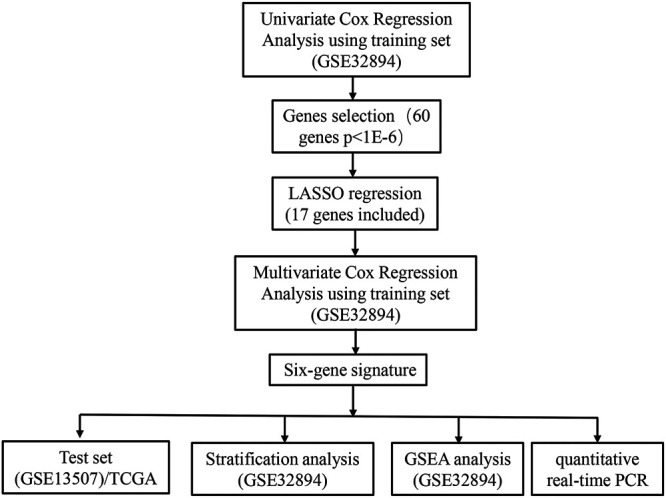
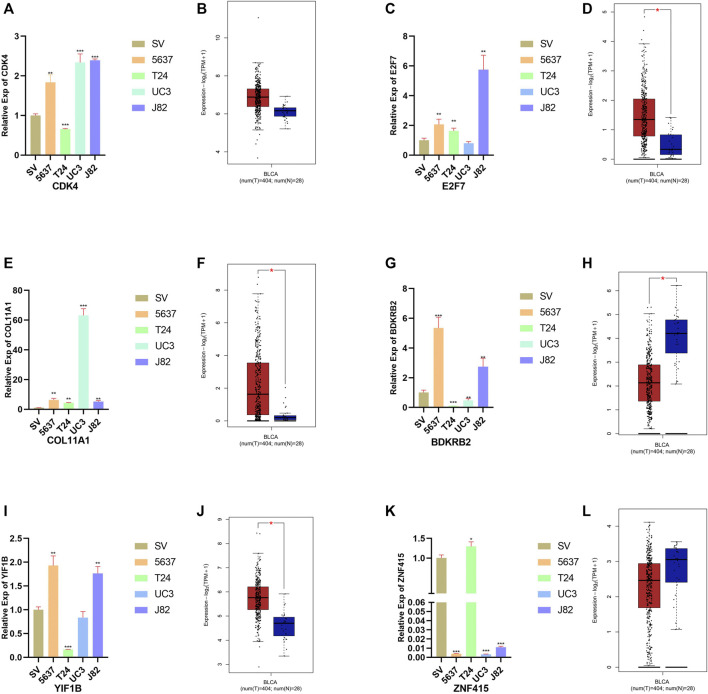
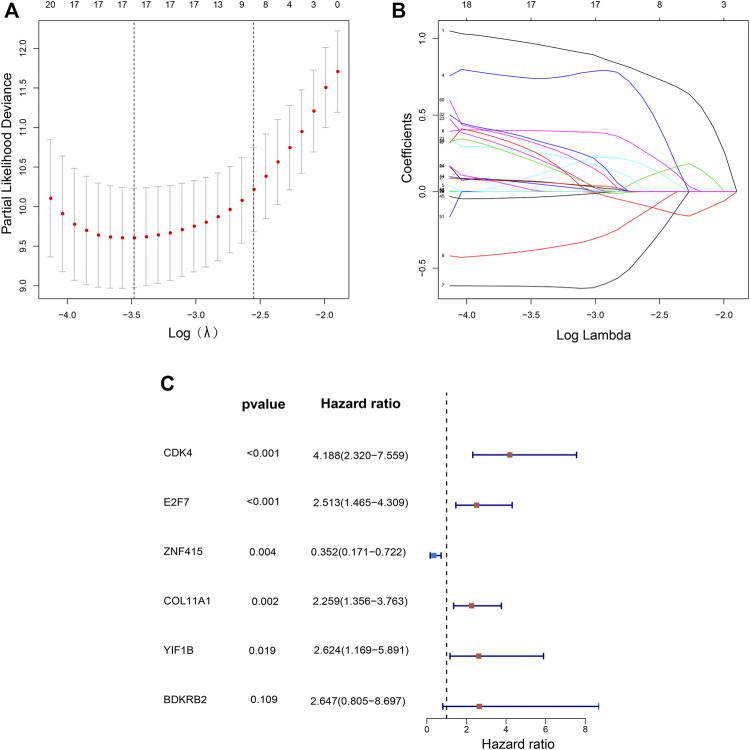
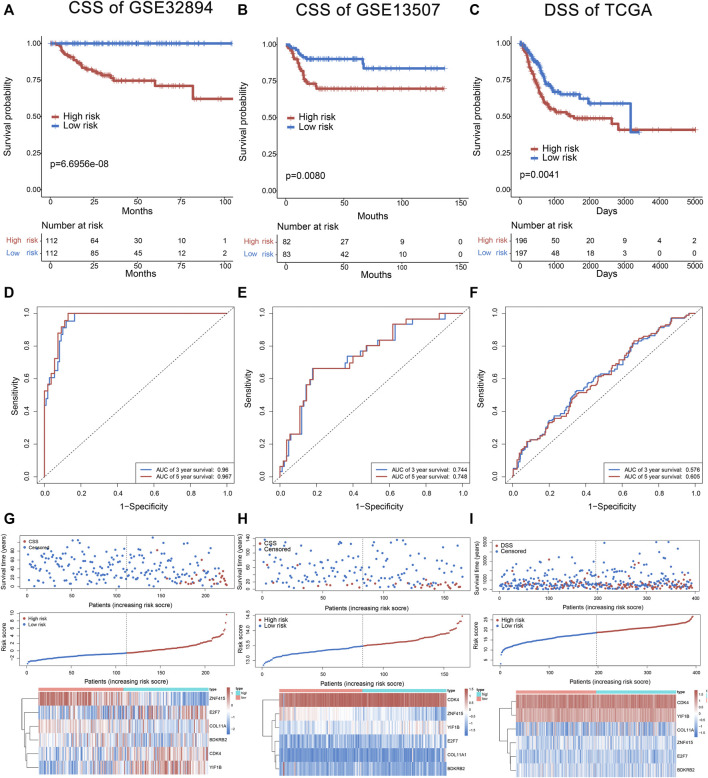
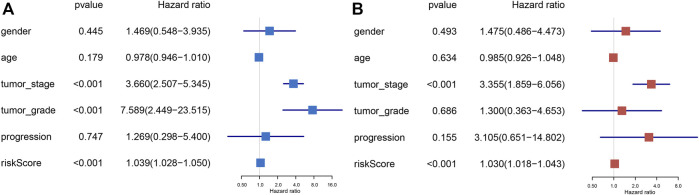
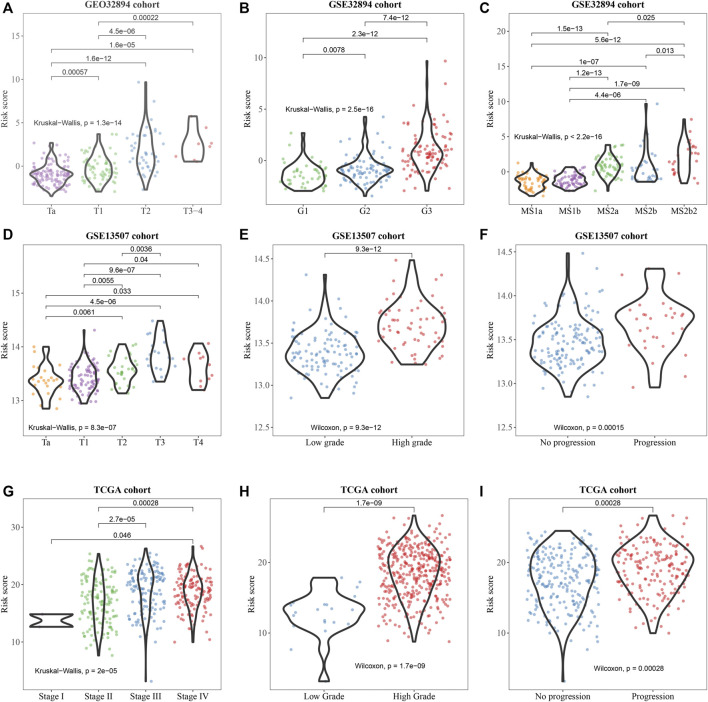
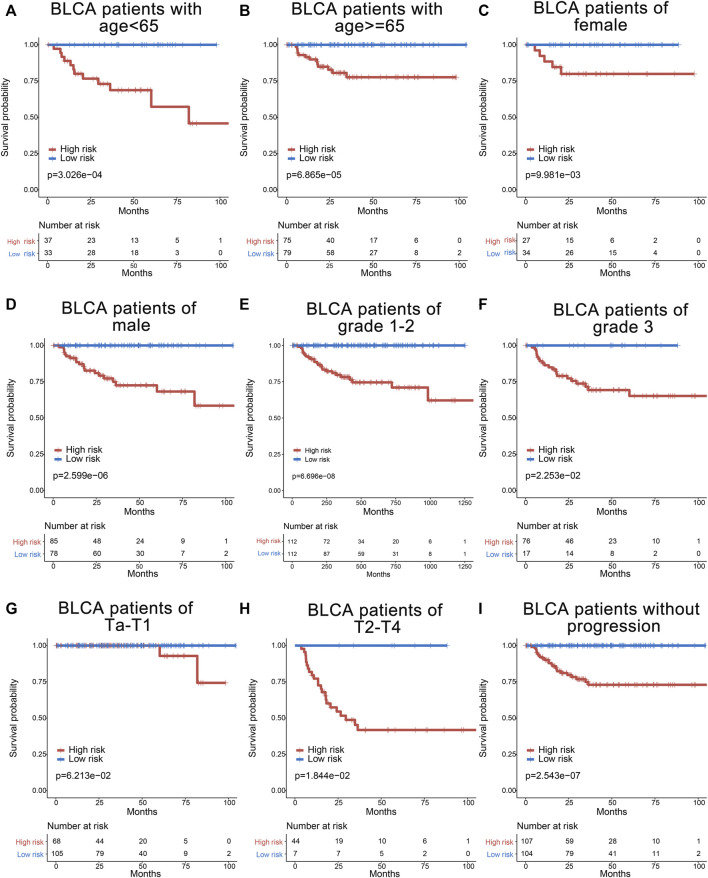
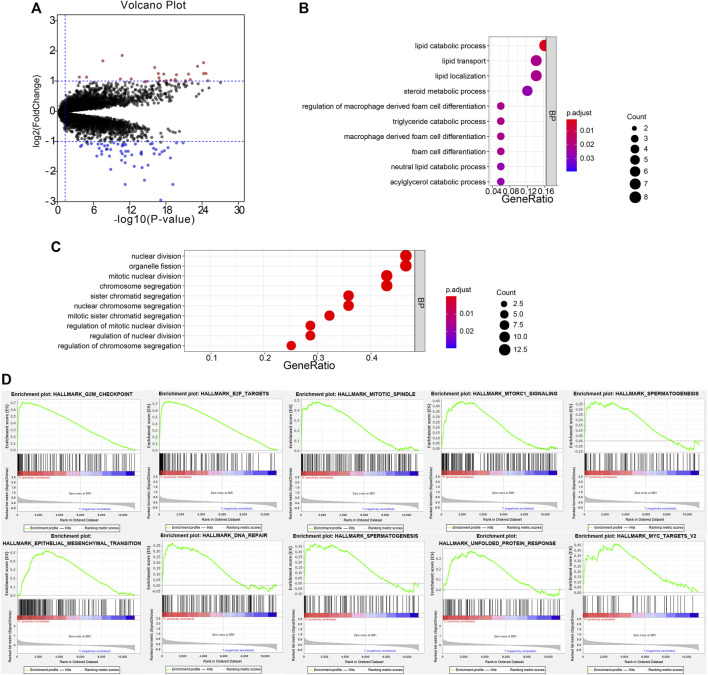
Human bladder cancer (BCa) is the most common urogenital system malignancy. Patients with BCa have limited treatment efficacy in clinical practice. Novel biomarkers could provide more crucial information conferring to cancer diagnosis, treatment, and prognosis. Here, we aimed to explore and identify novel biomarkers associated with cancer-specific survival of patients with BCa to build a prognostic signature. Based on univariate Cox regression, Lasso regression, and multivariate Cox regression analysis, we conducted an integrated analysis in the training set (GSE32894) and established a six-gene signature to predict the cancer-specific survival for human BCa. The six genes were Cyclin Dependent Kinase 4 (), E2F Transcription Factor 7 (), Collagen Type XI Alpha 1 Chain (), Bradykinin Receptor B2 (), Yip1 Interacting Factor Homolog B (), and Zinc Finger Protein 415 (). Then, we validated the prognostic value of the model by using two other datasets (GSE13507 and TCGA). Also, we conducted univariate and multivariate Cox regression analyses, and results indicated that the six-gene signature was an independent prognostic factor of cancer-specific survival of patients with BCa. Functional analysis was performed based on the differentially expressed genes of low- and high-risk patients, and we found that they were enriched in lipid metabolic and cell division-related biological processes. Meanwhile, the gene set enrichment analysis (GSEA) revealed that high-risk samples were enriched in cell cycle and cancer-related pathways [G2/M checkpoint, E2F targets, mitotic spindle, mTOR signaling, spermatogenesis, epithelial-mesenchymal transition (EMT), DNA repair, PI3K/AKT/mTOR signaling, unfolded protein response (UPR), and MYC targets V2]. Lastly, we detected the relative expression of each signature in BCa cell lines by quantitative real-time PCR (qRT-PCR). As far as we know, currently, the present study is the first research that developed and validated a cancer-specific survival prognostic index based on three independent cohorts. The results revealed that this six-gene signature has a predictive ability for cancer-specific prognosis. Moreover, we also verified the relative expression of these six signatures between the bladder cell line and four BCa cell lines by qRT-PCR. Nevertheless, experiments to further explore the function of six genes are lacking.
人类膀胱癌(BCa)是泌尿生殖系统中最常见的恶性肿瘤。在临床实践中,BCa患者的治疗效果有限。新型生物标志物可为癌症的诊断、治疗和预后提供更关键的信息。在此,我们旨在探索和鉴定与BCa患者癌症特异性生存相关的新型生物标志物,以构建一个预后特征。基于单因素Cox回归、Lasso回归和多因素Cox回归分析,我们在训练集(GSE32894)中进行了综合分析,并建立了一个六基因特征来预测人类BCa的癌症特异性生存。这六个基因分别是细胞周期蛋白依赖性激酶4()、E2F转录因子7()、XI型胶原蛋白α1链()、缓激肽受体B2()、Yip1相互作用因子同源物B()和锌指蛋白415()。然后,我们使用另外两个数据集(GSE13507和TCGA)验证了该模型的预后价值。此外,我们进行了单因素和多因素Cox回归分析,结果表明该六基因特征是BCa患者癌症特异性生存的独立预后因素。基于低风险和高风险患者的差异表达基因进行了功能分析,我们发现它们在脂质代谢和细胞分裂相关的生物学过程中富集。同时,基因集富集分析(GSEA)显示高风险样本在细胞周期和癌症相关通路中富集[G2/M检查点、E2F靶点、有丝分裂纺锤体、mTOR信号通路、精子发生、上皮-间质转化(EMT)、DNA修复、PI3K/AKT/mTOR信号通路、未折叠蛋白反应(UPR)和MYC靶点V2]。最后,我们通过定量实时PCR(qRT-PCR)检测了BCa细胞系中每个特征的相对表达。据我们所知,目前本研究是首个基于三个独立队列开发并验证癌症特异性生存预后指数的研究。结果表明,这个六基因特征对癌症特异性预后具有预测能力。此外,我们还通过qRT-PCR验证了膀胱细胞系与四种BCa细胞系之间这六个特征的相对表达。然而,缺乏进一步探索这六个基因功能的实验。