Zai Wenjing, Chen Wei, Liu Hongrui, Ju Dianwen
Department of Biological Medicines & Shanghai Engineering Research Center of Immunotherapeutics, Fudan University School of Pharmacy, Shanghai 201203, China.
Key Laboratory of Medical Molecular Virology (MOE/NHC/CAMS), School of Basic Medical Sciences, Shanghai Medical College, Fudan University, Shanghai 200032, China.
Biomedicines. 2021 Dec 14;9(12):1912. doi: 10.3390/biomedicines9121912.
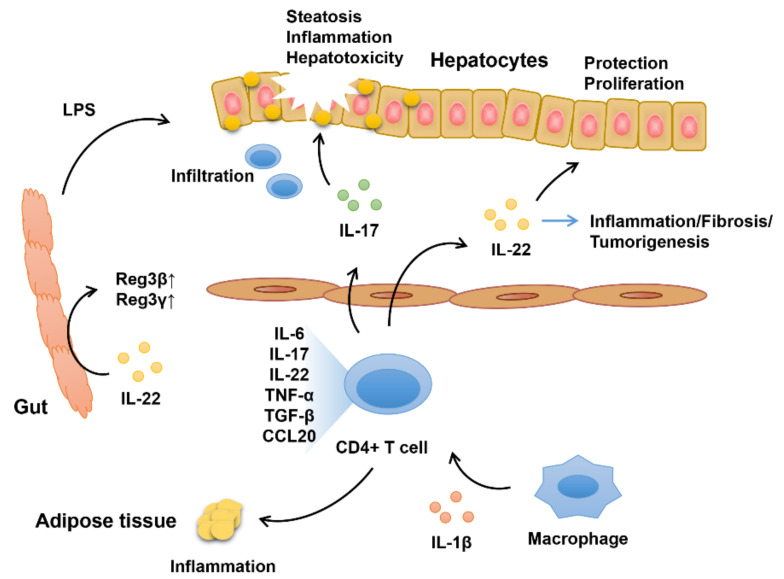
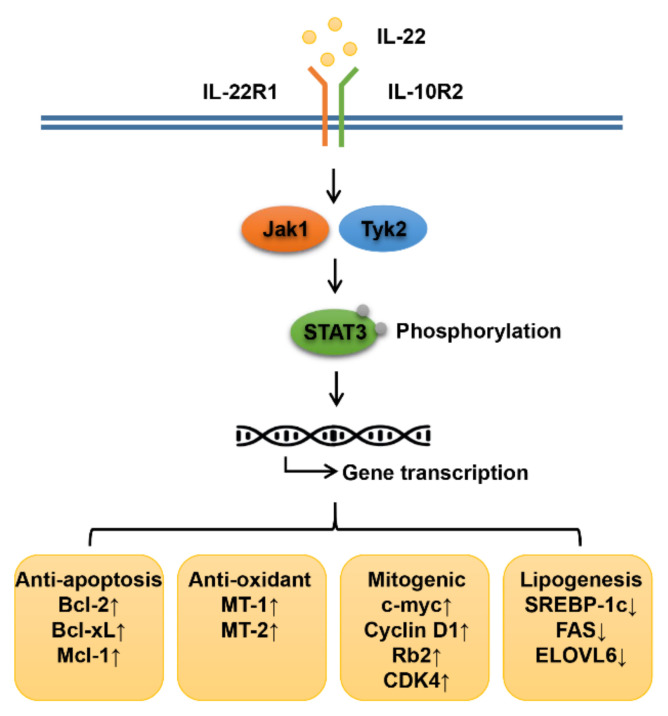
Nonalcoholic fatty liver disease (NAFLD) represents one of the most common liver disorders and can progress into a series of liver diseases, including nonalcoholic steatohepatitis (NASH), fibrosis, cirrhosis, and even liver cancer. Interleukin-22 (IL-22), a member of the IL-10 family of cytokines, is predominantly produced by lymphocytes but acts exclusively on epithelial cells. IL-22 was proven to favor tissue protection and regeneration in multiple diseases. Emerging evidence suggests that IL-22 plays important protective functions against NAFLD by improving insulin sensitivity, modulating lipid metabolism, relieving oxidative and endoplasmic reticulum (ER) stress, and inhibiting apoptosis. By directly interacting with the heterodimeric IL-10R2 and IL-22R1 receptor complex on hepatocytes, IL-22 activates the Janus kinase 1 (JAK1)/ signal transducer and activator of transcription 3 (STAT3), c-Jun N-terminal kinase (JNK) and extracellular-signal regulated kinase (ERK) pathways to regulate the subsequent expression of genes involved in inflammation, metabolism, tissue repair, and regeneration, thus alleviating hepatitis and steatosis. However, due to the wide biodistribution of the IL-22 receptor and its proinflammatory effects, modifications such as targeted delivery of IL-22 expression and recombinant IL-22 fusion proteins to improve its efficacy while reducing systemic side effects should be taken for further clinical application. In this review, we summarized recent progress in understanding the physiological and pathological importance of the IL-22-IL-22R axis in NAFLD and the mechanisms of IL-22 in the protection of NAFLD and discussed the potential strategies to maneuver this specific cytokine for therapeutic applications for NAFLD.
非酒精性脂肪性肝病(NAFLD)是最常见的肝脏疾病之一,可进展为一系列肝脏疾病,包括非酒精性脂肪性肝炎(NASH)、纤维化、肝硬化,甚至肝癌。白细胞介素-22(IL-22)是细胞因子IL-10家族的成员之一,主要由淋巴细胞产生,但仅作用于上皮细胞。已证实IL-22在多种疾病中有助于组织保护和再生。新出现的证据表明,IL-22通过改善胰岛素敏感性、调节脂质代谢、减轻氧化应激和内质网(ER)应激以及抑制细胞凋亡,对NAFLD发挥重要的保护作用。通过与肝细胞上的异二聚体IL-10R2和IL-22R1受体复合物直接相互作用,IL-22激活Janus激酶1(JAK1)/信号转导和转录激活因子3(STAT3)、c-Jun氨基末端激酶(JNK)和细胞外信号调节激酶(ERK)途径,以调节参与炎症、代谢、组织修复和再生的基因的后续表达,从而减轻肝炎和脂肪变性。然而,由于IL-22受体广泛的生物分布及其促炎作用,在进一步临床应用中应采取如靶向递送IL-22表达和重组IL-22融合蛋白等修饰方法,以提高其疗效同时减少全身副作用。在本综述中,我们总结了在理解IL-22-IL-22R轴在NAFLD中的生理和病理重要性以及IL-22保护NAFLD的机制方面的最新进展,并讨论了操纵这种特定细胞因子用于NAFLD治疗应用的潜在策略。