Benzekry Sébastien, Grangeon Mathieu, Karlsen Mélanie, Alexa Maria, Bicalho-Frazeto Isabella, Chaleat Solène, Tomasini Pascale, Barbolosi Dominique, Barlesi Fabrice, Greillier Laurent
Computational Pharmacology and Clinical Oncology (COMPO) Unit, Inria Sophia Antipolis-Méditerranée, Cancer Research Center of Marseille, Inserm UMR1068, CNRS UMR7258, Aix Marseille University UM105, 13385 Marseille, France.
Multidisciplinary Oncology and Therapeutic Innovations Department, Assistance Publique-Hôpitaux de Marseille, Aix Marseille University, 13005 Marseille, France.
Cancers (Basel). 2021 Dec 9;13(24):6210. doi: 10.3390/cancers13246210.
Immune checkpoint inhibitors (ICIs) are now a therapeutic standard in advanced non-small cell lung cancer (NSCLC), but strong predictive markers for ICIs efficacy are still lacking. We evaluated machine learning models built on simple clinical and biological data to individually predict response to ICIs.
Patients with metastatic NSCLC who received ICI in second line or later were included. We collected clinical and hematological data and studied the association of this data with disease control rate (DCR), progression free survival (PFS) and overall survival (OS). Multiple machine learning (ML) algorithms were assessed for their ability to predict response.
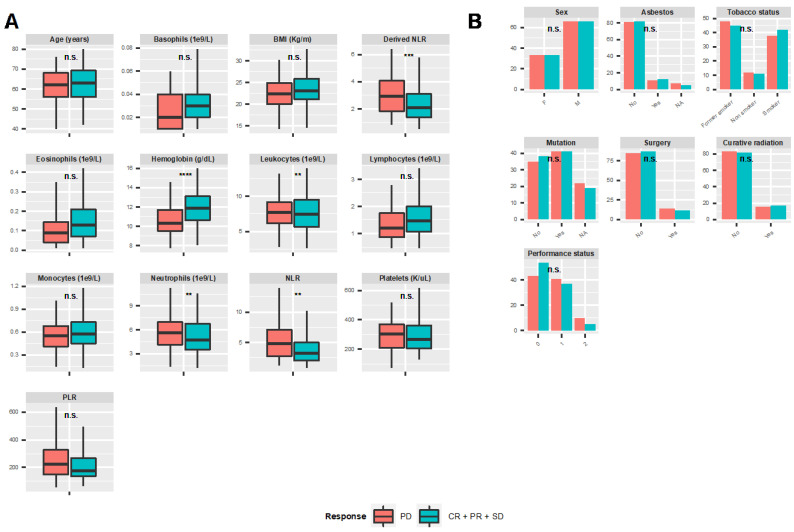
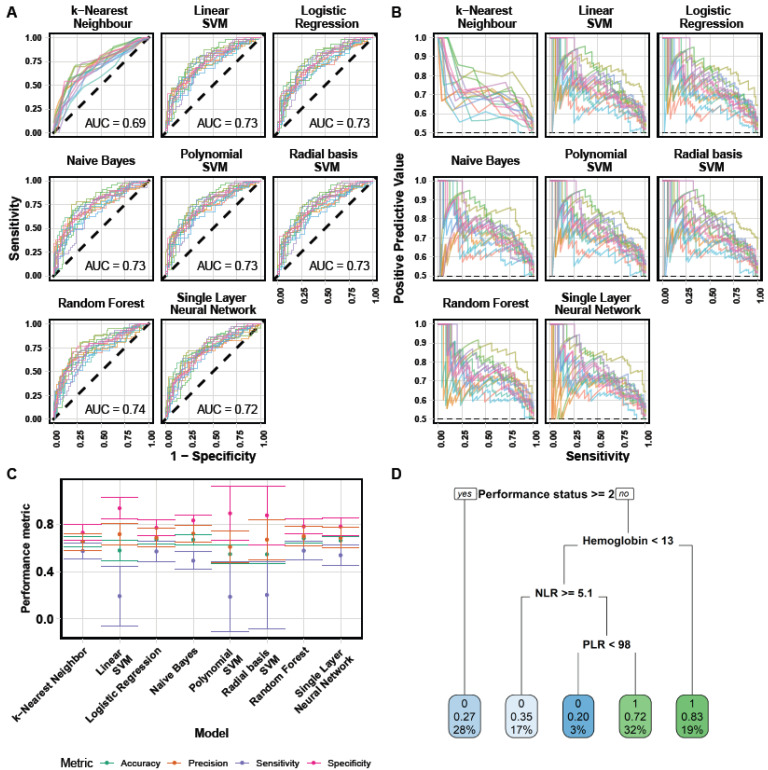
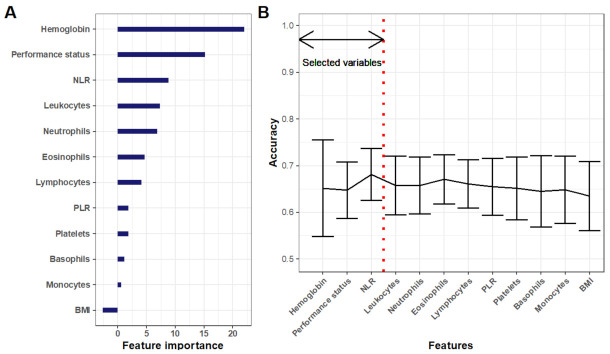
Overall, 298 patients were enrolled. The overall response rate and DCR were 15.3% and 53%, respectively. Median PFS and OS were 3.3 and 11.4 months, respectively. In multivariable analysis, DCR was significantly associated with performance status (PS) and hemoglobin level (OR 0.58, < 0.0001; OR 1.8, < 0.001). These variables were also associated with PFS and OS and ranked top in random forest-based feature importance. Neutrophil-to-lymphocyte ratio was also associated with DCR, PFS and OS. The best ML algorithm was a random forest. It could predict DCR with satisfactory efficacy based on these three variables. Ten-fold cross-validated performances were: accuracy 0.68 ± 0.04, sensitivity 0.58 ± 0.08; specificity 0.78 ± 0.06; positive predictive value 0.70 ± 0.08; negative predictive value 0.68 ± 0.06; AUC 0.74 ± 0.03.
Combination of simple clinical and biological data could accurately predict disease control rate at the individual level.
免疫检查点抑制剂(ICI)目前是晚期非小细胞肺癌(NSCLC)的治疗标准,但仍缺乏预测ICI疗效的强预测标志物。我们评估了基于简单临床和生物学数据构建的机器学习模型,以个体预测对ICI的反应。
纳入二线或更晚接受ICI治疗的转移性NSCLC患者。我们收集了临床和血液学数据,并研究了这些数据与疾病控制率(DCR)、无进展生存期(PFS)和总生存期(OS)的关联。评估了多种机器学习(ML)算法预测反应的能力。
总体而言,共纳入298例患者。总缓解率和DCR分别为15.3%和53%。中位PFS和OS分别为3.3个月和11.4个月。在多变量分析中,DCR与体能状态(PS)和血红蛋白水平显著相关(OR 0.58,<0.0001;OR 1.8,<0.001)。这些变量也与PFS和OS相关,并在基于随机森林的特征重要性中排名靠前。中性粒细胞与淋巴细胞比值也与DCR、PFS和OS相关。最佳的ML算法是随机森林。基于这三个变量,它可以以令人满意的疗效预测DCR。十倍交叉验证性能为:准确率0.68±0.04,灵敏度0.58±0.08;特异性0.78±0.06;阳性预测值0.70±0.08;阴性预测值0.68±0.06;AUC 0.74±0.03。
简单的临床和生物学数据相结合可以在个体水平上准确预测疾病控制率。