Pezeshkian Zahra, Nobili Stefania, Peyravian Noshad, Shojaee Bahador, Nazari Haniye, Soleimani Hiva, Asadzadeh-Aghdaei Hamid, Ashrafian Bonab Maziar, Nazemalhosseini-Mojarad Ehsan, Mini Enrico
Basic and Molecular Epidemiology of Gastrointestinal Disorders Research Center, Research Institute for Gastroenterology and Liver Diseases, Shahid Beheshti University of Medical Sciences, Tehran 19835-178, Iran.
Department of Neurosciences, Imaging and Clinical Sciences, "G. D'Annunzio" University of Chieti-Pescara, 66100 Chieti, Italy.
Cancers (Basel). 2021 Dec 10;13(24):6226. doi: 10.3390/cancers13246226.
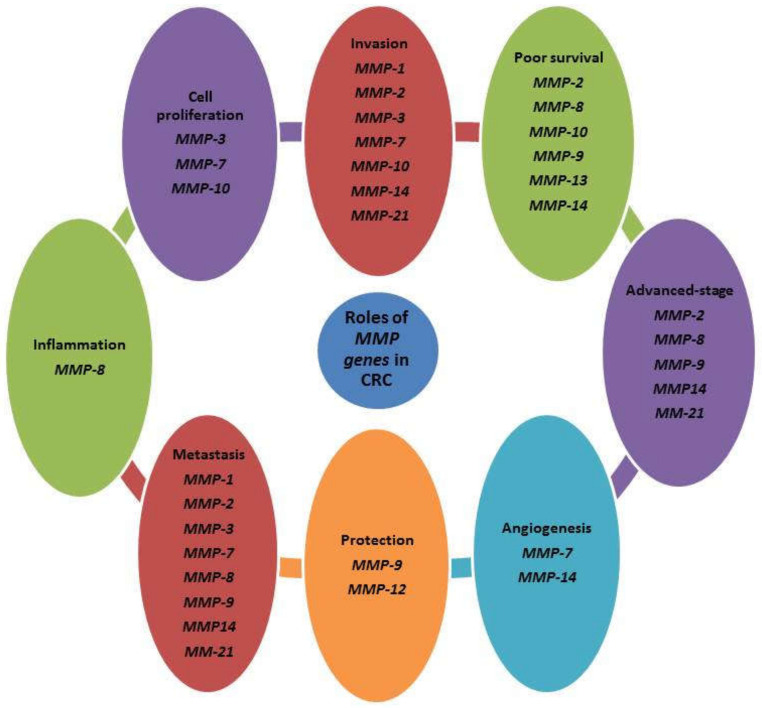
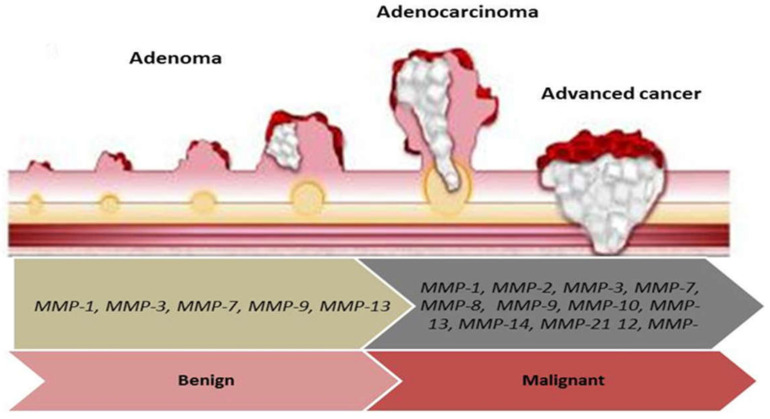
Colorectal cancer (CRC) is the third and second cancer for incidence and mortality worldwide, respectively, and is becoming prevalent in developing countries. Most CRCs derive from polyps, especially adenomatous polyps, which can gradually transform into CRC. The family of Matrix Metalloproteinases (MMPs) plays a critical role in the initiation and progression of CRC. Prominent MMPs, including MMP-1, MMP-2, MMP-7, MMP-8, MMP-9, MMP-12, MMP-13, MMP-14, and MMP-21, have been detected in CRC patients, and the expression of most of them correlates with a poor prognosis. Moreover, many studies have explored the inhibition of MMPs and targeted therapy for CRC, but there is not enough information about the role of MMPs in polyp malignancy. In this review, we discuss the role of MMPs in colorectal cancer and its pathogenesis.
结直肠癌(CRC)在全球范围内分别是发病率和死亡率位列第三和第二的癌症,并且在发展中国家正变得日益普遍。大多数结直肠癌源自息肉,尤其是腺瘤性息肉,其可逐渐转变为结直肠癌。基质金属蛋白酶(MMPs)家族在结直肠癌的发生和发展中起关键作用。在结直肠癌患者中已检测到多种显著的MMPs,包括MMP-1、MMP-2、MMP-7、MMP-8、MMP-9、MMP-12、MMP-13、MMP-14和MMP-21,其中大多数的表达与不良预后相关。此外,许多研究探讨了MMPs的抑制作用及针对结直肠癌的靶向治疗,但关于MMPs在息肉恶变中的作用的信息还不够充分。在本综述中,我们讨论了MMPs在结直肠癌及其发病机制中的作用。