Fiber and Polymer Science Program, Wilson College of Textiles, NC State University, Raleigh, NC 27606, USA.
Department of Chemistry, Middle East Technical University, 06800 Ankara, Turkey.
Molecules. 2021 Dec 13;26(24):7554. doi: 10.3390/molecules26247554.
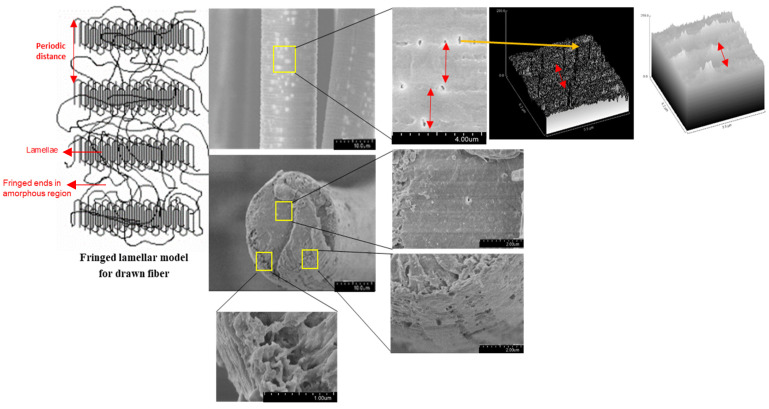
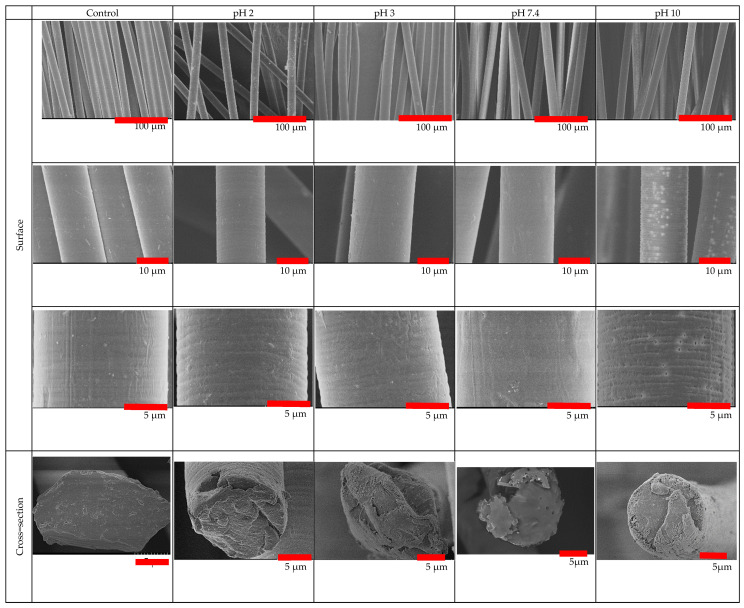
Polylactic acid (PLA) is a widely used bioresorbable polymer in medical devices owing to its biocompatibility, bioresorbability, and biodegradability. It is also considered a sustainable solution for a wide variety of other applications, including packaging. Because of its widespread use, there have been many studies evaluating this polymer. However, gaps still exist in our understanding of the hydrolytic degradation in extreme pH environments and its impact on physical and mechanical properties, especially in fibrous materials. The goal of this work is to explore the hydrolytic degradation of PLA fibers as a function of a wide range of pH values and exposure times. To complement the experimental measurements, molecular-level details were obtained using both molecular dynamics (MD) simulations with ReaxFF and density functional theory (DFT) calculations. The hydrolytic degradation of PLA fibers from both experiments and simulations was observed to have a faster rate of degradation in alkaline conditions, with 40% of strength loss of the fibers in just 25 days together with an increase in the percent crystallinity of the degraded samples. Additionally, surface erosion was observed in these PLA fibers, especially in extreme alkaline environments, in contrast to bulk erosion observed in molded PLA grafts and other materials, which is attributed to the increased crystallinity induced during the fiber spinning process. These results indicate that spun PLA fibers function in a predictable manner as a bioresorbable medical device when totally degraded at end-of-life in more alkaline conditions.
聚乳酸(PLA)是一种在医疗器械中广泛使用的生物可吸收聚合物,因为它具有生物相容性、生物可吸收性和生物降解性。它也被认为是广泛应用于其他各种应用的可持续解决方案,包括包装。由于其广泛的应用,已经有许多研究评估了这种聚合物。然而,我们对极端 pH 环境下水解降解及其对物理和机械性能的影响的理解仍然存在差距,特别是在纤维材料方面。这项工作的目的是探索 PLA 纤维在广泛的 pH 值和暴露时间下的水解降解。为了补充实验测量,使用 ReaxFF 分子动力学 (MD) 模拟和密度泛函理论 (DFT) 计算获得了分子水平的细节。实验和模拟观察到 PLA 纤维在碱性条件下的降解速度更快,仅在 25 天内纤维的强度损失就达到了 40%,同时降解样品的结晶度增加。此外,在这些 PLA 纤维中观察到表面侵蚀,特别是在极端碱性环境中,与在模制 PLA 接枝和其他材料中观察到的体侵蚀相反,这归因于纤维纺丝过程中诱导的结晶度增加。这些结果表明,在更碱性的条件下完全降解时,作为生物可吸收医疗器械的纺丝 PLA 纤维以可预测的方式发挥作用。