Exercise and Immunometabolism Research Group, Universidade Estadual Paulista (UNESP), Presidente Prudente, São Paulo 19060-560, Brazil.
Clinical Physiology, Coimbra Health School, Polytechnic Institute of Coimbra, Rua 5 de Outubro-SM Bispo, Apartado 7006, 3046-854 Coimbra, Portugal.
Int J Environ Res Public Health. 2021 Dec 8;18(24):12949. doi: 10.3390/ijerph182412949.
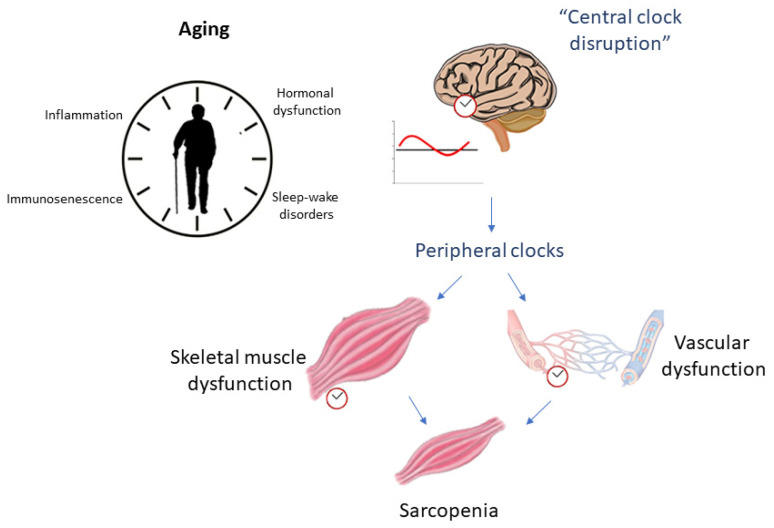
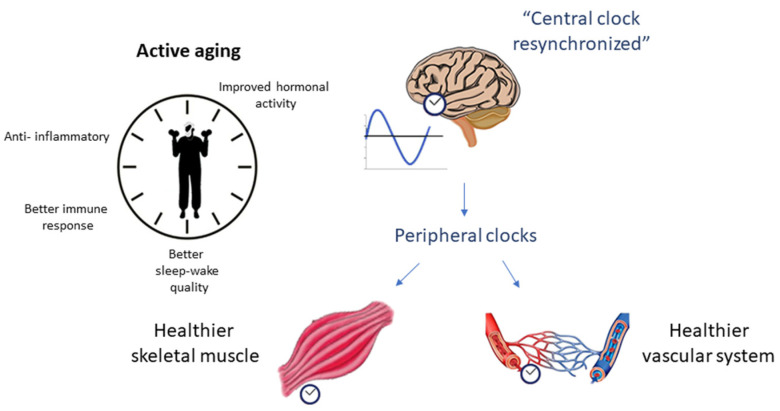
Aging is characterized by several progressive physiological changes, including changes in the circadian rhythm. Circadian rhythms influence behavior, physiology, and metabolic processes in order to maintain homeostasis; they also influence the function of endothelial cells, smooth muscle cells, and immune cells in the vessel wall. A clock misalignment could favor vascular damage and indirectly also affect skeletal muscle function. In this review, we focus on the dysregulation of circadian rhythm due to aging and its relationship with skeletal muscle changes and vascular health as possible risk factors for the development of sarcopenia, as well as the role of physical exercise as a potential modulator of these processes.
衰老是多种进行性生理变化的特征,包括昼夜节律的变化。昼夜节律影响行为、生理和代谢过程,以维持体内平衡;它们还影响血管壁中的内皮细胞、平滑肌细胞和免疫细胞的功能。时钟失准可能有利于血管损伤,并间接影响骨骼肌功能。在这篇综述中,我们重点关注由于衰老导致的昼夜节律失调及其与骨骼肌变化和血管健康的关系,这些可能是导致肌肉减少症发展的危险因素,以及体育锻炼作为这些过程的潜在调节剂的作用。