Kruzan Kaylee Payne, Meyerhoff Jonah, Biernesser Candice, Goldstein Tina, Reddy Madhu, Mohr David C
Center for Behavioral Intervention Technologies, Feinberg School of Medicine, Northwestern University, Chicago, IL, United States.
Department of Psychiatry, University of Pittsburgh Medical Center, Pittsburgh, PA, United States.
JMIR Ment Health. 2021 Dec 24;8(12):e31367. doi: 10.2196/31367.
The prevalence of self-injurious thoughts and behaviors (SITB) signals a growing public health crisis. Despite a recognized need for improved and scalable interventions, the field of SITB intervention faces several challenges: existing interventions are often time and resource intensive, most individuals with SITB do not seek formal mental health care, and efficacious treatments are characterized by small effects. Combined, these challenges indicate a need for improved SITB interventions for individuals in formal treatment and those who are not treatment engaged but are at high risk of worsening mental health and future suicide attempts.
We present a methodological approach and set of techniques that may address these challenges by centering the lived experience of individuals with SITB in the process of developing needed services: user-centered design (UCD).
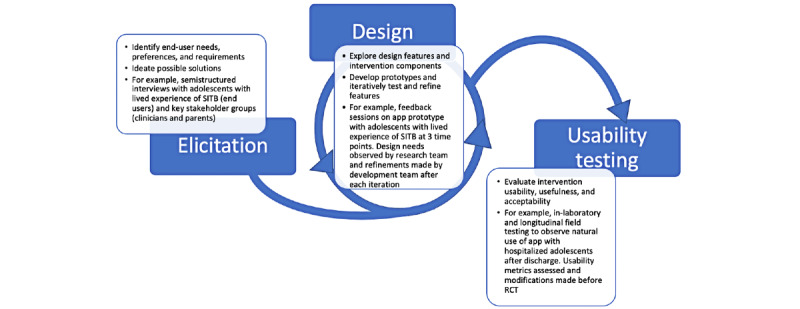
We highlight the value of UCD in the context of digital interventions for SITB by describing the UCD approach and explicating how it can be leveraged to include lived experience throughout the development and evaluation process. We provide a detailed case example highlighting 3 phases of the early development process that can be used to design an intervention that is engaging and meets end-user needs. In addition, we point to novel applications of UCD to complement new directions in SITB research.
In this paper, we offer a 2-pronged approach to meet these challenges. First, in terms of addressing access to effective interventions, digital interventions hold promise to extend the reach of evidence-based treatments outside of brick-and-mortar health care settings. Second, to address challenges related to treatment targets and engagement, we propose involving individuals with lived experience in the design and research process.
UCD offers a well-developed and systematic process to center the unique needs, preferences, and perceived barriers of individuals with lived SITB experience in the development and evaluation of digital interventions.
自我伤害性想法和行为(SITB)的流行标志着一场日益严重的公共卫生危机。尽管人们认识到需要改进并扩大干预措施,但SITB干预领域面临若干挑战:现有干预措施通常耗费时间和资源,大多数有SITB的个体不寻求正规的心理健康护理,且有效治疗的效果甚微。综合来看,这些挑战表明需要为接受正规治疗的个体以及那些未接受治疗但心理健康状况恶化和未来有自杀企图风险较高的个体改进SITB干预措施。
我们提出一种方法和一套技术,通过在开发所需服务的过程中以有SITB个体的生活经历为中心,即用户中心设计(UCD),来应对这些挑战。
我们通过描述UCD方法并阐明如何在整个开发和评估过程中利用它纳入生活经历,来突出UCD在SITB数字干预背景下的价值。我们提供一个详细的案例示例,突出早期开发过程的三个阶段,这些阶段可用于设计一种有吸引力且满足最终用户需求的干预措施。此外,我们指出UCD的新应用,以补充SITB研究的新方向。
在本文中,我们提供一种双管齐下的方法来应对这些挑战。首先,在解决获得有效干预措施的问题方面,数字干预有望将循证治疗的覆盖范围扩展到实体医疗保健机构之外。其次,为应对与治疗目标和参与度相关的挑战,我们建议让有生活经历的个体参与设计和研究过程。
UCD提供了一个完善且系统的过程,以便在数字干预的开发和评估中,将有SITB生活经历个体的独特需求、偏好和感知障碍作为中心。