Lu Weicong, Ji Rongyuan, Ding Wenzhi, Tian Yuyin, Long Keli, Guo Zhen, Leng Lin
State Key Laboratory Cultivation Base, Shandong Provincial Key Laboratory of Ophthalmology, Eye Institute of Shandong First Medical University, Qingdao Eye Hospital of Shandong First Medical University, Qingdao, China.
Front Med (Lausanne). 2021 Dec 9;8:777685. doi: 10.3389/fmed.2021.777685. eCollection 2021.
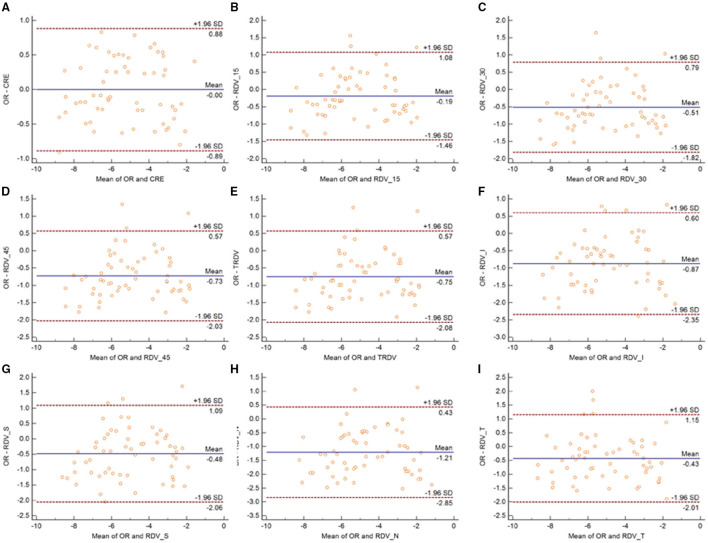
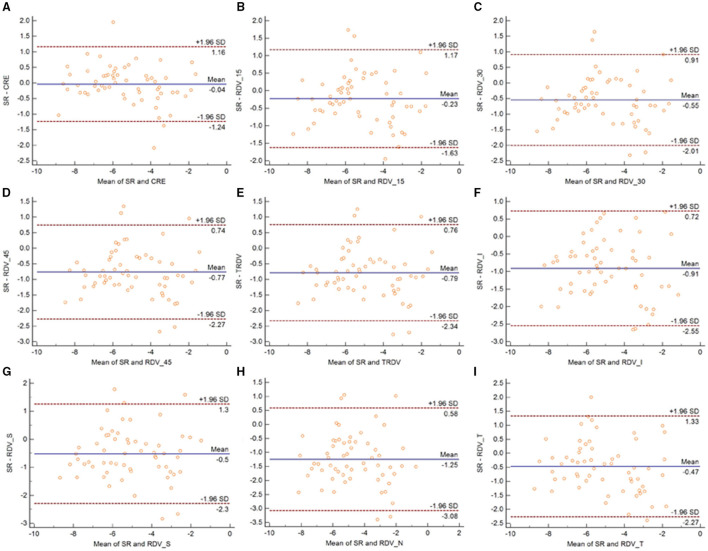
To evaluate the repeatability of a multispectral-based refractor in central and peripheral refraction measurement, and to assess the agreement of such measurements with objective refraction (OR) and subjective refraction (SR) in patients with myopia. A total of 60 subjects were recruited in this prospective research. Patients were divided into three groups according to the refractive error. Next, the central and peripheral refraction parameters were measured using multispectral refractive tomography (MRT) before and after cycloplegia. In addition, OR and SR measurements were also performed. The intraobserver repeatability was analyzed using within-subject standard deviation (Sw), test-retest repeatability (TRT), and intraclass correlation coefficient (ICC). Agreement was evaluated using Bland-Altman plot and 95% limits of agreement (LoA). The ICC value of central and peripheral refraction were all higher than 0.97 with or without cycloplegia. The peripheral refraction in the nasal, temporal, superior, and inferior quadrants was slightly worse than other parameters, with the largest error interval being 1.43 D. The 95% LoA of the central refraction and OR or SR ranged from -0.89 to 0.88 D and -1.24 to 1.16 D without cycloplegia, respectively, and from -0.80 to 0.42 D and -1.39 to -0.84 D under cycloplegia, respectively. The novel multispectral refraction topography demonstrated good repeatability in central and peripheral refraction. However, the refraction in the nasal, temporal, superior, and inferior quadrants were not as good as that of central and circle peripheral refraction.
评估基于多光谱的验光仪在测量中央和周边屈光时的可重复性,并评估近视患者中此类测量与客观验光(OR)和主观验光(SR)的一致性。本前瞻性研究共招募了60名受试者。根据屈光不正将患者分为三组。接下来,在睫状肌麻痹前后使用多光谱屈光断层扫描(MRT)测量中央和周边屈光参数。此外,还进行了OR和SR测量。使用受试者内标准差(Sw)、重测可重复性(TRT)和组内相关系数(ICC)分析观察者内可重复性。使用Bland-Altman图和95%一致性界限(LoA)评估一致性。无论是否使用睫状肌麻痹,中央和周边屈光的ICC值均高于0.97。鼻侧、颞侧、上方和下方象限的周边屈光略逊于其他参数,最大误差区间为1.43 D。未使用睫状肌麻痹时,中央屈光与OR或SR的95% LoA分别为-0.89至0.88 D和-1.24至1.16 D,使用睫状肌麻痹时分别为-0.80至0.42 D和-1.39至-0.84 D。新型多光谱屈光地形图在中央和周边屈光方面显示出良好的可重复性。然而,鼻侧、颞侧、上方和下方象限的屈光不如中央和环形周边屈光。