Vue Dallas, Tang Qiyi
Department of Microbiology, Howard University College of Medicine, 520 W Street NW Washington, DC 20059, USA.
Zoonoses. 2021;1(1). doi: 10.15212/zoonoses-2021-0017. Epub 2021 Dec 7.
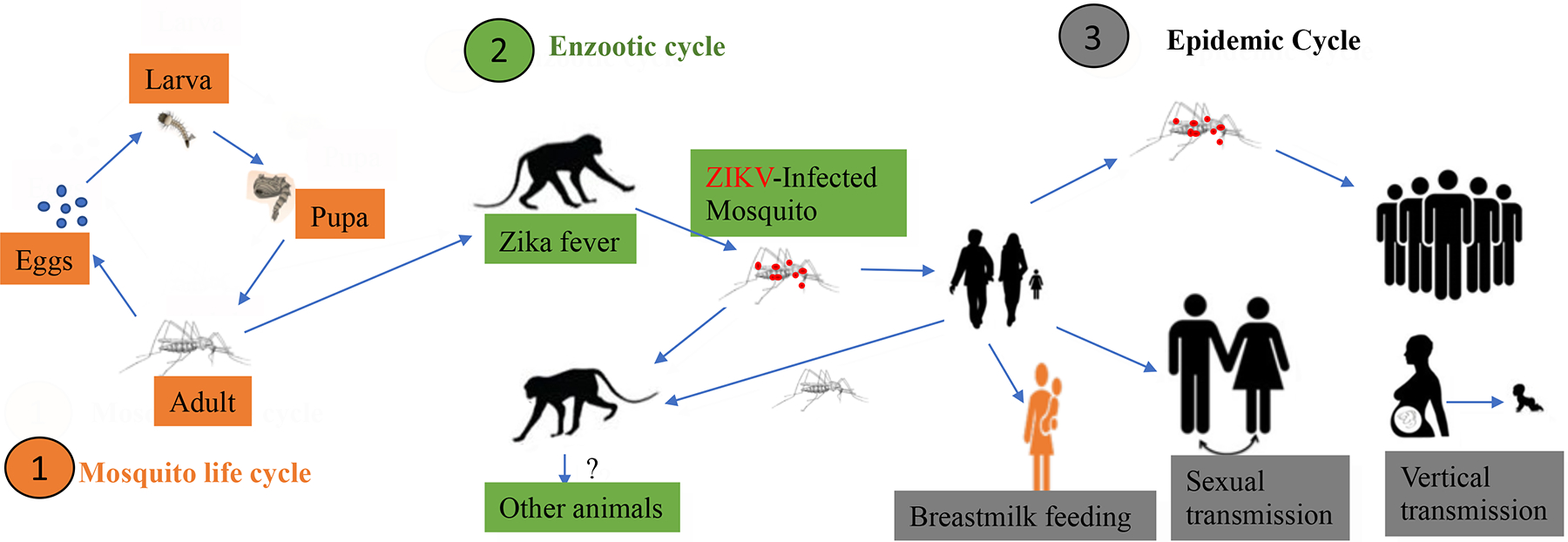
Zika virus (ZIKV) was first discovered in 1947 in Uganda. ZIKV did not entice much attention until Brazil hosted the 2016 Summer Olympics Game, where ZIKV attracted a global audience. ZIKV is a flavivirus that can be transmitted chiefly through the biting of the mosquito or sexually or by breastfeeding at a lower scale. As time passed, the recent discovery of how the ZIKV causes congenital neurodevelopmental defects, including microcephaly, makes us reevaluate the importance of ZIKV interaction with centrosome organization because centrosome plays an important role in cell division. When the ZIKV disrupts centrosome organization and mitotic abnormalities, this will alter neural progenitor differentiation. Altering the neural progenitor differentiation will lead to cell cycle arrest, increase apoptosis, and inhibit the neural progenitor cell differentiation, as this can lead to abnormalities in neural cell development resulting in microcephaly. Understanding the importance of ZIKV infection throughout the years, this review article gives an overview of the history, transmission routes, pathogenesis, animal models, and diagnosis.
寨卡病毒(ZIKV)于1947年在乌干达首次被发现。直到巴西举办2016年夏季奥运会时,寨卡病毒才引起广泛关注,当时它吸引了全球目光。寨卡病毒是一种黄病毒,主要通过蚊子叮咬传播,也可通过性传播或在较小程度上通过母乳喂养传播。随着时间推移,最近发现寨卡病毒如何导致先天性神经发育缺陷,包括小头畸形,这使我们重新评估寨卡病毒与中心体组织相互作用的重要性,因为中心体在细胞分裂中起着重要作用。当寨卡病毒破坏中心体组织并导致有丝分裂异常时,这将改变神经祖细胞的分化。改变神经祖细胞的分化会导致细胞周期停滞、增加细胞凋亡,并抑制神经祖细胞的分化,因为这可能导致神经细胞发育异常,从而导致小头畸形。了解多年来寨卡病毒感染的重要性,这篇综述文章概述了其历史、传播途径、发病机制、动物模型和诊断方法。