Mulvey Peter, Duong Veasna, Boyer Sebastien, Burgess Graham, Williams David T, Dussart Philippe, Horwood Paul F
Australian Institute of Tropical Health and Medicine, James Cook University, Townsville 4811, Australia.
Institut Pasteur du Cambodge, Institut Pasteur International Network, Phnom Penh 12201, Cambodia.
Pathogens. 2021 Nov 24;10(12):1534. doi: 10.3390/pathogens10121534.
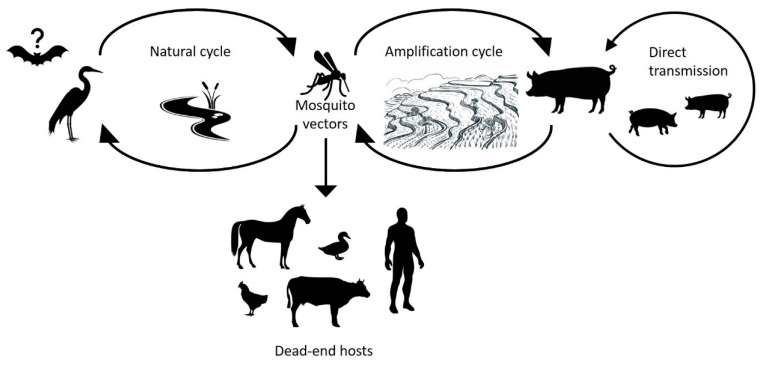
Japanese encephalitis virus (JEV) is a mosquito-borne flavivirus mainly spread by mosquitoes that currently has a geographic distribution across most of Southeast Asia and the Western Pacific. Infection with JEV can cause Japanese encephalitis (JE), a severe disease with a high mortality rate, which also results in ongoing sequalae in many survivors. The natural reservoir of JEV is ardeid wading birds, such as egrets and herons, but pigs commonly play an important role as an amplifying host during outbreaks in human populations. Other domestic animals and wildlife have been detected as hosts for JEV, but their role in the ecology and epidemiology of JEV is uncertain. Safe and effective JEV vaccines are available, but unfortunately, their use remains low in most endemic countries where they are most needed. Increased surveillance and diagnosis of JE is required as climate change and social disruption are likely to facilitate further geographical expansion of vectors and JE risk areas.
日本脑炎病毒(JEV)是一种主要通过蚊子传播的黄病毒,目前在东南亚大部分地区和西太平洋地区均有地理分布。感染JEV可导致日本脑炎(JE),这是一种死亡率很高的严重疾病,许多幸存者还会留下持续的后遗症。JEV的自然宿主是鹭科涉禽,如白鹭和苍鹭,但在人类疫情暴发期间,猪通常作为扩增宿主发挥重要作用。其他家畜和野生动物也被检测出是JEV的宿主,但其在JEV生态和流行病学中的作用尚不确定。目前已有安全有效的JEV疫苗,但遗憾的是,在最需要这些疫苗的大多数流行国家,其使用率仍然很低。由于气候变化和社会动荡可能会促使病媒和JE风险地区进一步扩大地理范围,因此需要加强对JE的监测和诊断。