Auerswald Heidi, Ruget Anne-Sophie, Ladreyt Helena, In Saraden, Mao Sokthearom, Sorn San, Tum Sothyra, Duong Veasna, Dussart Philippe, Cappelle Julien, Chevalier Véronique
Virology Unit, Institut Pasteur du Cambodge, Institut Pasteur International Network, Phnom Penh, Cambodia.
Epidemiology and Public Health Unit, Institut Pasteur du Cambodge, Institut Pasteur International Network, Phnom Penh, Cambodia.
Front Vet Sci. 2020 Jan 29;7:15. doi: 10.3389/fvets.2020.00015. eCollection 2020.
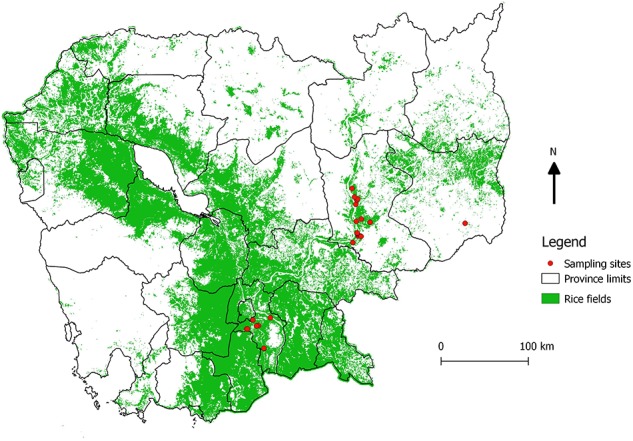
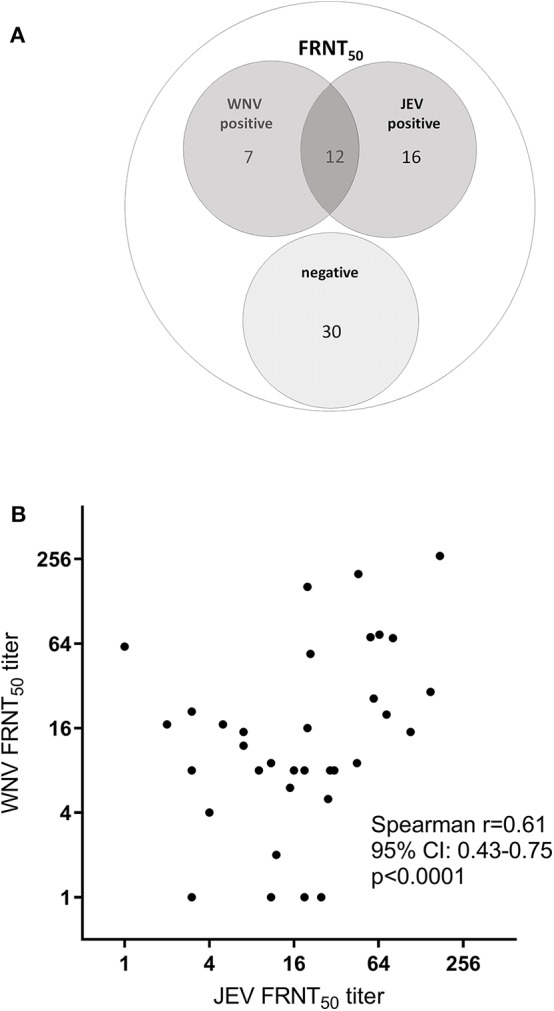
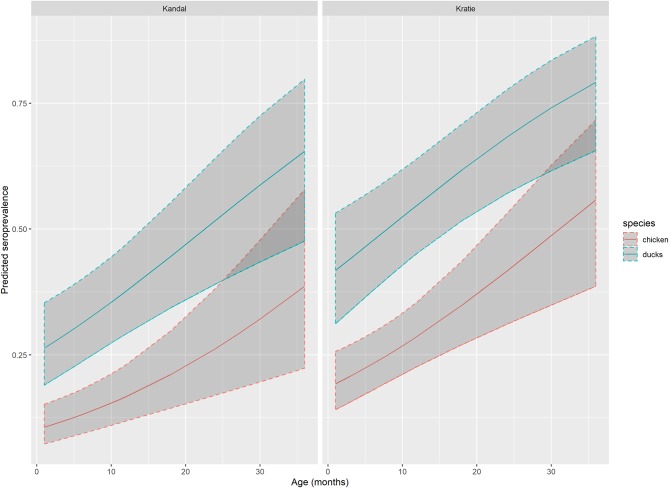
Mosquito-borne flaviviruses with an enzootic transmission cycle like Japanese encephalitis virus (JEV) and West Nile virus (WNV) are a major public health concern. The circulation of JEV in Southeast Asia is well-documented, and the important role of pigs as amplification hosts for the virus is long known. The influence of other domestic animals especially poultry that lives in high abundance and close proximity to humans is not intensively analyzed. Another understudied field in Asia is the presence of the closely related WNV. Such analyses are difficult to perform due to the intense antigenic cross-reactivity between these viruses and the lack of suitable standardized serological assays. The main objective of this study was to assess the prevalence of JEV and WNV flaviviruses in domestic birds, detailed in chickens and ducks, in three different Cambodian provinces. We determined the flavivirus seroprevalence using an hemagglutination inhibition assay (HIA). Additionally, we investigated in positive samples the presence of JEV and WNV neutralizing antibodies (nAb) using foci reduction neutralization test (FRNT). We found 29% (180/620) of the investigated birds positive for flavivirus antibodies with an age-depended increase of the seroprevalence (OR = 1.04) and a higher prevalence in ducks compared to chicken (OR = 3.01). Within the flavivirus-positive birds, we found 43% (28/65) with nAb against JEV. We also observed the expected cross-reactivity between JEV and WNV, by identifying 18.5% double-positive birds that had higher titers of nAb than single-positive birds. Additionally, seven domestic birds (10.7%) showed only nAb against WNV and no nAb against JEV. Our study provides evidence for an intense JEV circulation in domestic birds in Cambodia, and the first serological evidence for WNV presence in Southeast Asia since decades. These findings mark the need for a re-definition of areas at risk for JEV and WNV transmission, and the need for further and intensified surveillance of mosquito-transmitted diseases in domestic animals.
具有如日本脑炎病毒(JEV)和西尼罗河病毒(WNV)这种动物源性传播循环的蚊媒黄病毒是主要的公共卫生问题。JEV在东南亚的传播情况已有充分记录,而且猪作为该病毒扩增宿主的重要作用早已为人所知。其他家畜尤其是数量众多且与人类生活密切相关的家禽所产生的影响尚未得到深入分析。亚洲另一个研究不足的领域是密切相关的WNV的存在情况。由于这些病毒之间强烈的抗原交叉反应以及缺乏合适的标准化血清学检测方法,此类分析难以进行。本研究的主要目的是评估柬埔寨三个不同省份家禽(详细为鸡和鸭)中JEV和WNV黄病毒的流行情况。我们使用血凝抑制试验(HIA)测定黄病毒血清阳性率。此外,我们通过蚀斑减少中和试验(FRNT)在阳性样本中检测JEV和WNV中和抗体(nAb)的存在情况。我们发现29%(180/620)的被调查禽类黄病毒抗体呈阳性,血清阳性率随年龄增长而增加(比值比 = 1.04),且鸭的阳性率高于鸡(比值比 = 3.01)。在黄病毒阳性禽类中,我们发现43%(28/65)具有抗JEV的nAb。我们还观察到了JEV和WNV之间预期的交叉反应,鉴定出18.5%的双阳性禽类,其nAb滴度高于单阳性禽类。此外,七只家禽(10.7%)仅显示抗WNV的nAb,而无抗JEV的nAb。我们的研究为柬埔寨家禽中JEV的活跃传播提供了证据,也是数十年来WNV在东南亚存在的首个血清学证据。这些发现表明需要重新定义JEV和WNV传播的风险区域,以及需要进一步加强对家畜蚊媒疾病的监测。