Phonera Marvin Collen, Simuunza Martin Chitolongo, Kainga Henson, Ndebe Joseph, Chembensofu Mwelwa, Chatanga Elisha, Kanyanda Setiala, Changula Katendi, Muleya Walter, Mubemba Benjamin, Chitanga Simbarashe, Kajihara Masahiro, Sawa Hirofumi, Njunga Gilson, Takada Ayato, Simulundu Edgar
Department of Animal Health and Livestock Development, Ministry of Agriculture, Lilongwe 207203, Malawi.
Department of Disease Control, School of Veterinary Medicine, University of Zambia, Lusaka 10101, Zambia.
Pathogens. 2021 Dec 10;10(12):1613. doi: 10.3390/pathogens10121613.
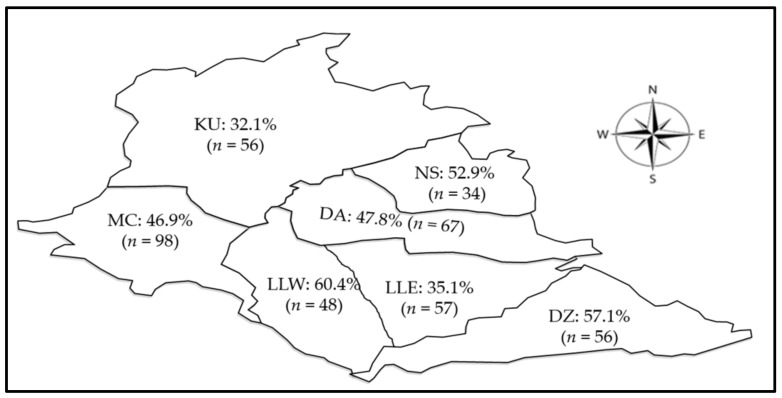
Crimean-Congo hemorrhagic fever virus (CCHFV) is endemic in Africa, Asia, and Eastern Europe where it circulates among animals and ticks causing sporadic outbreaks in humans. Although CCHF is endemic in sub-Saharan Africa, epidemiological information is lacking in many countries, including Malawi. To assess the risk of CCHF in Malawi, we conducted an epidemiological study in cattle reared by smallholder livestock farmers in central Malawi. A cross-sectional study was conducted in April 2020 involving seven districts, four from Kasungu and three from Lilongwe Agriculture Development Divisions. A structured questionnaire was administered to farmers to obtain demographic, animal management, and ecological risk factors data. Sera were collected from randomly selected cattle and screened for CCHF virus (CCHFV) specific antibodies using a commercial ELISA kit. Ticks were collected from cattle and classified morphologically to species level. An overall CCHFV seropositivity rate of 46.9% ( = 416; 95% CI: 42.0-51.8%) was observed. The seropositivity was significantly associated with the age of cattle ( < 0.001), sex ( < 0.001), presence of ticks in herds ( = 0.01), district ( = 0.025), and type of grazing lands ( = 0.013). Five species of ticks were identified, including , a known vector of CCHFV. Ticks of the species were not detected in two districts with the highest seroprevalence for CCHF and vector competency must be further explored in the study area. To our knowledge, this is the first report of serologic evidence of the presence of CCHV among smallholder cattle in central Malawi. This study emphasizes the need for continued monitoring of CCHFV infection among livestock, ticks, and humans for the development of data-based risk mitigation strategies.
克里米亚-刚果出血热病毒(CCHFV)在非洲、亚洲和东欧流行,在这些地区,该病毒在动物和蜱虫之间传播,导致人类散发性疫情。虽然CCHF在撒哈拉以南非洲地区流行,但包括马拉维在内的许多国家缺乏流行病学信息。为评估马拉维CCHF的风险,我们在马拉维中部小农户饲养的牛群中开展了一项流行病学研究。2020年4月进行了一项横断面研究,涉及7个区,其中4个来自卡松古,3个来自利隆圭农业发展司。向农民发放了一份结构化问卷,以获取人口统计学、动物管理和生态风险因素数据。从随机挑选的牛身上采集血清,并使用商用ELISA试剂盒筛查CCHF病毒(CCHFV)特异性抗体。从牛身上采集蜱虫,并在形态学上分类到物种水平。观察到CCHFV总体血清阳性率为46.9%( = 416;95%CI:42.0-51.8%)。血清阳性与牛的年龄( < 0.001)、性别( < 0.001)、牛群中蜱虫的存在( = 0.01)、地区( = 0.025)以及放牧地类型( = 0.013)显著相关。鉴定出5种蜱虫,包括 ,这是CCHFV的已知传播媒介。在CCHF血清阳性率最高的两个区未检测到 蜱虫,研究区域内的传播媒介能力必须进一步探究。据我们所知,这是马拉维中部小农户饲养的牛群中存在CCHV血清学证据的首次报告。本研究强调需要持续监测家畜、蜱虫和人类中的CCHFV感染情况,以制定基于数据的风险缓解策略。