
浮萍科和香蒲科在系统发育和形态上与天南星科不同。
Lemnaceae and Orontiaceae Are Phylogenetically and Morphologically Distinct from Araceae.
作者信息
Tippery Nicholas P, Les Donald H, Appenroth Klaus J, Sree K Sowjanya, Crawford Daniel J, Bog Manuela
机构信息
Department of Biological Sciences, University of Wisconsin-Whitewater, Whitewater, WI 53190, USA.
Department of Ecology and Evolutionary Biology, University of Connecticut, Storrs, CT 06269, USA.
出版信息
Plants (Basel). 2021 Nov 30;10(12):2639. doi: 10.3390/plants10122639.
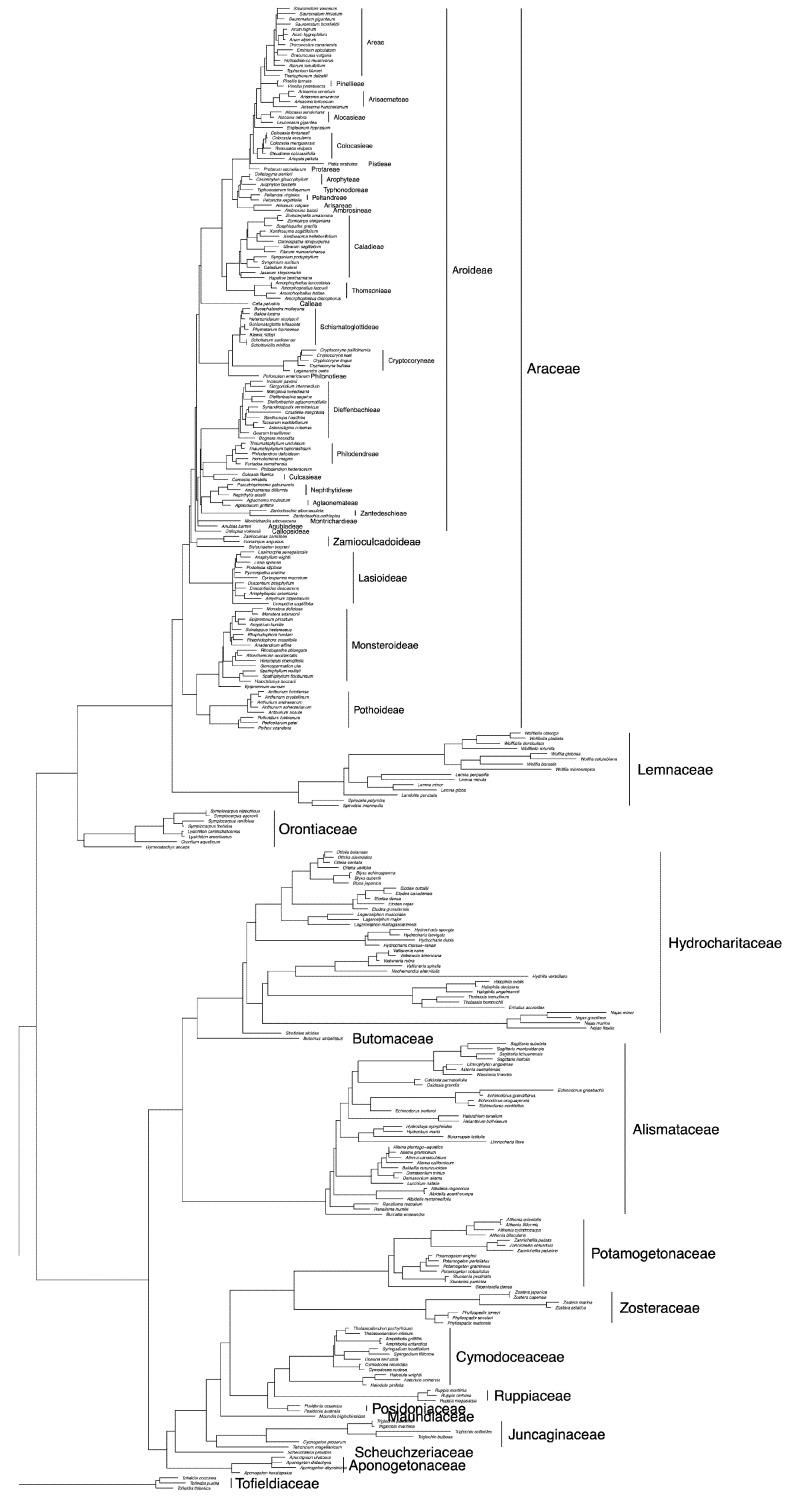
Duckweeds comprise a distinctive clade of pleustophytic monocots that traditionally has been classified as the family Lemnaceae. However, molecular evidence has called into question their phylogenetic independence, with some authors asserting instead that duckweeds should be reclassified as subfamily Lemnoideae of an expanded family Araceae. Although a close phylogenetic relationship of duckweeds with traditional Araceae has been supported by multiple studies, the taxonomic disposition of duckweeds must be evaluated more critically to promote nomenclatural stability and utility. Subsuming duckweeds as a morphologically incongruent lineage of Araceae effectively eliminates the family category of Lemnaceae that has been widely used for many years. Instead, we suggest that Araceae subfamily Orontioideae should be restored to family status as Orontiaceae, which thereby would enable the recognition of three morphologically and phylogenetically distinct lineages: Araceae, Lemnaceae, and Orontiaceae.
浮萍是一类独特的漂浮水生单子叶植物分支,传统上被归类为浮萍科。然而,分子证据对它们的系统发育独立性提出了质疑,一些作者反而主张浮萍应重新分类为扩大后的天南星科的浮萍亚科。尽管多项研究支持浮萍与传统天南星科有密切的系统发育关系,但必须更严格地评估浮萍的分类地位,以促进命名的稳定性和实用性。将浮萍归入天南星科中形态上不一致的分支,实际上消除了多年来广泛使用的浮萍科类别。相反,我们建议天南星科的菖蒲亚科应恢复为菖蒲科的科级地位,这样就能识别出三个在形态和系统发育上不同的分支:天南星科、浮萍科和菖蒲科。



 Zotero 插件