Semenov Alexander L, Gubareva Ekaterina A, Ermakova Elena D, Dorofeeva Anastasia A, Tumanyan Irina A, Radetskaya Ekaterina A, Yurova Maria N, Aboushanab Saied A, Kanwugu Osman N, Fedoros Elena I, Panchenko Andrey V
N.N. Petrov National Medical Research Center of Oncology, Leningradskaya str, 68, 197758 St. Petersburg, Russia.
Institute of Biomedical Systems and Biotechnology, Peter the Great St. Petersburg Polytechnic University, Polytechnicheskaya, 29, 195251 St. Petersburg, Russia.
Plants (Basel). 2021 Dec 12;10(12):2735. doi: 10.3390/plants10122735.
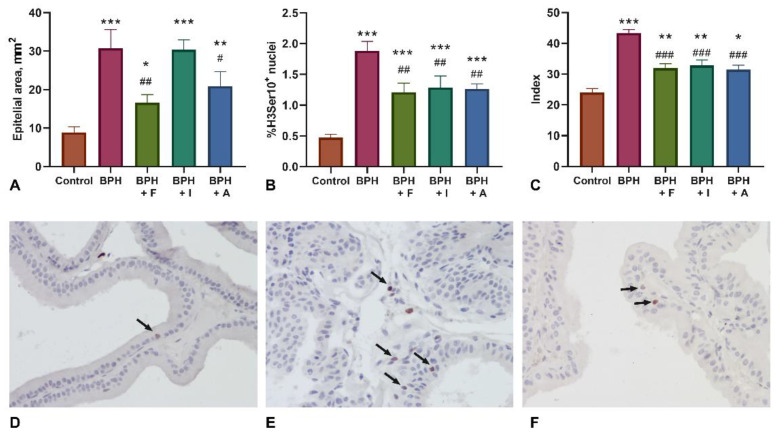
Benign prostatic hyperplasia (BPH) is a common pathology among aging men. Despite the broad pharmacological interventions, the available remedies to treat BPH are yet not devoid of side effects. Herbal compounds are suggested to be an alternative option for the BPH treatment. In our study, we evaluated the effect of kudzu isoflavones and astaxanthin on the BPH animal model. The animals were randomly divided into five groups: control; testosterone-induced BPH group; and three BPH-induced groups, which received intragastrically for 28 days finasteride (5 mg/kg) as a positive control, isoflavones (200 mg/kg), and astaxanthin (25 mg/kg). BPH was induced by castration of animals and subsequent subcutaneous injections of prolonged testosterone (25 mg/kg). Prostate index and histology, biochemical parameters, and antioxidant activity were evaluated. A significant decrease in prostate weight, immunohistochemical markers, and normalization of prostate Ca/Mg ratio was found in all treatment groups. Astaxanthin treatment also resulted in decreased epithelial proliferation and normalized superoxide dismutase activity. In conclusion, both isoflavones and astaxanthin inhibited BPH development at a level comparable to finasteride in terms of prostate weight, prostatic epithelium proliferation, and prostate tissue cumulative histology score. These results suggest that isoflavones and especially astaxanthin could serve as a potential alternative therapy to treat BHP.
良性前列腺增生(BPH)是老年男性常见的病理状况。尽管有广泛的药物干预措施,但现有的治疗BPH的药物仍有副作用。草药化合物被认为是治疗BPH的另一种选择。在我们的研究中,我们评估了葛根异黄酮和虾青素对BPH动物模型的影响。动物被随机分为五组:对照组;睾酮诱导的BPH组;以及三个BPH诱导组,分别灌胃给予非那雄胺(5毫克/千克)作为阳性对照、异黄酮(200毫克/千克)和虾青素(25毫克/千克),持续28天。通过阉割动物并随后皮下注射长效睾酮(25毫克/千克)诱导BPH。评估前列腺指数和组织学、生化参数以及抗氧化活性。在所有治疗组中均发现前列腺重量、免疫组化标志物显著降低,前列腺钙/镁比值恢复正常。虾青素治疗还导致上皮细胞增殖减少,超氧化物歧化酶活性恢复正常。总之,就前列腺重量、前列腺上皮细胞增殖和前列腺组织累积组织学评分而言,异黄酮和虾青素在抑制BPH发展方面的效果与非那雄胺相当。这些结果表明,异黄酮尤其是虾青素可作为治疗BHP的潜在替代疗法。