Moitra Ethan, Tao Jun, Olsen Joseph, Shearer Riley D, Wood Brian R, Busch Andrew M, LaPlante Andrea, Baker Jason V, Chan Philip A
Department of Psychiatry and Human Behavior, Brown University, Box G-BH, Providence, RI 02912, USA.
Department of Medicine, Brown University, Providence, RI, USA.
Lancet Reg Health Am. 2022 Mar;7:100159. doi: 10.1016/j.lana.2021.100159. Epub 2021 Dec 23.
Non-emergent clinical services were limited or suspended during the early stages of the coronavirus disease 2019 (COVID-19) pandemic in the United States (U.S.). This could adversely impact epidemics of public health importance, such as HIV, and access to testing, which is a cornerstone of prevention efforts.
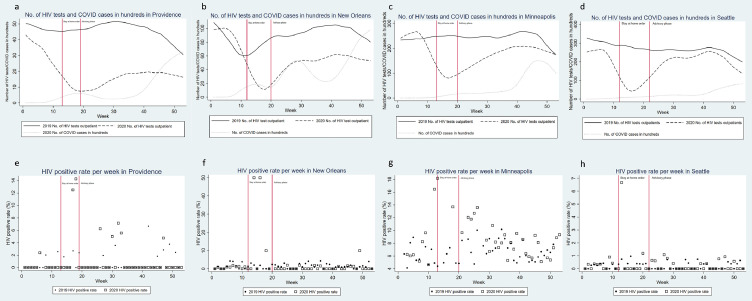
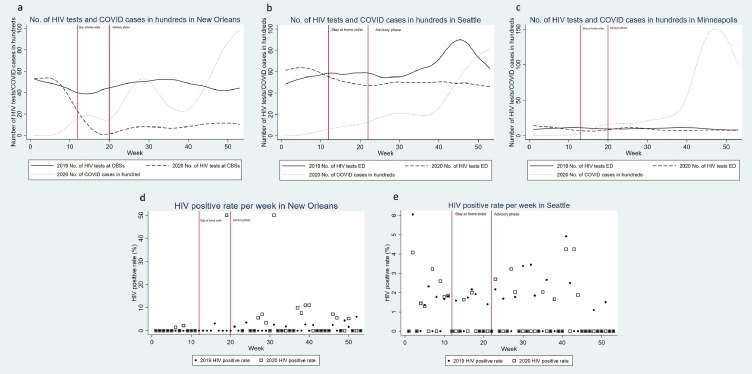
In this observational study, we collected HIV testing and positivity rate clinical data from four geographically diverse U.S. healthcare systems in New Orleans, Louisiana; Minneapolis, Minnesota; Providence, Rhode Island; and, Seattle, Washington. Data from 2019 to 2020 were examined to assess changes in HIV testing in community-based, emergency department, and outpatient settings. Poisson regression was used to explore trends in HIV testing through phases of the COVID-19 pandemic.
In outpatient settings, there was a 68-97% reduction in the number of HIV tests per week during each state's stay-at-home order period, compared to during the pre-stay-at-home order period in early 2020. HIV testing remained reduced 11-54% after states transitioned to advisory phases. The HIV positivity rate increased slightly at outpatient settings, except in New Orleans where it fell.
We found a concerning trend of substantially decreased HIV testing across four geographically diverse sites. These findings suggest that new HIV infections within the U.S. may be undiagnosed and not yet linked to clinical care and services, as a consequence of the COVID-19 pandemic. Thus, augmented efforts to identify patients and link them to HIV services will be needed as healthcare settings return to full operation.
U.S. National Institute of Mental Health.
在美国,2019冠状病毒病(COVID-19)大流行的早期阶段,非紧急临床服务受到限制或暂停。这可能对诸如艾滋病毒等具有公共卫生重要性的流行病产生不利影响,并影响检测的可及性,而检测是预防工作的基石。
在这项观察性研究中,我们收集了来自美国四个地理位置不同的医疗系统的艾滋病毒检测和阳性率临床数据,这些系统分别位于路易斯安那州新奥尔良市、明尼苏达州明尼阿波利斯市、罗德岛州普罗维登斯市和华盛顿州西雅图市。对2019年至2020年的数据进行了检查,以评估社区、急诊科和门诊环境中艾滋病毒检测的变化。采用泊松回归分析来探究COVID-19大流行各阶段艾滋病毒检测的趋势。
在门诊环境中,与2020年初居家令实施前相比,每个州实施居家令期间,每周艾滋病毒检测数量减少了68%至97%。在各州过渡到建议阶段后,艾滋病毒检测数量仍减少了11%至54%。门诊环境中的艾滋病毒阳性率略有上升,但新奥尔良除外,该市的阳性率有所下降。
我们发现在四个地理位置不同的地点,艾滋病毒检测大幅下降,这一趋势令人担忧。这些发现表明,由于COVID-19大流行,美国境内新的艾滋病毒感染可能未被诊断出来,且尚未与临床护理和服务相联系。因此,随着医疗机构全面恢复运营,需要加大力度识别患者并将他们与艾滋病毒服务联系起来。
美国国立精神卫生研究所。