Department of Onco-hematology, Gene and Cell Therapy, Bambino Gesù Children's Hospital-IRCCS, Rome, Italy.
National Centre for Drug Research and Evaluation, Istituto Superiore di Sanità-Rome, Rome, Italy.
Neuro Oncol. 2022 Jul 1;24(7):1150-1163. doi: 10.1093/neuonc/noab300.
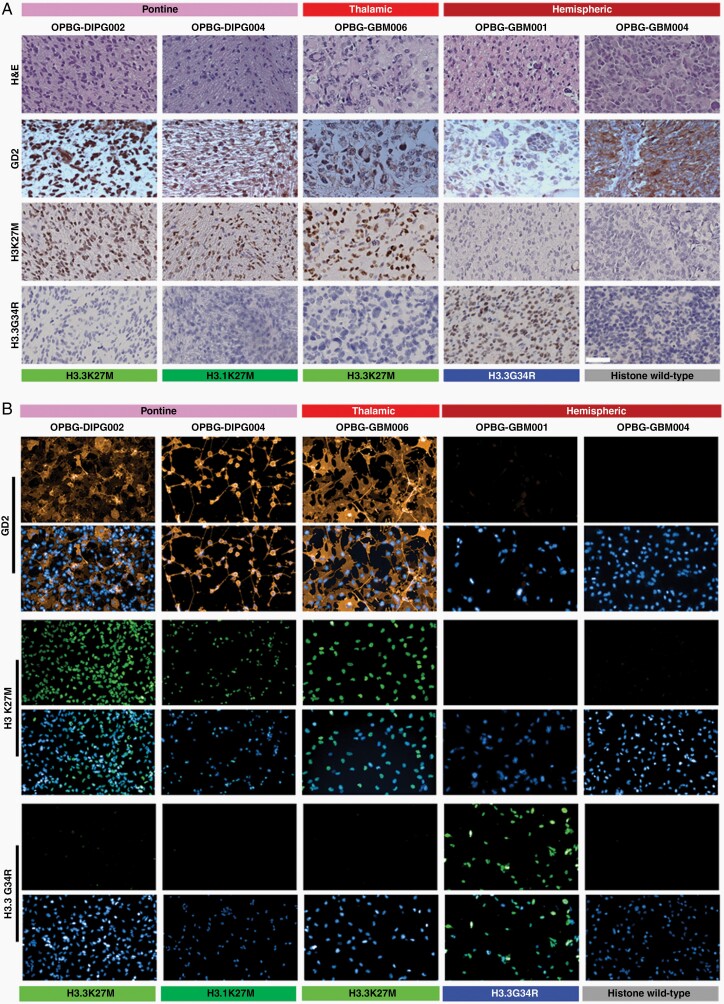
Diffuse midline gliomas (DMG) H3K27M-mutant, including diffuse intrinsic pontine glioma (DIPG), are pediatric brain tumors associated with grim prognosis. Although GD2-CAR T-cells demonstrated significant anti-tumor activity against DMG H3K27M-mutant in vivo, a multimodal approach may be needed to more effectively treat patients. We investigated GD2 expression in DMG/DIPG and other pediatric high-grade gliomas (pHGG) and sought to identify chemical compounds that would enhance GD2-CAR T-cell anti-tumor efficacy.
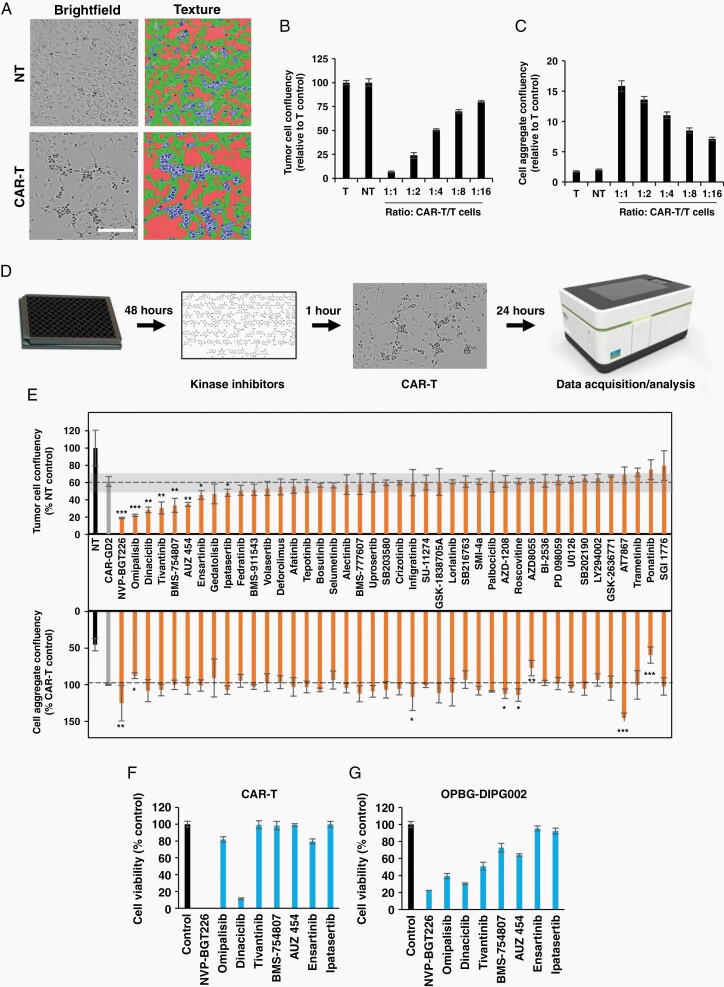
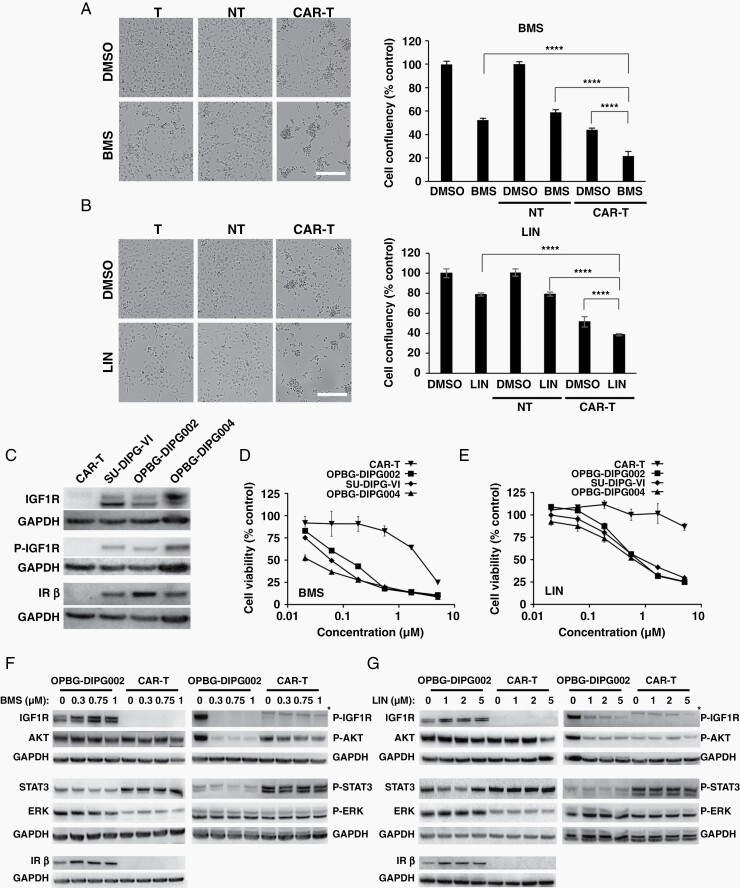
Immunohistochemistry in tumor tissue samples and immunofluorescence in primary patient-derived cell lines were performed to study GD2 expression. We developed a high-throughput cell-based assay to screen 42 kinase inhibitors in combination with GD2-CAR T-cells. Cell viability, western blots, flow-cytometry, real time PCR experiments, DIPG 3D culture models, and orthotopic xenograft model were applied to investigate the effect of selected compounds on DIPG cell death and CAR T-cell function.
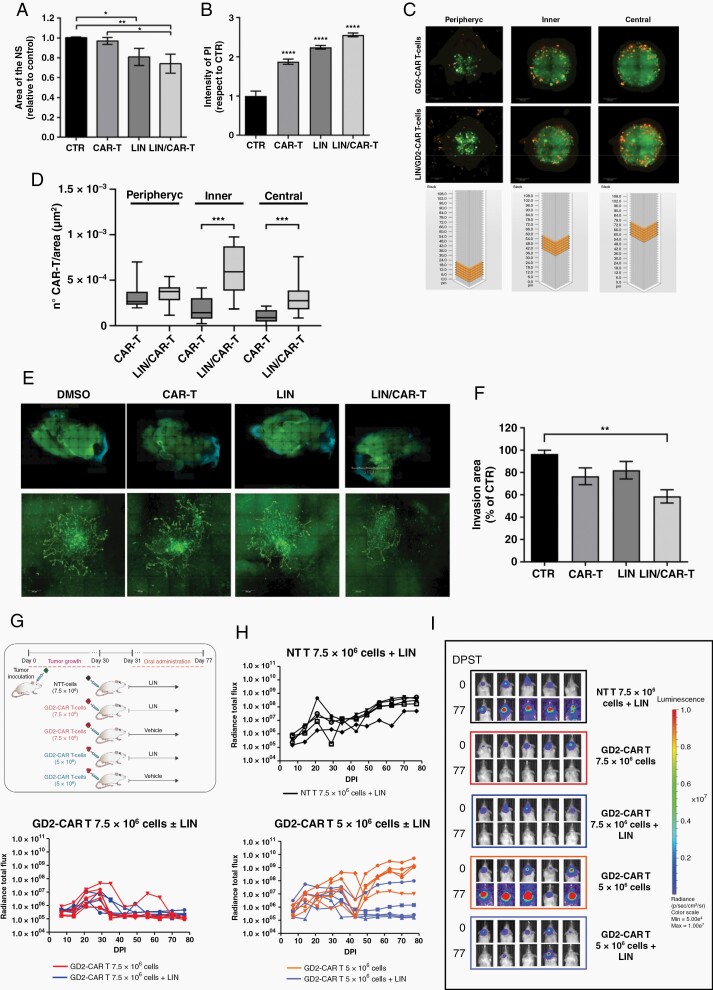
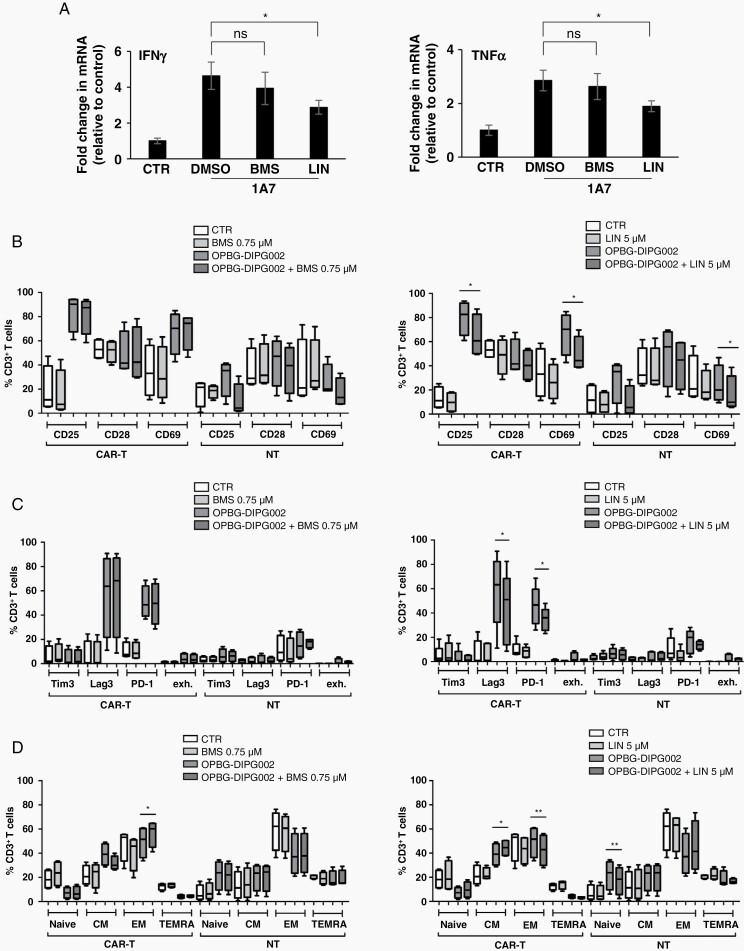
GD2 was heterogeneously, but widely, expressed in the tissue tested, while its expression was homogeneous and restricted to DMG/DIPG H3K27M-mutant cell lines. We identified dual IGF1R/IR antagonists, BMS-754807 and linsitinib, able to inhibit tumor cell viability at concentrations that do not affect CAR T-cells. Linsitinib, but not BMS-754807, decreases activation/exhaustion of GD2-CAR T-cells and increases their central memory profile. The enhanced anti-tumor activity of linsitinib/GD2-CAR T-cell combination was confirmed in DIPG models in vitro, ex vivo, and in vivo.
Our study supports the development of IGF1R/IR inhibitors to be used in combination with GD2-CAR T-cells for treating patients affected by DMG/DIPG and, potentially, by pHGG.
弥漫性中线胶质瘤(DMG)H3K27M 突变型,包括弥漫性内在脑桥胶质瘤(DIPG),是与预后不良相关的儿科脑肿瘤。尽管 GD2-CAR T 细胞在体内对 DMG H3K27M 突变型显示出显著的抗肿瘤活性,但可能需要多模态方法来更有效地治疗患者。我们研究了 DMG/DIPG 和其他儿科高级别胶质瘤(pHGG)中的 GD2 表达,并试图确定可增强 GD2-CAR T 细胞抗肿瘤疗效的化学化合物。
对肿瘤组织样本进行免疫组织化学染色,对原代患者来源的细胞系进行免疫荧光染色,以研究 GD2 表达。我们开发了一种高通量基于细胞的测定法,用于筛选 42 种激酶抑制剂与 GD2-CAR T 细胞联合使用。应用细胞活力测定、western blot、流式细胞术、实时 PCR 实验、DIPG 3D 培养模型和原位异种移植模型来研究选定化合物对 DIPG 细胞死亡和 CAR T 细胞功能的影响。
在测试的组织中,GD2 呈异质但广泛表达,而其表达是同质且仅限于 DMG/DIPG H3K27M 突变型细胞系。我们发现两种 IGF1R/IR 拮抗剂,BMS-754807 和 linsitinib,能够以不影响 CAR T 细胞的浓度抑制肿瘤细胞活力。与 BMS-754807 不同,linsitinib 降低了 GD2-CAR T 细胞的激活/耗竭,并增加了其中央记忆表型。在体外、离体和体内 DIPG 模型中证实了 linsitinib/GD2-CAR T 细胞组合的增强抗肿瘤活性。
我们的研究支持开发 IGF1R/IR 抑制剂与 GD2-CAR T 细胞联合用于治疗受 DMG/DIPG 影响的患者,并且可能用于治疗 pHGG 患者。