Department of Aquatic Resources, Swedish University of Agricultural Sciences, Institute of Coastal Research, Skolgatan 6, 742 42, Öregrund, Sweden.
Ambio. 2022 Jun;51(6):1485-1503. doi: 10.1007/s13280-021-01684-x. Epub 2021 Dec 29.
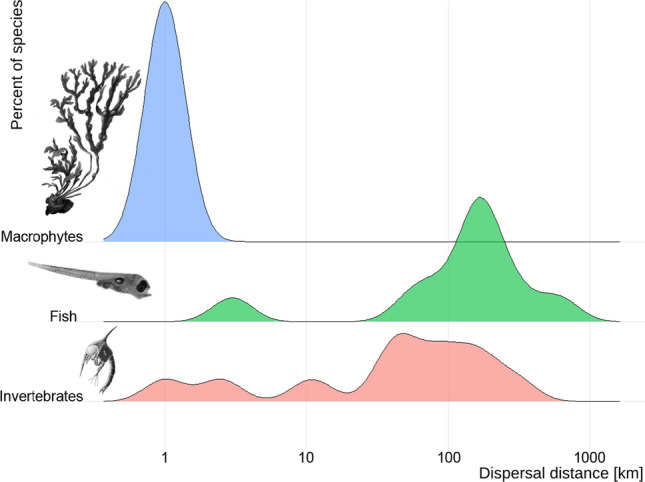
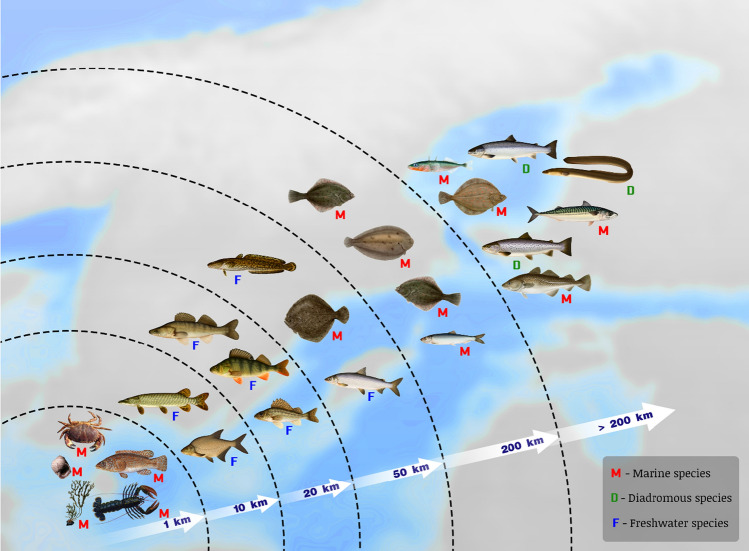
Marine protected areas (MPAs) have become a key component of conservation and fisheries management to alleviate anthropogenic pressures. For MPA networks to efficiently promote persistence and recovery of populations, ecological connectivity, i.e. dispersal and movement of organisms and material across ecosystems, needs to be taken into account. To improve the ecological coherence of MPA networks, there is hence a need to evaluate the connectivity of species spreading through active migration and passive dispersal. We reviewed knowledge on ecological connectivity in the Baltic Sea, Kattegat and Skagerrak in the northeast Atlantic and present available information on species-specific dispersal and migration distances. Studies on genetic connectivity are summarised and discussed in relation to dispersal-based analyses. Threats to ecological connectivity, limiting dispersal of populations and lowering the resilience to environmental change, were examined. Additionally, a review of studies evaluating the ecological coherence of MPA networks in the Baltic Sea, Kattegat and Skagerrak was performed, and suggestions for future evaluations to meet management needs are presented.
海洋保护区(MPAs)已成为减轻人为压力的保护和渔业管理的关键组成部分。为了使 MPA 网络有效地促进种群的持续存在和恢复,需要考虑生态连通性,即生物和物质在生态系统中的扩散和移动。为了提高 MPA 网络的生态一致性,因此需要评估通过主动迁移和被动扩散传播的物种的连通性。我们回顾了东北大西洋波罗的海、卡特加特海峡和斯卡格拉克海峡的生态连通性知识,并介绍了有关物种特定扩散和迁移距离的现有信息。总结了与基于扩散的分析有关的遗传连通性研究,并进行了讨论。审查了对生态连通性的威胁,这些威胁限制了种群的扩散并降低了对环境变化的恢复力。此外,还对评估波罗的海、卡特加特海峡和斯卡格拉克海峡 MPA 网络生态一致性的研究进行了回顾,并提出了满足管理需求的未来评估建议。