Department of Brain Sciences, Weizmann Institute of Science, Rehovot, Israel.
Department of Mathematics and Computer Science, The Open University of Israel, Ra'anana, Israel.
PLoS Comput Biol. 2021 Dec 30;17(12):e1009754. doi: 10.1371/journal.pcbi.1009754. eCollection 2021 Dec.
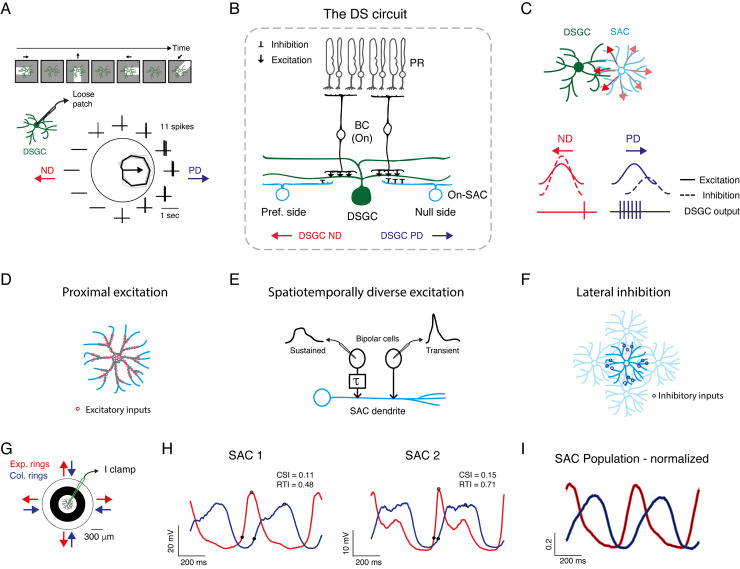
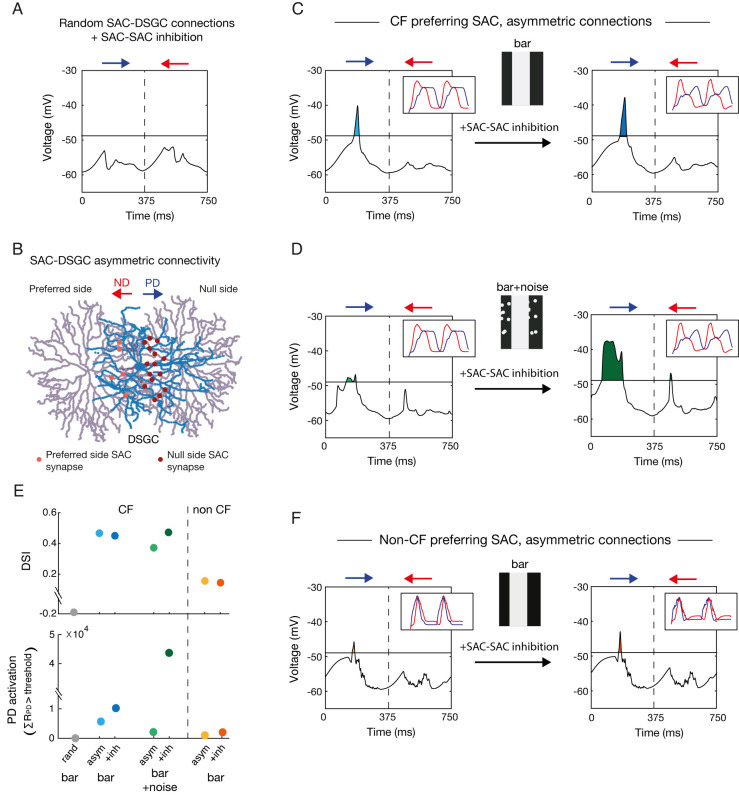
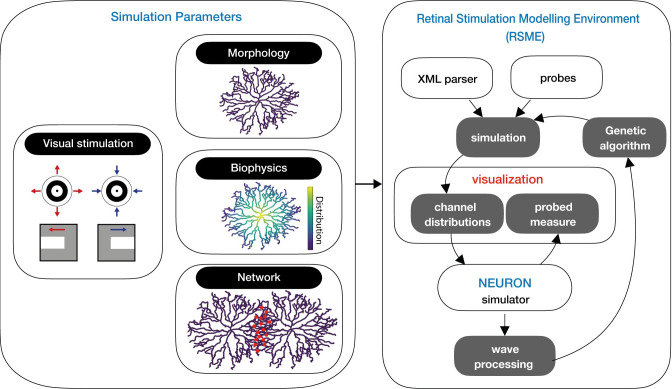
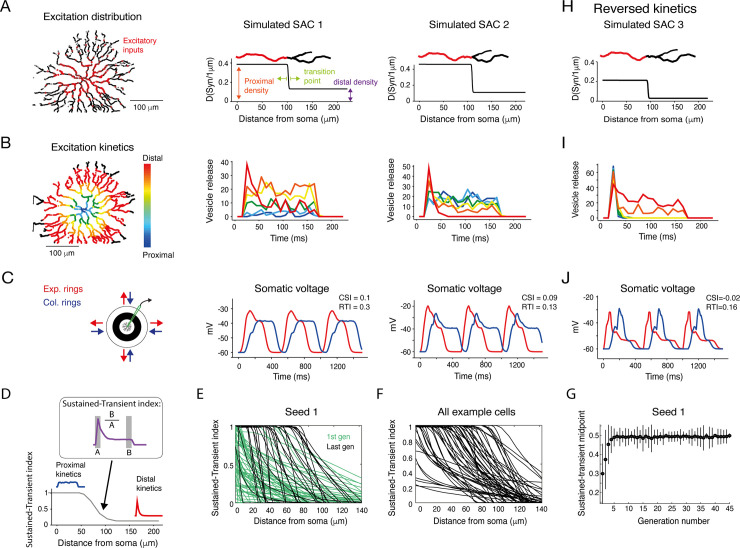
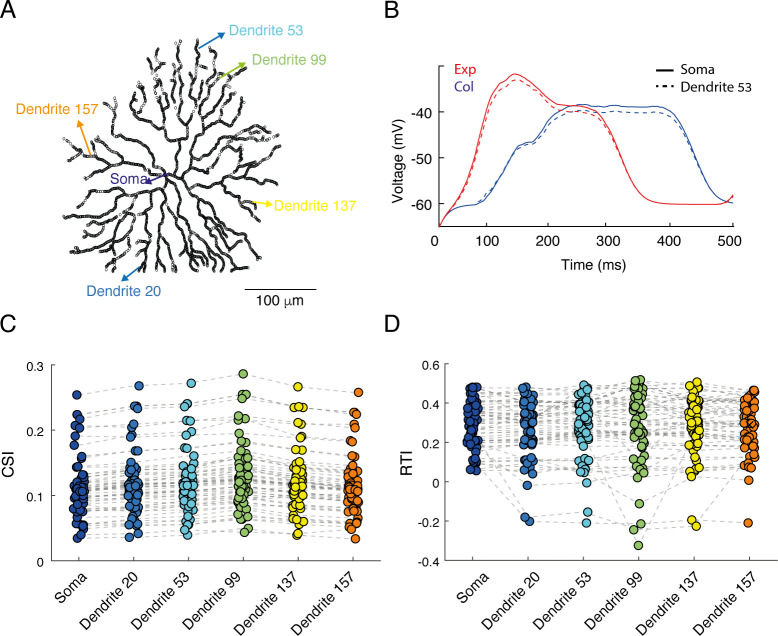
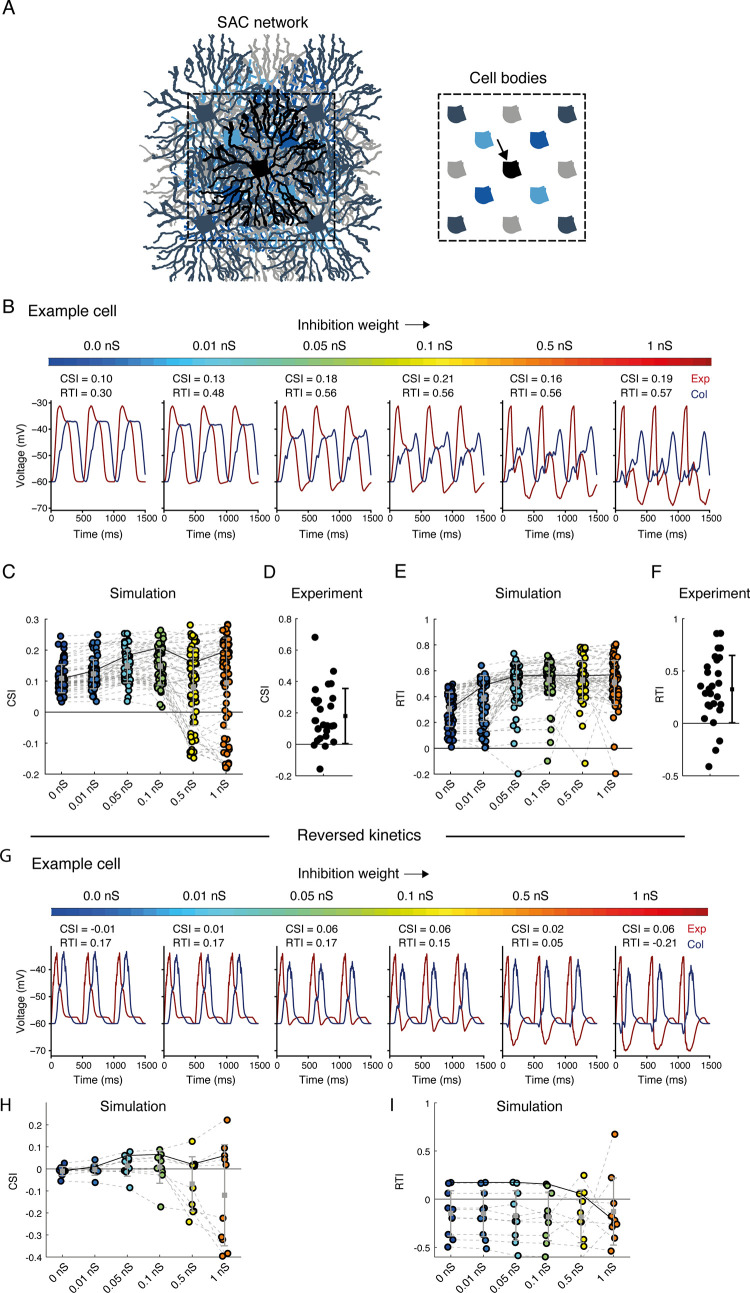
Retinal direction-selectivity originates in starburst amacrine cells (SACs), which display a centrifugal preference, responding with greater depolarization to a stimulus expanding from soma to dendrites than to a collapsing stimulus. Various mechanisms were hypothesized to underlie SAC centrifugal preference, but dissociating them is experimentally challenging and the mechanisms remain debatable. To address this issue, we developed the Retinal Stimulation Modeling Environment (RSME), a multifaceted data-driven retinal model that encompasses detailed neuronal morphology and biophysical properties, retina-tailored connectivity scheme and visual input. Using a genetic algorithm, we demonstrated that spatiotemporally diverse excitatory inputs-sustained in the proximal and transient in the distal processes-are sufficient to generate experimentally validated centrifugal preference in a single SAC. Reversing these input kinetics did not produce any centrifugal-preferring SAC. We then explored the contribution of SAC-SAC inhibitory connections in establishing the centrifugal preference. SAC inhibitory network enhanced the centrifugal preference, but failed to generate it in its absence. Embedding a direction selective ganglion cell (DSGC) in a SAC network showed that the known SAC-DSGC asymmetric connectivity by itself produces direction selectivity. Still, this selectivity is sharpened in a centrifugal-preferring SAC network. Finally, we use RSME to demonstrate the contribution of SAC-SAC inhibitory connections in mediating direction selectivity and recapitulate recent experimental findings. Thus, using RSME, we obtained a mechanistic understanding of SACs' centrifugal preference and its contribution to direction selectivity.
视网膜方向选择性起源于星状无长突细胞(SAC),其表现出离心偏好,对从体部到树突扩展的刺激的去极化反应大于对收缩刺激的反应。假设了各种机制来解释 SAC 的离心偏好,但分离它们在实验上具有挑战性,并且这些机制仍存在争议。为了解决这个问题,我们开发了视网膜刺激建模环境(RSME),这是一个多方面的数据驱动的视网膜模型,包含详细的神经元形态和生物物理特性、针对视网膜的连接方案和视觉输入。我们使用遗传算法证明,空间和时间上不同的兴奋性输入——在近端持续,在远端短暂——足以在单个 SAC 中产生经过实验验证的离心偏好。反转这些输入动力学并不能产生任何离心偏好的 SAC。然后,我们探索了 SAC-SAC 抑制性连接在建立离心偏好中的作用。SAC 抑制性网络增强了离心偏好,但在没有抑制性网络的情况下无法产生离心偏好。在 SAC 网络中嵌入一个方向选择性节细胞(DSGC)表明,已知的 SAC-DSGC 非对称连接本身就产生了方向选择性。尽管如此,这种选择性在离心偏好的 SAC 网络中得到了加强。最后,我们使用 RSME 来证明 SAC-SAC 抑制性连接在介导方向选择性中的作用,并重现了最近的实验发现。因此,我们使用 RSME 对 SAC 的离心偏好及其对方向选择性的贡献有了更深入的了解。