Gaynes John A, Budoff Samuel A, Grybko Michael J, Poleg-Polsky Alon
Department of Physiology and Biophysics, University of Colorado School of Medicine, Aurora, CO 80045, USA.
bioRxiv. 2023 Oct 5:2023.08.02.551732. doi: 10.1101/2023.08.02.551732.
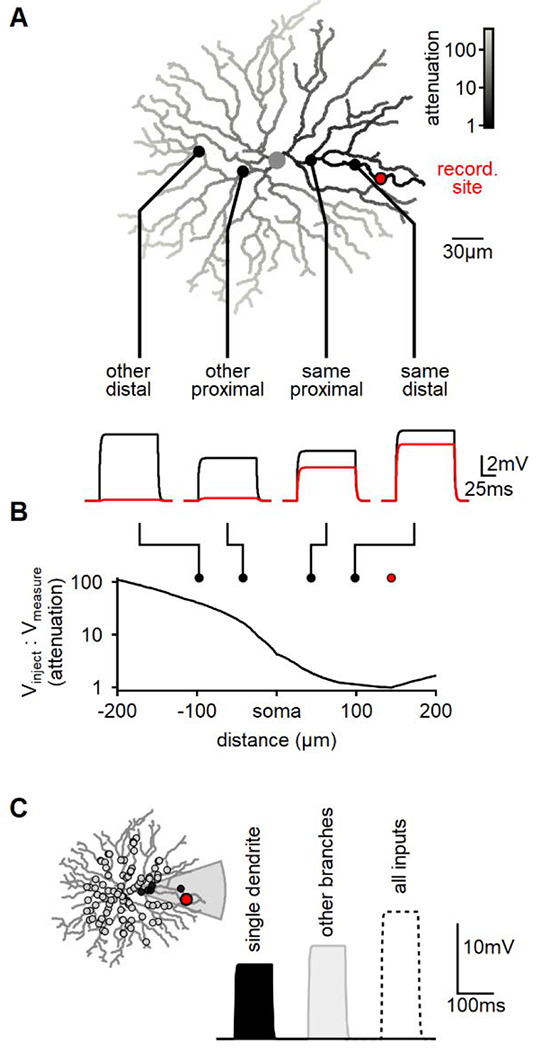
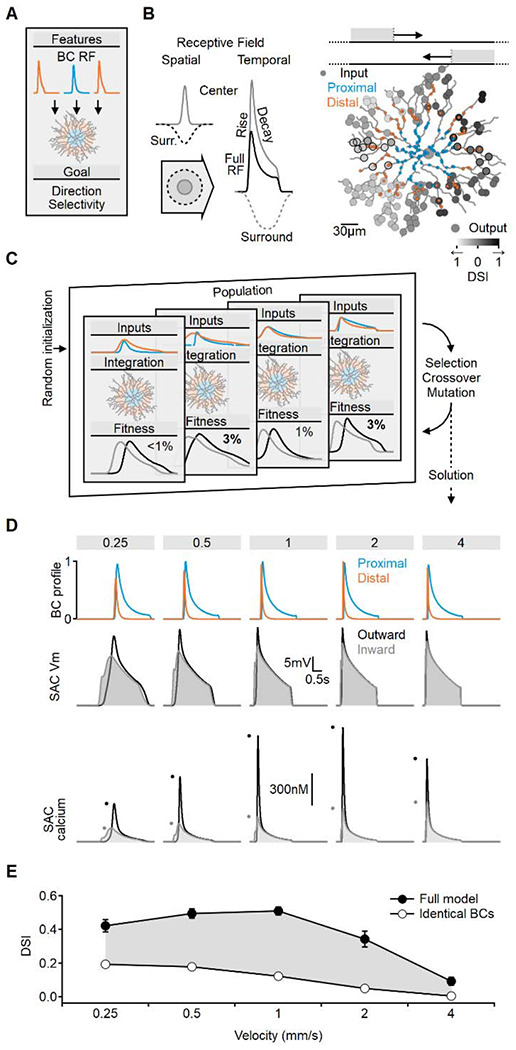
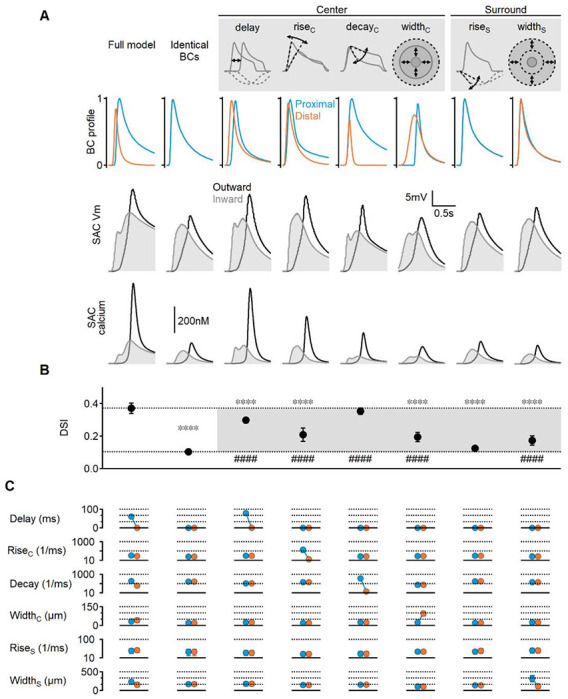
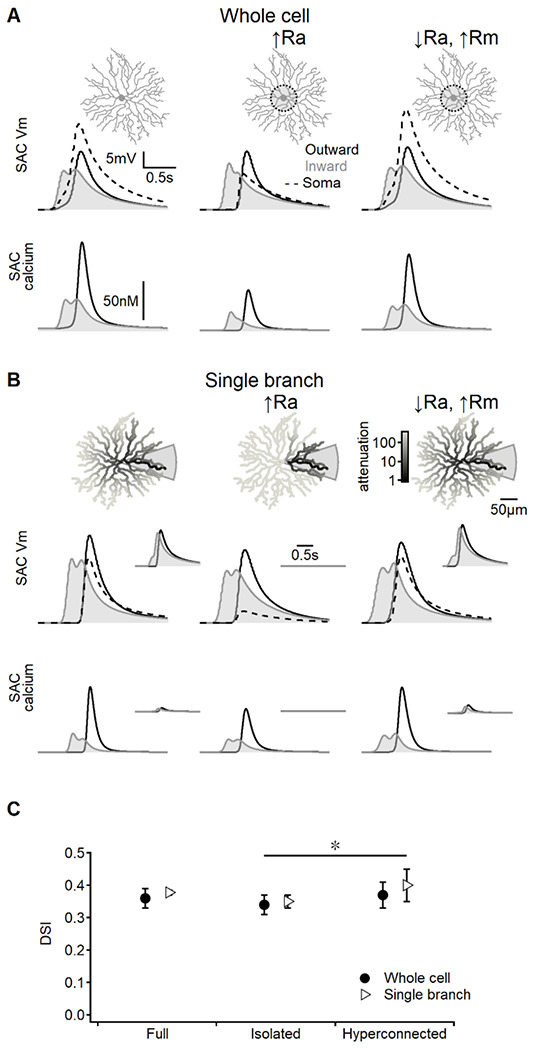
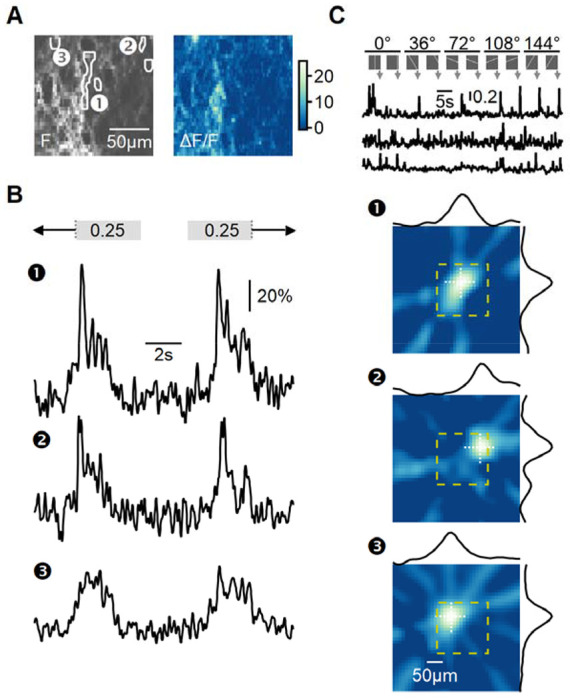
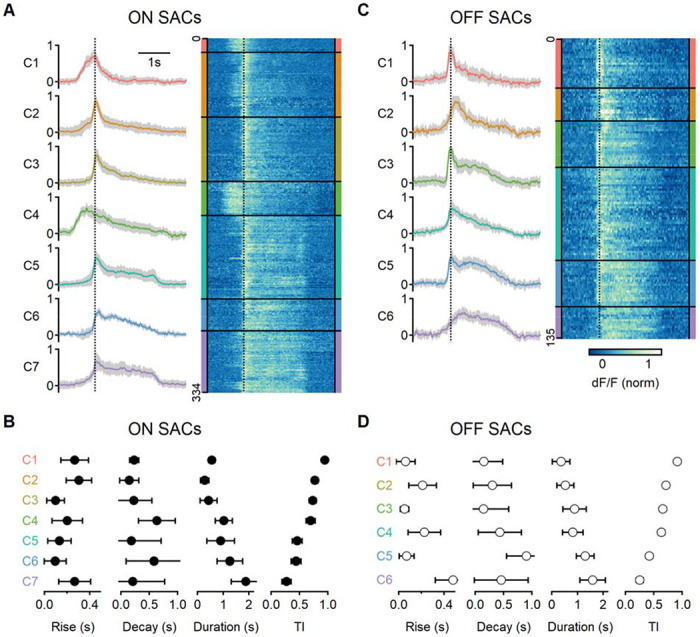
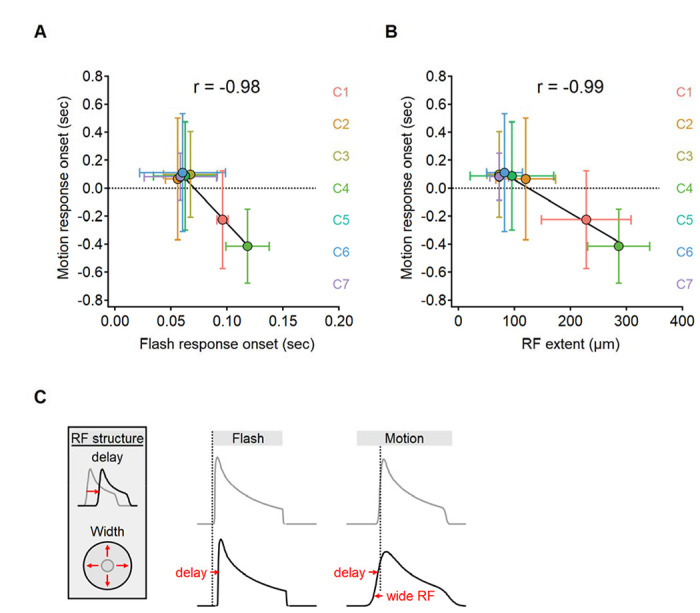
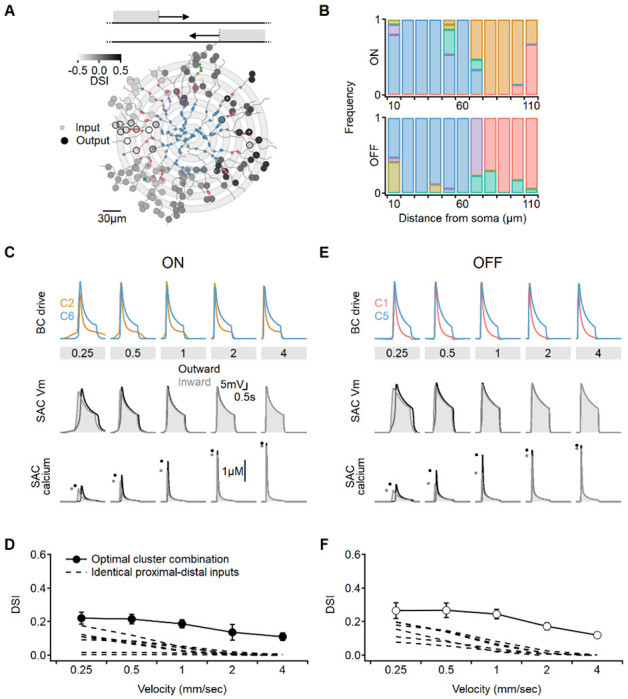
The processing of visual information by retinal starburst amacrine cells (SACs) involves transforming excitatory input from bipolar cells (BCs) into directional calcium output. While previous studies have suggested that an asymmetry in the kinetic properties of bipolar cells along the soma-dendritic axes of the postsynaptic cell could enhance directional tuning at the level of individual branches, it remains unclear whether biologically relevant presynaptic kinetics contribute to direction selectivity when visual stimulation engages the entire dendritic tree. To address this question, we built multicompartmental models of the bipolar-SAC circuit and trained them to boost directional tuning. We report that despite significant dendritic crosstalk and dissimilar directional preferences along the dendrites that occur during whole-cell stimulation, the rules that guide BC kinetics leading to optimal directional selectivity are similar to the single-dendrite condition. To correlate model predictions to empirical findings, we utilized two-photon glutamate imaging to study the dynamics of bipolar release onto ON- and OFF-starburst dendrites in the murine retina. We reveal diverse presynaptic dynamics in response to motion in both BC populations; algorithms trained on the experimental data suggested that the differences in the temporal release kinetics are likely to correspond to heterogeneous receptive field (RF) properties among the different BC types, including the spatial extent of the center and surround components. In addition, we demonstrate that circuit architecture composed of presynaptic units with experimentally recorded dynamics could enhance directional drive but not to levels that replicate empirical findings, suggesting other DS mechanisms are required to explain SAC function. Our study provides new insights into the complex mechanisms underlying direction selectivity in retinal processing and highlights the potential contribution of presynaptic kinetics to the computation of visual information by starburst amacrine cells.
视网膜星爆无长突细胞(SACs)对视觉信息的处理涉及将来自双极细胞(BCs)的兴奋性输入转化为定向钙输出。虽然先前的研究表明,双极细胞沿突触后细胞体 - 树突轴的动力学特性不对称可增强单个分支水平的定向调谐,但当视觉刺激作用于整个树突树时,生物学上相关的突触前动力学是否有助于方向选择性仍不清楚。为了解决这个问题,我们构建了双极 - SAC 电路的多室模型并对其进行训练以增强定向调谐。我们报告称,尽管在全细胞刺激期间树突之间存在显著的串扰以及沿树突的不同定向偏好,但导致最佳方向选择性的双极细胞动力学规则与单树突情况相似。为了将模型预测与实验结果相关联,我们利用双光子谷氨酸成像来研究双极细胞在小鼠视网膜 ON - 和 OFF - 星爆树突上释放的动力学。我们揭示了两个双极细胞群体对运动的不同突触前动力学;根据实验数据训练的算法表明,时间释放动力学的差异可能对应于不同双极细胞类型之间异质的感受野(RF)特性,包括中心和周边成分的空间范围。此外,我们证明由具有实验记录动力学的突触前单元组成的电路结构可以增强定向驱动,但无法达到复制实验结果的水平,这表明需要其他方向选择性机制来解释 SAC 的功能。我们的研究为视网膜处理中方向选择性的复杂机制提供了新的见解,并强调了突触前动力学对星爆无长突细胞视觉信息计算的潜在贡献。