Massini Danilo A, Almeida Tiago A F, Vasconcelos Camila M T, Macedo Anderson G, Espada Mário A C, Reis Joana F, Alves Francisco J B, Fernandes Ricardo J P, Pessôa Filho Dalton M
Postgraduate Programme in Human Development and Technologies, São Paulo State University - UNESP, Rio Claro, Brazil.
São Paulo State University - UNESP, Bauru, Brazil.
Front Physiol. 2021 Dec 14;12:796886. doi: 10.3389/fphys.2021.796886. eCollection 2021.
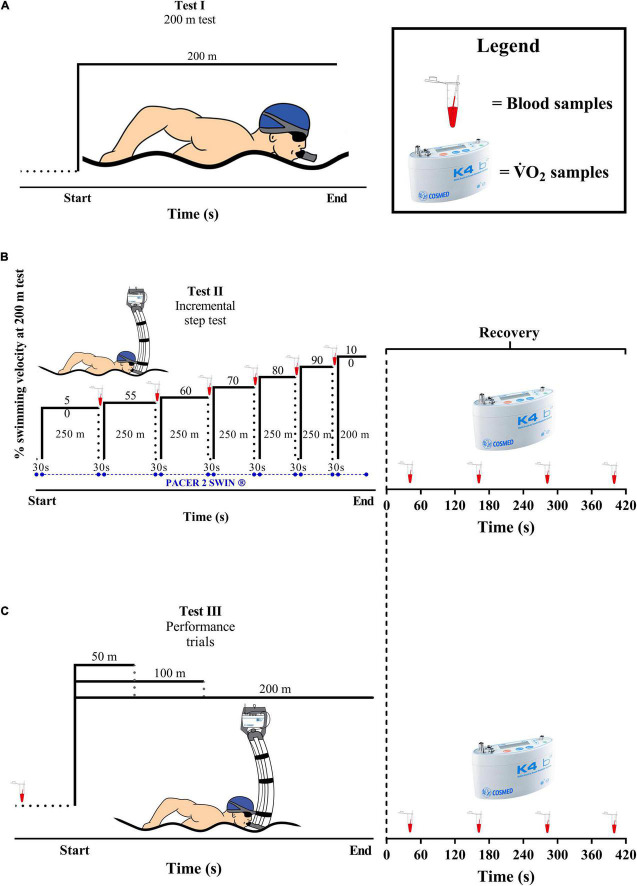
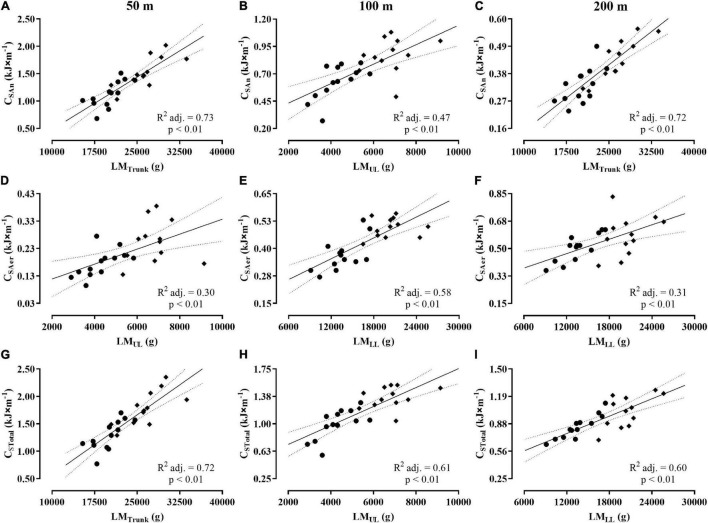
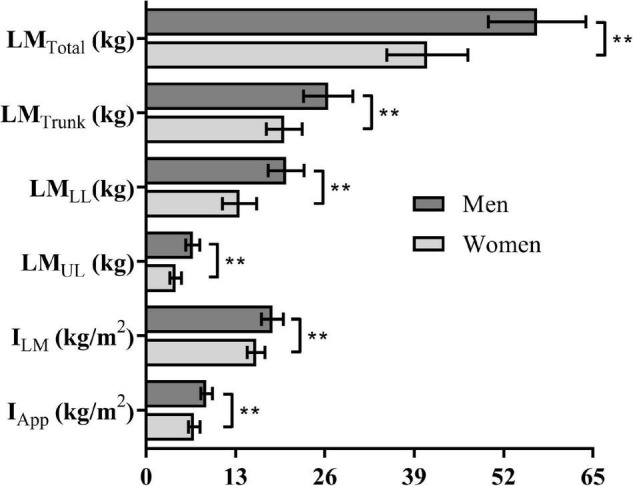
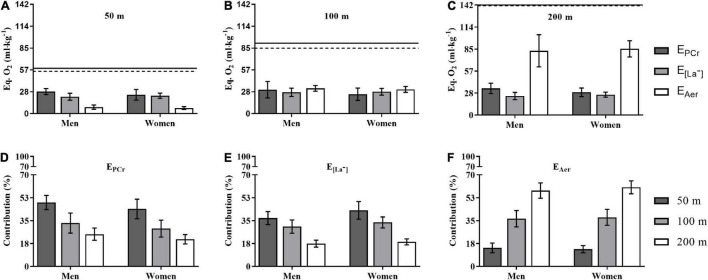
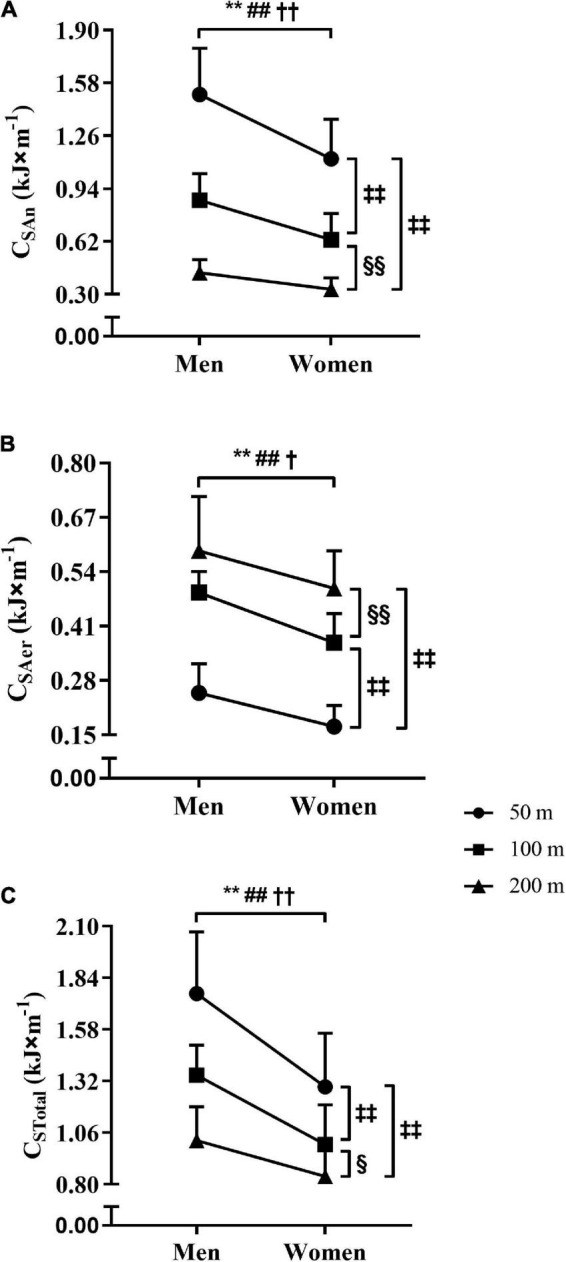
This study assessed the energy cost in swimming (C) during short and middle distances to analyze the sex-specific responses of C during supramaximal velocity and whether body composition account to the expected differences. Twenty-six swimmers (13 men and 13 women: 16.7 ± 1.9 vs. 15.5 ± 2.8 years old and 70.8 ± 10.6 vs. 55.9 ± 7.0 kg of weight) performed maximal front crawl swimming trials in 50, 100, and 200 m. The oxygen uptake ( O) was analyzed along with the tests (and post-exercise) through a portable gas analyser connected to a respiratory snorkel. Blood samples were collected before and after exercise (at the 1st, 3rd, 5th, and 7th min) to determine blood lactate concentration [La]. The lean mass of the trunk (LM ), upper limb (LM ), and lower limb (LM ) was assessed using dual X-ray energy absorptiometry. Anaerobic energy demand was calculated from the phosphagen and glycolytic components, with the first corresponding to the fast component of the O bi-exponential recovery phase and the second from the 2.72 ml × kg equivalent for each 1.0 mmol × L [La] variation above the baseline value. The aerobic demand was obtained from the integral value of the O vs. swimming time curve. The C was estimated by the rate between total energy releasing (in Joules) and swimming velocity. The sex effect on C for each swimming trial was verified by the two-way ANOVA (Bonferroni test) and the relationships between LM , LM , and LM to C were tested by Pearson coefficient. The C was higher for men than women in 50 (1.8 ± 0.3 vs. 1.3 ± 0.3 kJ × m), 100 (1.4 ± 0.1 vs. 1.0 ± 0.2 kJ × m), and 200 m (1.0 ± 0.2 vs. 0.8 ± 0.1 kJ × m) with < 0.01 for all comparisons. In addition, C differed between distances for each sex ( < 0.01). The regional LM (26.5 ± 3.6 vs. 20.1 ± 2.6 kg), LM (6.8 ± 1.0 vs. 4.3 ± 0.8 kg), and LM (20.4 ± 2.6 vs. 13.6 ± 2.5 kg) for men vs. women were significantly correlated to C in 50 ( = 0.73), 100 ( = 0.61), and 200 m ( = 0.60, < 0.01). Therefore, the increase in C with distance is higher for men than women and is determined by the lean mass in trunk and upper and lower limbs independent of the differences in body composition between sexes.
本研究评估了短距离和中距离游泳时的能量消耗(C),以分析在超最大速度下C的性别特异性反应,以及身体成分是否导致了预期差异。26名游泳运动员(13名男性和13名女性:年龄分别为16.7±1.9岁和15.5±2.8岁,体重分别为70.8±10.6千克和55.9±7.0千克)进行了50米、100米和200米的最大自由泳测试。通过连接呼吸管的便携式气体分析仪在测试期间(以及运动后)分析摄氧量( O)。在运动前和运动后(第1、3、5和7分钟)采集血样以测定血乳酸浓度[La]。使用双能X线吸收法评估躯干瘦体重(LM )、上肢瘦体重(LM )和下肢瘦体重(LM )。无氧能量需求由磷酸原和糖酵解成分计算得出,前者对应于 O双指数恢复阶段的快速成分,后者根据高于基线值每1.0毫摩尔/升[La]变化2.72毫升/千克当量计算得出。有氧需求从 O与游泳时间曲线的积分值获得。C通过总能量释放(以焦耳为单位)与游泳速度之间的比率估算。通过双向方差分析(Bonferroni检验)验证每个游泳测试中性别对C的影响,并通过Pearson系数检验LM 、LM 和LM 与C之间的关系。在50米(1.8±0.3 vs. 1.3±0.3千焦×米)、100米(1.4±0.1 vs. 1.0±0.2千焦×米)和200米(1.0±0.2 vs. 0.8±0.1千焦×米)中,男性的C高于女性,所有比较的P<0.01。此外,每个性别的C在不同距离之间也存在差异(P<0.01)。男性与女性的区域LM (26.5±3.6 vs. 20.1±2.6千克)、LM (6.8±1.0 vs. 4.3±0.8千克)和LM (20.4±2.6 vs. 13.6±2.5千克)在50米( = 0.73)、100米( = 0.61)和200米( = 0.60,P<0.01)中与C显著相关。因此,男性的C随距离增加的幅度高于女性,并且由躯干、上肢和下肢的瘦体重决定,与性别之间身体成分的差异无关。