Zhylka Andrey, Sollmann Nico, Kofler Florian, Radwan Ahmed, De Luca Alberto, Gempt Jens, Wiestler Benedikt, Menze Bjoern, Krieg Sandro M, Zimmer Claus, Kirschke Jan S, Sunaert Stefan, Leemans Alexander, Pluim Josien P W
Biomedical Engineering, Eindhoven University of Technology, Eindhoven, Netherlands.
Department of Diagnostic and Interventional Radiology, University Hospital Ulm, Ulm, Germany.
Front Oncol. 2021 Dec 14;11:761169. doi: 10.3389/fonc.2021.761169. eCollection 2021.
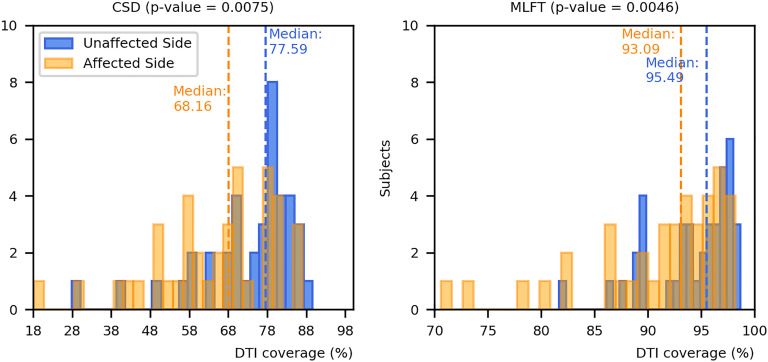
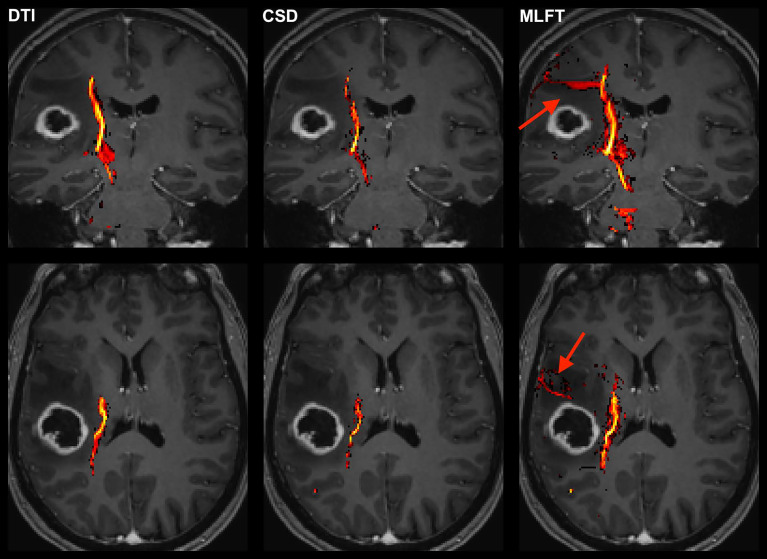
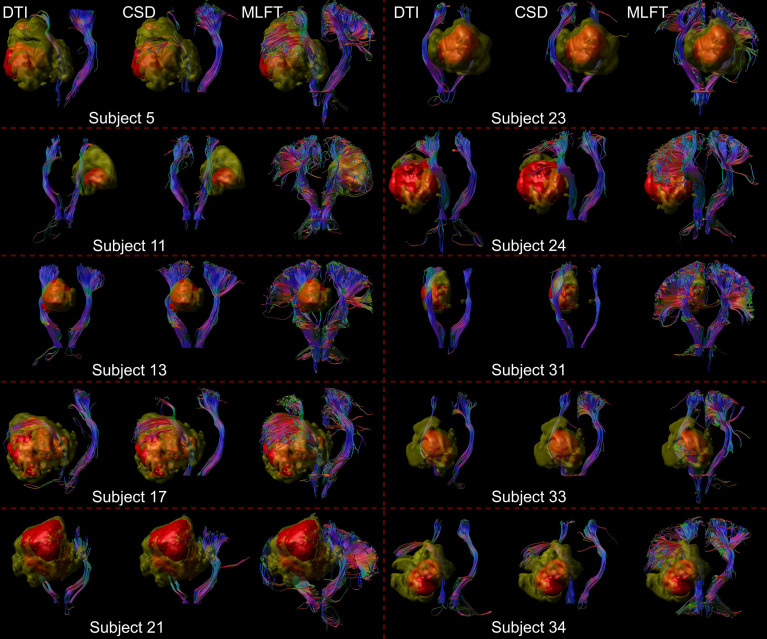
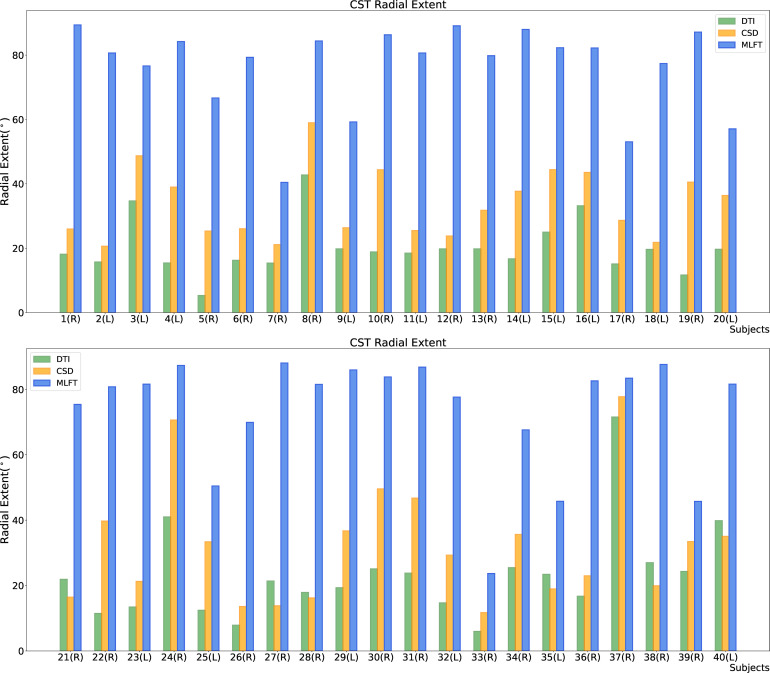
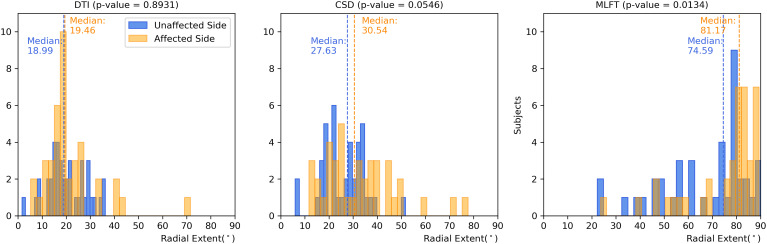
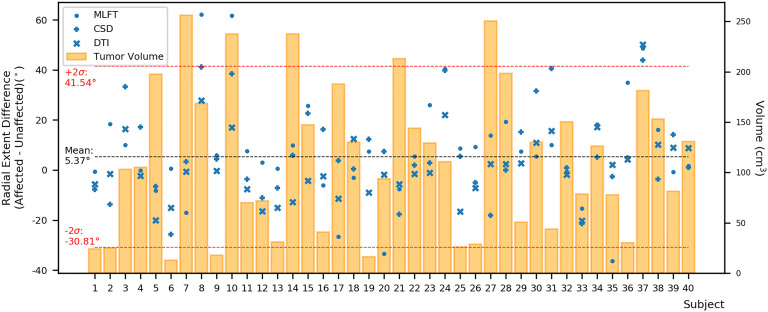
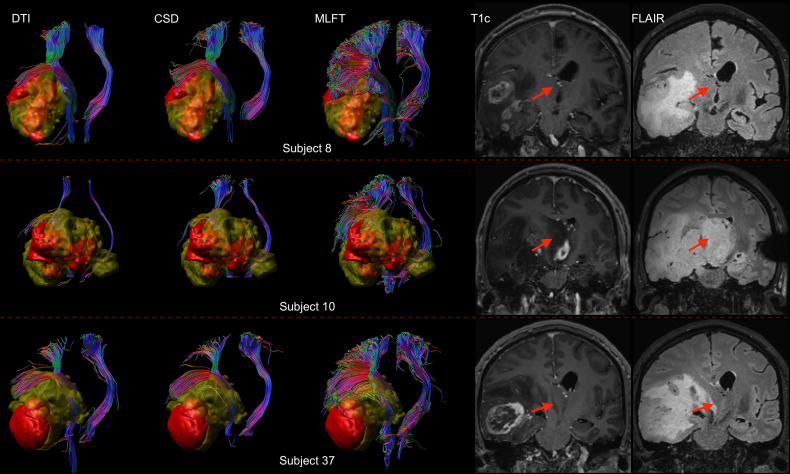
While the diagnosis of high-grade glioma (HGG) is still associated with a considerably poor prognosis, neurosurgical tumor resection provides an opportunity for prolonged survival and improved quality of life for affected patients. However, successful tumor resection is dependent on a proper surgical planning to avoid surgery-induced functional deficits whilst achieving a maximum extent of resection (EOR). With diffusion magnetic resonance imaging (MRI) providing insight into individual white matter neuroanatomy, the challenge remains to disentangle that information as correctly and as completely as possible. In particular, due to the lack of sensitivity and accuracy, the clinical value of widely used diffusion tensor imaging (DTI)-based tractography is increasingly questioned. We evaluated whether the recently developed multi-level fiber tracking (MLFT) technique can improve tractography of the corticospinal tract (CST) in patients with motor-eloquent HGGs. Forty patients with therapy-naïve HGGs (mean age: 62.6 ± 13.4 years, 57.5% males) and preoperative diffusion MRI [repetition time (TR)/echo time (TE): 5000/78 ms, voxel size: 2x2x2 mm, one volume at b=0 s/mm, 32 volumes at b=1000 s/mm] underwent reconstruction of the CST of the tumor-affected and unaffected hemispheres using MLFT in addition to deterministic DTI-based and deterministic constrained spherical deconvolution (CSD)-based fiber tractography. The brain stem was used as a seeding region, with a motor cortex mask serving as a target region for MLFT and a region of interest (ROI) for the other two algorithms. Application of the MLFT method substantially improved bundle reconstruction, leading to CST bundles with higher radial extent compared to the two other algorithms (delineation of CST fanning with a wider range; median radial extent for tumor-affected vs. unaffected hemisphere - DTI: 19.46° vs. 18.99°, p=0.8931; CSD: 30.54° vs. 27.63°, p=0.0546; MLFT: 81.17° vs. 74.59°, p=0.0134). In addition, reconstructions by MLFT and CSD-based tractography nearly completely included respective bundles derived from DTI-based tractography, which was however favorable for MLFT compared to CSD-based tractography (median coverage of the DTI-based CST for affected vs. unaffected hemispheres - CSD: 68.16% vs. 77.59%, p=0.0075; MLFT: 93.09% vs. 95.49%; p=0.0046). Thus, a more complete picture of the CST in patients with motor-eloquent HGGs might be achieved based on routinely acquired diffusion MRI data using MLFT.
虽然高级别胶质瘤(HGG)的诊断仍然与相当差的预后相关,但神经外科肿瘤切除术为受影响患者延长生存期和改善生活质量提供了机会。然而,成功的肿瘤切除取决于适当的手术规划,以避免手术引起的功能缺陷,同时实现最大程度的切除(EOR)。随着扩散磁共振成像(MRI)能够深入了解个体白质神经解剖结构,如何尽可能正确和完整地解读这些信息仍然是一个挑战。特别是,由于缺乏敏感性和准确性,广泛使用的基于扩散张量成像(DTI)的纤维束成像的临床价值受到越来越多的质疑。我们评估了最近开发的多级纤维追踪(MLFT)技术是否能改善运动功能区HGG患者皮质脊髓束(CST)的纤维束成像。40例未经治疗的HGG患者(平均年龄:62.6±13.4岁,57.5%为男性),术前行扩散MRI检查[重复时间(TR)/回波时间(TE):5000/78 ms,体素大小:2×2×2 mm,b=0 s/mm时1个容积,b=1000 s/mm时32个容积],除了基于确定性DTI和基于确定性约束球面反卷积(CSD)的纤维束成像外,还使用MLFT对肿瘤累及和未累及半球的CST进行重建。脑干用作种子区域,运动皮层掩码用作MLFT的目标区域,以及其他两种算法的感兴趣区域(ROI)。MLFT方法的应用显著改善了束重建,与其他两种算法相比,导致CST束具有更高的径向范围(CST扇形描绘范围更广;肿瘤累及半球与未累及半球的径向范围中位数 - DTI:19.46°对18.99°,p = 0.8931;CSD:30.54°对27.63°,p = 0.0546;MLFT:81.17°对74.59°,p = 0.0134)。此外,基于MLFT和基于CSD的纤维束成像重建几乎完全包含了基于DTI的纤维束成像得到的相应束,但与基于CSD的纤维束成像相比,MLFT更具优势(肿瘤累及半球与未累及半球基于DTI的CST的中位数覆盖率 - CSD:68.16%对77.59%,p = 0.0075;MLFT:93.09%对95.49%;p = 0.0046)。因此,基于常规采集的扩散MRI数据使用MLFT,可能会更完整地呈现运动功能区HGG患者的CST情况。