Okello Denis, Yang Sungyu, Komakech Richard, Chung Yuseong, Rahmat Endang, Gang Roggers, Omujal Francis, Lamwaka Alice V, Kang Youngmin
Herbal Medicine Resources Research Center, Korea Institute of Oriental Medicine (KIOM), Naju-si, South Korea.
Korean Convergence Medicine Major, University of Science and Technology (UST), Naju-si, South Korea.
Front Plant Sci. 2021 Dec 17;12:797721. doi: 10.3389/fpls.2021.797721. eCollection 2021.
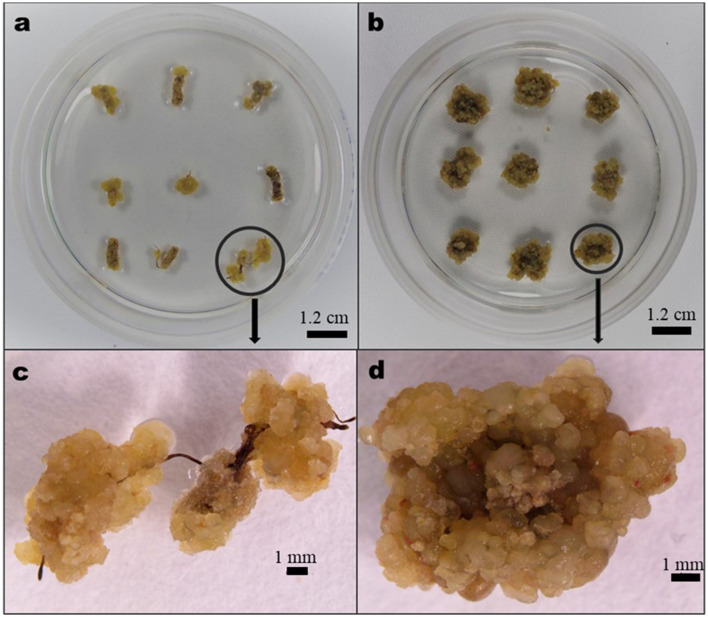
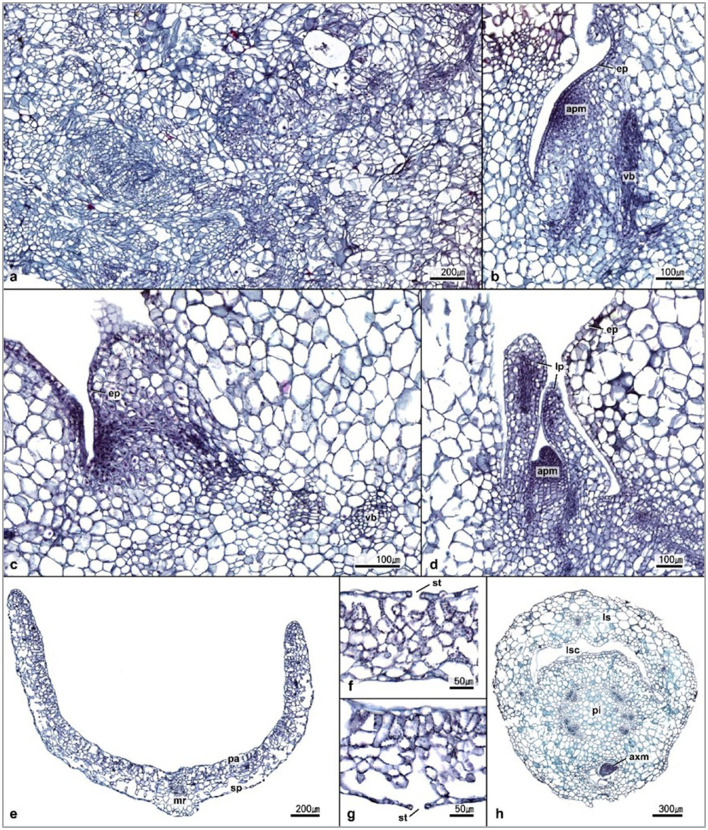
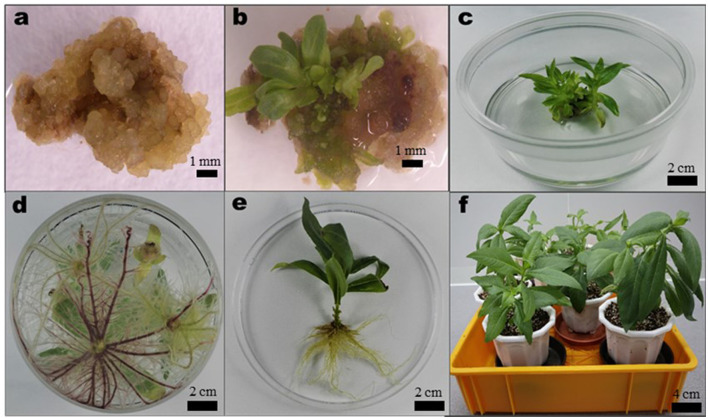
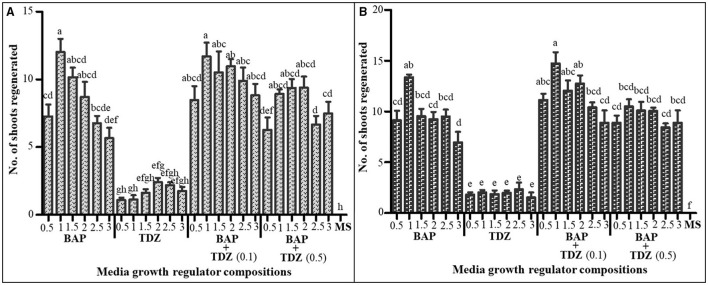
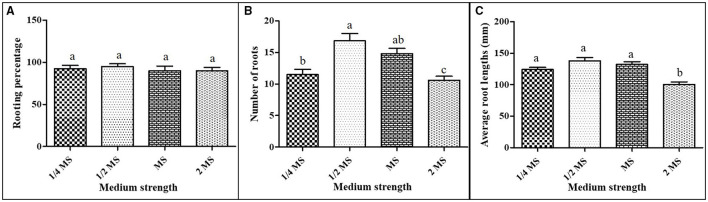
The medicinal plant, , has been traditionally used in several African countries to treat many diseases such as tuberculosis, cough, inflammation, malaria, osteoporosis, and diabetes. In this study, we developed a protocol for propagation of using indirect shoot organogenesis from leaf and root explants of -grown seedlings and assessed the tissues at different developmental stages. The highest callus induction (91.9 ± 2.96%) from leaf explants was in the Murashige and Skoog (MS) medium augmented with 1.0 mg/L 6-Benzylaminopurine (BAP) and 1.0 mg/L 2,4-dichlorophenoxyacetic acid (2,4-D) while from root explants, the highest callus induction (92.6 ± 2.80%) was in the same plant tissue culture medium augmented with 0.5 mg/L BAP and 1.0 mg/L 2,4-D. The best shoot regeneration capacity from leaf-derived calli (i.e., 80.0 ± 6.23% regeneration percentage and 12.0 ± 6.23 shoots per callus) was obtained in medium augmented with 1.0 mg/L BAP and 0.05 mg/L α-Naphthaleneacetic acid (NAA); the best regeneration capacity for root-derived calli (i.e., 86.7 ± 6.24% shoot regeneration percentage and 14.7 ± 1.11 shoots per callus) was obtained in the MS medium augmented with 1.0 mg/L BAP, 0.05 mg/L NAA, and 0.1 mg/L Thidiazuron (TDZ). Regenerated plantlets developed a robust root system in 1/2 MS medium augmented with 0.1 mg/L NAA and had a survival rate of 93.6% at acclimatization. The regenerated stem tissue was fully differentiated, while the young leaf tissue consisted of largely unorganized and poorly differentiated cells with large intercellular airspaces typical of leaf tissues. Our study established a protocol for the indirect regeneration of and offers a basis for its domestication, large-scale multiplication, and germplasm preservation. To the best of our knowledge, this is the first study to develop an indirect regeneration protocol for and conduct anatomical assessment through the different stages of development from callus to a fully developed plantlet.
药用植物[植物名称未给出]在一些非洲国家传统上被用于治疗多种疾病,如肺结核、咳嗽、炎症、疟疾、骨质疏松症和糖尿病。在本研究中,我们开发了一种利用[植物名称未给出]幼苗的叶片和根外植体通过间接芽器官发生进行[植物名称未给出]繁殖的方案,并评估了不同发育阶段的组织。叶片外植体在添加1.0毫克/升6 - 苄基腺嘌呤(BAP)和1.0毫克/升2,4 - 二氯苯氧乙酸(2,4 - D)的Murashige和Skoog(MS)培养基中诱导愈伤组织的效率最高(91.9 ± 2.96%),而根外植体在添加0.5毫克/升BAP和1.0毫克/升2,4 - D的相同植物组织培养基中诱导愈伤组织的效率最高(92.6 ± 2.80%)。从叶片愈伤组织再生芽的最佳能力(即再生率为80.0 ± 6.23%,每个愈伤组织再生12.0 ± 6.23个芽)是在添加1.0毫克/升BAP和0.05毫克/升α - 萘乙酸(NAA)的培养基中获得的;从根愈伤组织再生芽的最佳能力(即芽再生率为86.7 ± 6.24%,每个愈伤组织再生14.7 ± 1.11个芽)是在添加1.0毫克/升BAP、0.05毫克/升NAA和0.1毫克/升噻苯隆(TDZ)的MS培养基中获得的。再生植株在添加0.1毫克/升NAA的1/2 MS培养基中发育出健壮的根系,驯化后的成活率为93.6%。再生的茎组织已完全分化,而幼叶组织主要由排列无序且分化程度低的细胞组成,具有[植物名称未给出]叶片组织典型的大细胞间隙。我们的研究建立了[植物名称未给出]间接再生的方案,并为其驯化、大规模繁殖和种质保存提供了依据。据我们所知,这是第一项为[植物名称未给出]开发间接再生方案并通过从愈伤组织到完全发育的植株的不同发育阶段进行解剖学评估的研究。