Institute for Translational Medicine and Therapeutics, Perelman School of Medicine, University of Pennsylvania, Philadelphia, PA, United States.
Faculty of Science & Engineering, University of Limerick, Limerick, Ireland.
Front Public Health. 2021 Dec 16;9:751451. doi: 10.3389/fpubh.2021.751451. eCollection 2021.
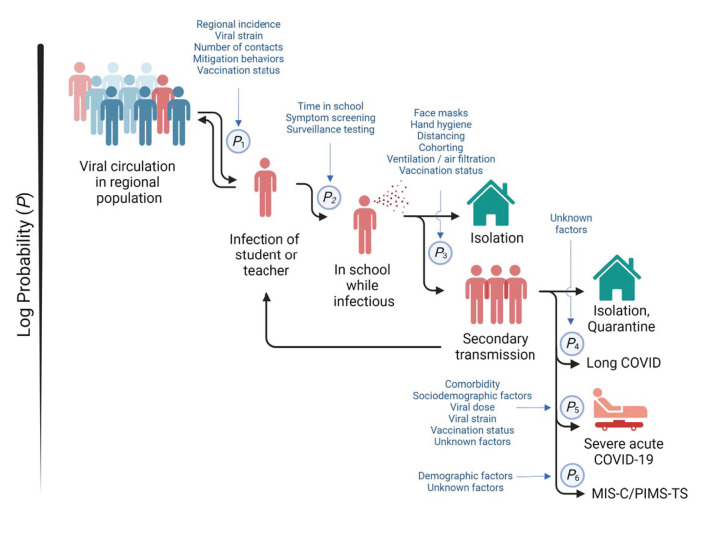
During the severe acute respiratory syndrome coronavirus 2 (SARS-CoV-2) pandemic, providing safe in-person schooling has been a dynamic process balancing evolving community disease burden, scientific information, and local regulatory requirements with the mandate for education. Considerations include the health risks of SARS-CoV-2 infection and its post-acute sequelae, the impact of remote learning or periods of quarantine on education and well-being of children, and the contribution of schools to viral circulation in the community. The risk for infections that may occur within schools is related to the incidence of SARS-CoV-2 infections within the local community. Thus, persistent suppression of viral circulation in the community through effective public health measures including vaccination is critical to in-person schooling. Evidence suggests that the likelihood of transmission of SARS-CoV-2 within schools can be minimized if mitigation strategies are rationally combined. This article reviews evidence-based approaches and practices for the continual operation of in-person schooling.
在严重急性呼吸综合征冠状病毒 2(SARS-CoV-2)大流行期间,提供安全的面对面教学是一个动态过程,需要平衡不断变化的社区疾病负担、科学信息以及当地监管要求与教育任务。需要考虑的因素包括 SARS-CoV-2 感染及其后遗症的健康风险、远程学习或隔离期对儿童教育和福祉的影响,以及学校对社区病毒传播的贡献。可能在学校内发生的感染风险与当地社区内 SARS-CoV-2 感染的发生率有关。因此,通过有效的公共卫生措施(包括疫苗接种)持续抑制社区中的病毒传播对于面对面教学至关重要。有证据表明,如果合理结合缓解策略,可最大程度降低 SARS-CoV-2 在学校内传播的可能性。本文回顾了持续开展面对面教学的循证方法和实践。