Yun Hyun-Sik, Kim Young-Saeng, Yoon Ho-Sung
School of Life Sciences, BK21 FOUR KNU Creative BioResearch Group, Kyungpook National University, Daegu, South Korea.
Research Institute of Ulleung-do & Dok-do, Kyungpook National University, Daegu, South Korea.
Front Bioeng Biotechnol. 2021 Dec 17;9:774143. doi: 10.3389/fbioe.2021.774143. eCollection 2021.
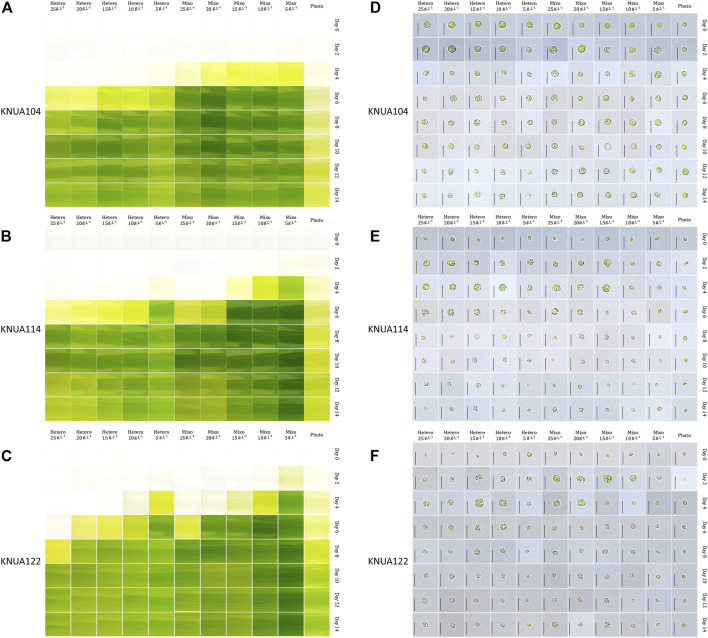
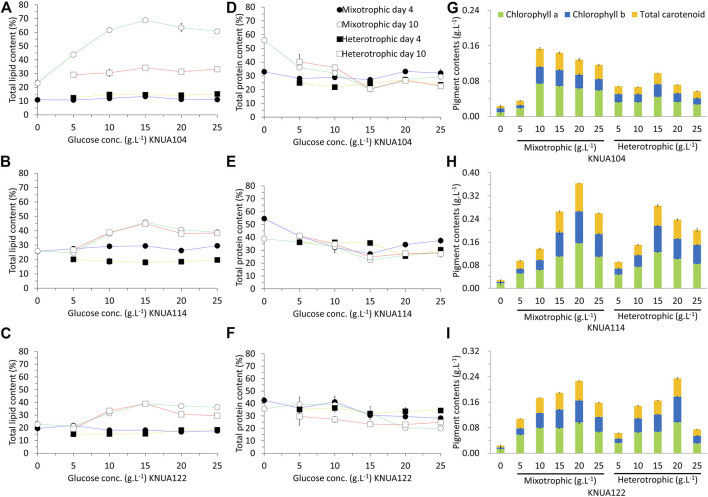
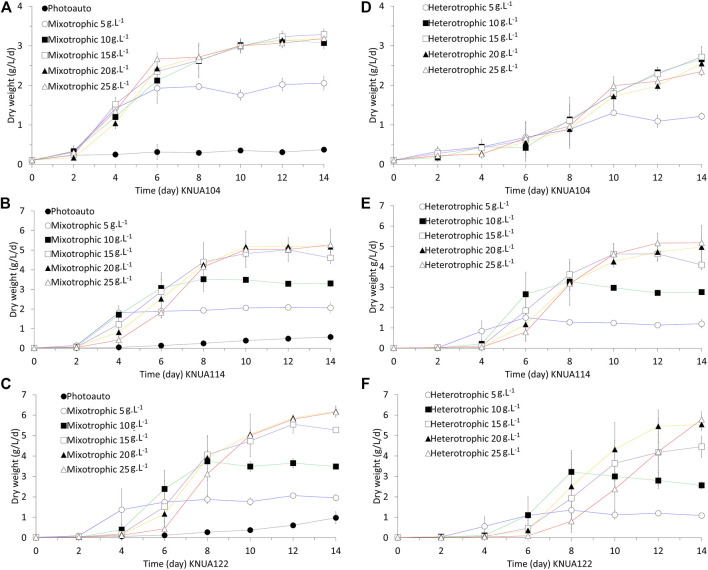
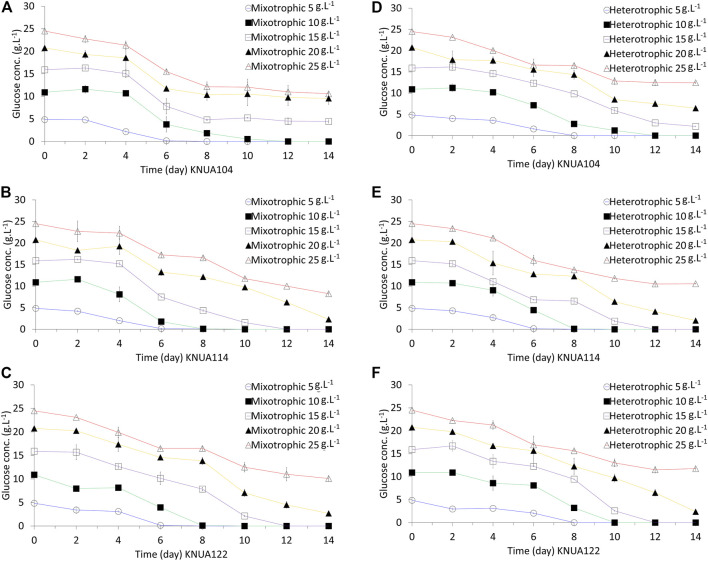
In the past, biomass production using microalgae culture was dependent on inorganic carbon sources as microalgae are photosynthetic organisms. However, microalgae utilize both organic and inorganic carbon sources, such as glucose. Glucose is an excellent source of organic carbon that enhances biomass yield and the content of useful substances in microalgae. In this study, photoautotrophic, mixotrophic, and heterotrophic cultivation conditions were applied to three well-known strains of (KNUA104, KNUA114, and KNUA122) to assess biomass productivity, and compositional changes (lipid, protein, and pigment) were evaluated in BG11 media under photoautotrophic, mixotrophic, and heterotrophic conditions utilizing different initial concentrations of glucose (5, 10, 15, 20, and 25 g L). Compared to the photoautotrophic condition (biomass yield: KNUA104, 0.35 ± 0.04 g/L/d; KNUA114, 0.40 ± 0.08 g/L/d; KNUA122, 0.38 ± 0.05 g/L/d) glucose was absent, and the biomass yield improved in the mixotrophic (glucose: 20 g L; biomass yield: KNUA104, 2.99 ± 0.10 g/L/d; KNUA114, 5.18 ± 0.81 g/L/d; KNUA122, 5.07 ± 0.22 g/L/d) and heterotrophic conditions (glucose: 20 g L; biomass yield: KNUA104, 1.72 ± 0.26 g/L/d; KNUA114, 4.26 ± 0.27 g/L/d; KNUA122, 4.32 ± 0.32 g/L/d). All strains under mixotrophic and heterotrophic conditions were optimally cultured when 15-20 g L initial glucose was provided. Although bioresourse productivity improved under both mixotrophic and heterotrophic conditions where mixotrophic conditions were found to be optimal as the yields of lipid and pigment were also enhanced. Protein content was less affected by the presence of light or the concentration of glucose. Under mixotrophic conditions, the highest lipid content (glucose: 15 g L; lipid content: 68.80 ± 0.54%) was obtained with KNUA104, and enhanced pigment productivity of KNUA114 and KNUA122 (additional pigment yield obtained with 15 g L glucose: KNUA 114, 0.33 ± 0.01 g L; KNUA122, 0.21 ± 0.01 g L). Also, saturated fatty acid (SFA) content was enhanced in all strains (SFA: KNUA104, 29.76 ± 1.31%; KNUA114, 37.01 ± 0.98%; KNUA122, 33.37 ± 0.17%) under mixotrophic conditions. These results suggest that mixotrophic cultivation of and could improve biomass yield and the raw material quality of biomass.
过去,由于微藻是光合生物,利用微藻培养进行生物质生产依赖于无机碳源。然而,微藻同时利用有机和无机碳源,如葡萄糖。葡萄糖是一种优质的有机碳源,可提高微藻的生物质产量和有用物质含量。在本研究中,将光合自养、混合营养和异养培养条件应用于三种著名的(KNUA104、KNUA114和KNUA122)菌株,以评估生物质生产力,并在光合自养、混合营养和异养条件下,利用不同初始浓度的葡萄糖(5、10、15、20和25 g/L)在BG11培养基中评估成分变化(脂质、蛋白质和色素)。与光合自养条件(生物质产量:KNUA104,0.35±0.04 g/L/d;KNUA114,0.40±0.08 g/L/d;KNUA122,0.38±0.05 g/L/d)相比,不存在葡萄糖时,混合营养(葡萄糖:20 g/L;生物质产量:KNUA104,2.99±0.10 g/L/d;KNUA114,5.18±0.81 g/L/d;KNUA122,5.07±0.22 g/L/d)和异养条件(葡萄糖:20 g/L;生物质产量:KNUA104,1.72±0.26 g/L/d;KNUA114,4.26±0.27 g/L/d;KNUA122,4.32±0.32 g/L/d)下的生物质产量有所提高。当提供15 - 20 g/L初始葡萄糖时,混合营养和异养条件下的所有菌株均实现最佳培养。虽然在混合营养和异养条件下生物资源生产力均有所提高,其中混合营养条件被发现是最佳的,因为脂质和色素的产量也有所提高。蛋白质含量受光照或葡萄糖浓度的影响较小。在混合营养条件下,KNUA104获得了最高的脂质含量(葡萄糖:15 g/L;脂质含量:68.80±0.54%),并且KNUA114和KNUA122的色素生产力提高(15 g/L葡萄糖获得的额外色素产量:KNUA 114,0.33±0.01 g/L;KNUA122,0.21±0.01 g/L)。此外,在混合营养条件下所有菌株的饱和脂肪酸(SFA)含量均有所提高(SFA:KNUA104,29.76±1.31%;KNUA114,37.01±0.98%;KNUA122,33.37±0.17%)。这些结果表明,[具体菌株名称]的混合营养培养可以提高生物质产量和生物质的原料质量。