Noguchi Kenneth S, O'Brien Kelly K, Aubry Rachel L, Carusone Soo Chan, Avery Lisa, Solomon Patricia, Ilic Ivan, Pandovski Zoran, Zobeiry Mehdi, Tang Ada
School of Rehabilitation Science, McMaster University, Hamilton, Ontario.
Department of Physical Therapy, University of Toronto, Toronto, Ontario.
Arch Rehabil Res Clin Transl. 2021 Oct 24;3(4):100164. doi: 10.1016/j.arrct.2021.100164. eCollection 2021 Dec.
To evaluate the construct validity and responsiveness of the Rapid Assessment of Physical Activity (RAPA) for measuring physical activity (PA) in adults living with HIV.
Secondary analysis of an interrupted time-series intervention study.
Community-based fitness facility in Toronto, Canada.
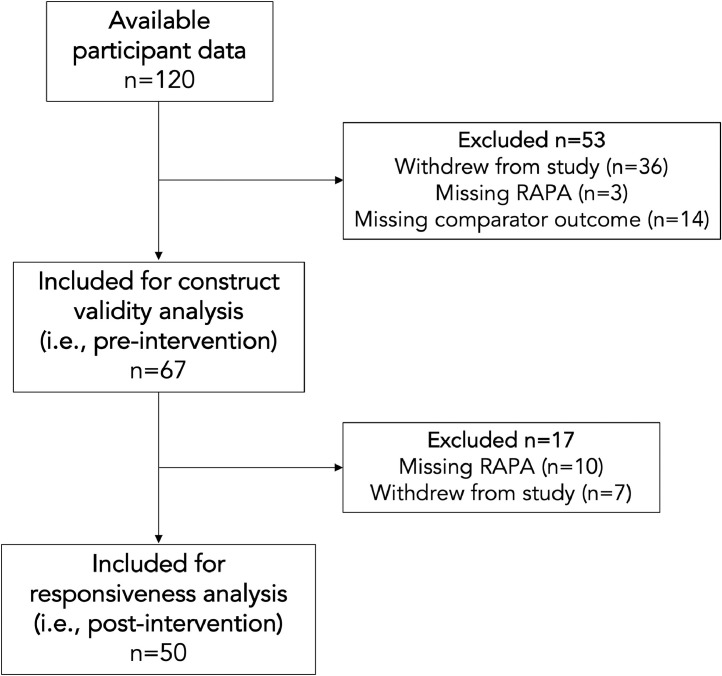
Sixty-seven adults (N=67) living with HIV (n=5 women; mean age, 51.8±11.6 years) with available baseline data to assess for construct validity of the RAPA, of which 50 (n=4 women; age, 53.2±11.4 years) had follow-up data to evaluate responsiveness.
Two months of a community-based exercise intervention involving thrice weekly multicomponent exercises.
We used a single-item PA questionnaire as a convergent outcome to the RAPA, while peak oxygen consumption, general health status, and number of concurrent health conditions were divergent outcomes. We tested 11 a priori hypotheses (6 construct validity, 5 responsiveness) using Spearman ρ, Wilcoxon signed-rank tests, Cohen's , standardized effect size (SES), and standardized response mean (SRM). We considered acceptable construct validity and responsiveness if >75% of hypotheses were confirmed.
All of the hypotheses (100%) for construct validity were confirmed. The RAPA demonstrated moderate correlations with the single-item PA questionnaire (ρ=0.61), and negligible correlations with divergent outcome measures (ρ=0.08-0.21). Two of the 5 hypotheses (40.0%) for responsiveness were confirmed. RAPA scores were significantly greater after 2 months of training (<.001) and demonstrated a small to moderate effect size (=0.50, SES=0.47, SRM=0.48). There was a low correlation between change in RAPA scores and change in single-item PA questionnaire scores (ρ=0.48).
The RAPA demonstrated acceptable construct validity and poor responsiveness in adults living with HIV. Therefore, the RAPA can be used cross-sectionally but may be used in conjunction with other measures of PA for adults living with HIV.
评估快速身体活动评估法(RAPA)在测量感染艾滋病毒成年人身体活动(PA)方面的结构效度和反应性。
对一项中断时间序列干预研究进行二次分析。
加拿大多伦多的社区健身设施。
67名感染艾滋病毒的成年人(N = 67,其中5名女性;平均年龄51.8±11.6岁),有可用的基线数据以评估RAPA的结构效度,其中50名(4名女性;年龄53.2±11.4岁)有随访数据以评估反应性。
为期两个月的基于社区的运动干预,包括每周三次的多组分运动。
我们使用单项PA问卷作为与RAPA的趋同结局,而峰值耗氧量、总体健康状况和并发健康状况数量则为不同结局。我们使用Spearman ρ、Wilcoxon符号秩检验、Cohen's 、标准化效应量(SES)和标准化反应均值(SRM)检验了11个先验假设(6个结构效度假设,5个反应性假设)。如果超过75%的假设得到证实,我们认为结构效度和反应性是可接受的。
所有关于结构效度的假设(100%)均得到证实。RAPA与单项PA问卷显示出中等相关性(ρ = 0.61),与不同结局指标的相关性可忽略不计(ρ = 0.08 - 0.21)。5个关于反应性的假设中有2个(40.0%)得到证实。训练2个月后,RAPA得分显著更高(<0.001),并显示出小到中等的效应量(= 0.50,SES = 0.47,SRM = 0.48)。RAPA得分变化与单项PA问卷得分变化之间的相关性较低(ρ = 0.48)。
RAPA在感染艾滋病毒的成年人中显示出可接受的结构效度和较差的反应性。因此,RAPA可用于横断面研究,但可能需要与其他PA测量方法结合用于感染艾滋病毒的成年人。