Department of Public Health and Epidemiology, Faculty of Medicine, University of Debrecen, Debrecen, Hungary.
MTA-DE Public Health Research Group, Hungarian Academy of Sciences and University of Debrecen, Debrecen, Hungary.
Eur J Nutr. 2022 Jun;61(4):1749-1778. doi: 10.1007/s00394-021-02763-1. Epub 2022 Jan 3.
Oat supplementation interventions (OSIs) may have a beneficial effect on cardiovascular disease (CVD) risk. However, dietary background can modulate such effect. This systematic review assesses the effects of OSIs on CVD risk markers among adults, accounting for different dietary backgrounds or control arms.
We included randomized clinical trials (RCTs) that assessed the effect of oat, oat beta-glucan-rich extracts or avenanthramides on CVD risk markers.
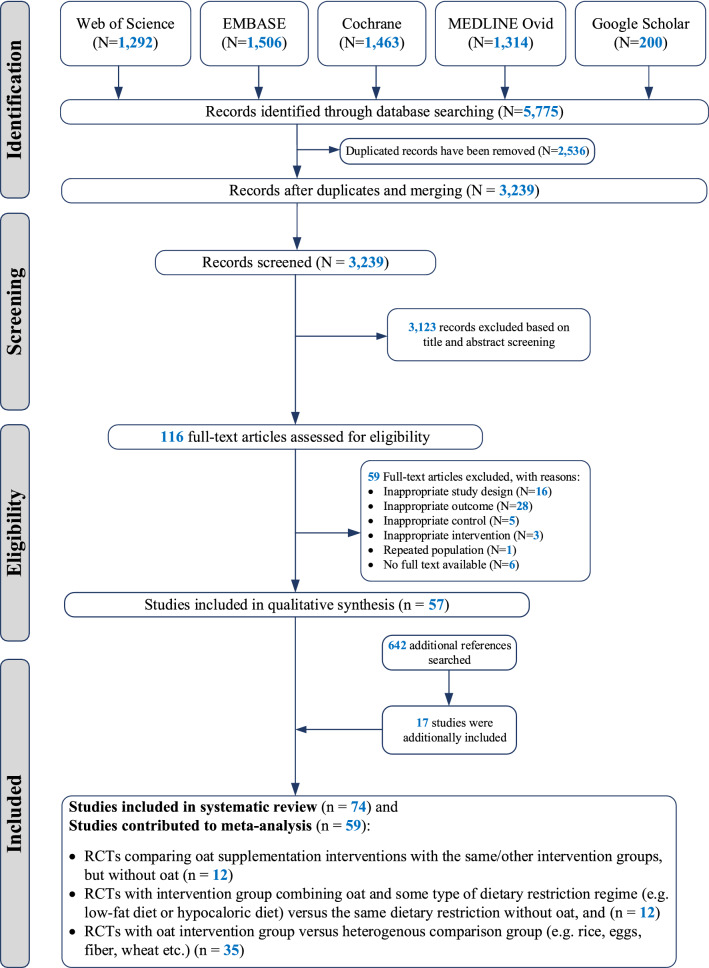
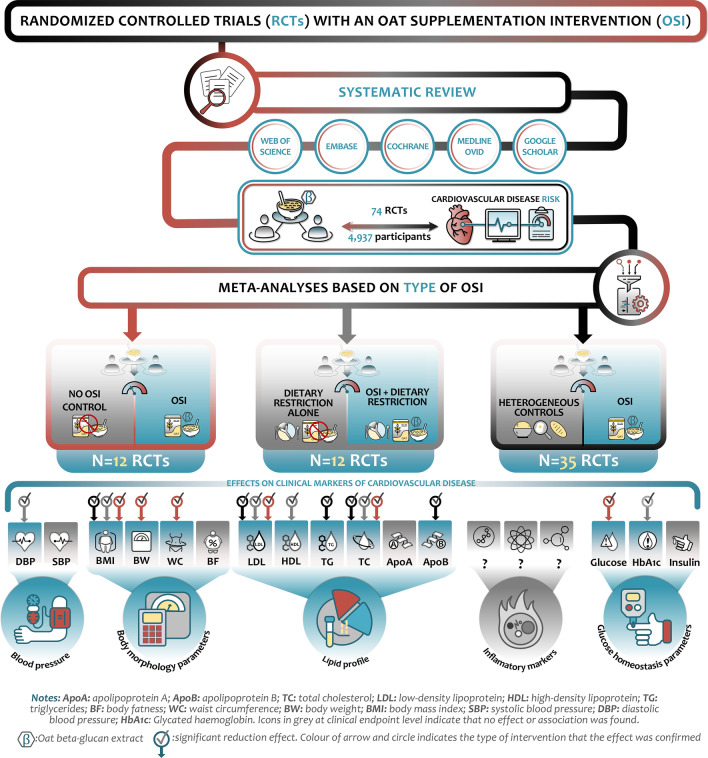
Seventy-four RCTs, including 4937 predominantly hypercholesterolemic, obese subjects, with mild metabolic disturbances, were included in the systematic review. Of these, 59 RCTs contributed to the meta-analyses. Subjects receiving an OSI, compared to control arms without oats, had improved levels of total cholesterol (TC) [weighted mean difference and (95% CI) - 0.42 mmol/L, (- 0.61; - 0.22)], LDL cholesterol [- 0.29 mmol/L, (- 0.37; - 0.20)], glucose [- 0.25 nmol/L, (- 0.36; - 0.14)], body mass index [- 0.13 kg/m, (- 0.26; - 0.01)], weight [- 0.94 kg, (- 1.84: - 0.05)], and waist circumference [- 1.06 cm, (- 1.85; - 0.27)]. RCTs on inflammation and/or oxidative stress markers were scarce and with inconsistent findings. RCTs comparing an OSI to heterogeneous interventions (e.g., wheat, eggs, rice, etc.), showed lowered levels of glycated haemoglobin, diastolic blood pressure, HDL cholesterol and apolipoprotein B. The majority of included RCTs (81.1%) had some concerns for risk of bias.
Dietary OSIs resulted in lowered levels of blood lipids and improvements in anthropometric parameters among participants with predominantly mild metabolic disturbances, regardless of dietary background or control. Further high-quality trials are warranted to establish the role of OSIs on blood pressure, glucose homeostasis and inflammation markers.
燕麦补充干预(OSI)可能对心血管疾病(CVD)风险有有益影响。然而,饮食背景可以调节这种影响。本系统评价评估了 OSI 对成年人 CVD 风险标志物的影响,同时考虑了不同的饮食背景或对照组。
我们纳入了评估燕麦、燕麦β-葡聚糖丰富提取物或燕麦蒽酰胺对 CVD 风险标志物影响的随机临床试验(RCT)。
该系统评价共纳入 74 项 RCT,包括 4937 名主要患有高胆固醇血症、肥胖、代谢紊乱轻微的受试者。其中 59 项 RCT 纳入了荟萃分析。与不食用燕麦的对照组相比,接受 OSI 的受试者的总胆固醇(TC)[加权均数差值和(95%置信区间)-0.42mmol/L,(-0.61;-0.22)]、低密度脂蛋白胆固醇(LDL-C)[-0.29mmol/L,(-0.37;-0.20)]、血糖[-0.25nmol/L,(-0.36;-0.14)]、体重指数(BMI)[-0.13kg/m,(-0.26;-0.01)]、体重[-0.94kg,(-1.84:-0.05)]和腰围[-1.06cm,(-1.85;-0.27)]水平有所改善。炎症和/或氧化应激标志物的 RCT 较少,且结果不一致。与异质干预(如小麦、鸡蛋、大米等)比较 OSI 的 RCT 显示糖化血红蛋白、舒张压、高密度脂蛋白胆固醇和载脂蛋白 B 水平降低。纳入的 RCT 中(81.1%)大多数存在一定的偏倚风险。
无论饮食背景或对照组如何,饮食 OSI 可降低代谢紊乱轻微的受试者的血脂水平,并改善其人体测量参数。需要进一步进行高质量试验来确定 OSI 对血压、血糖稳态和炎症标志物的作用。