Key Laboratory of Environmental Medicine and Engineering of Ministry of Education, Department of Nutrition and Food Hygiene, School of Public Health, Southeast University, Nanjing 210009, China.
Nutrients. 2022 May 13;14(10):2043. doi: 10.3390/nu14102043.
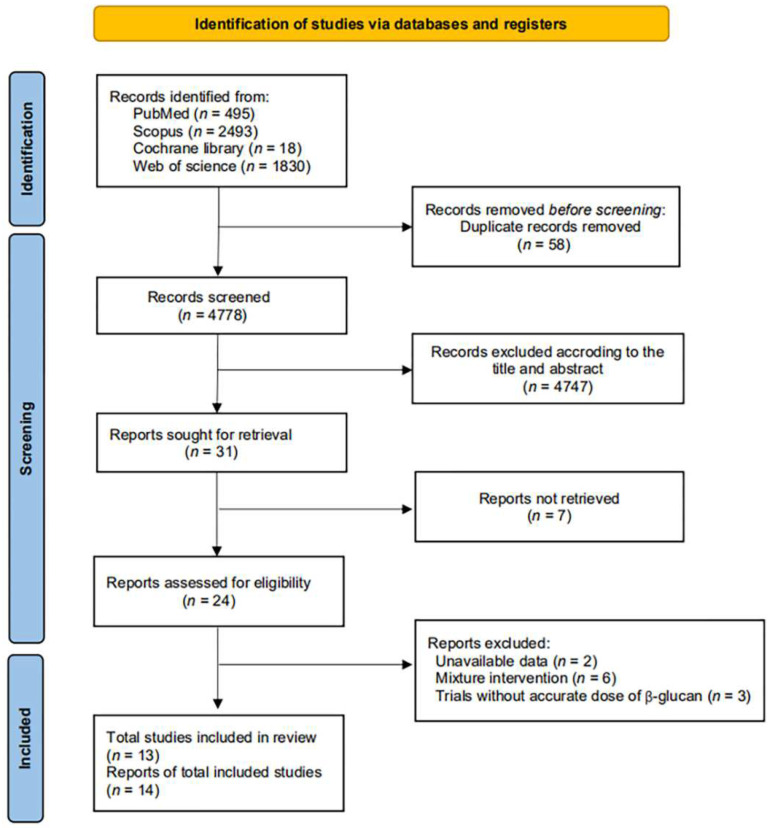
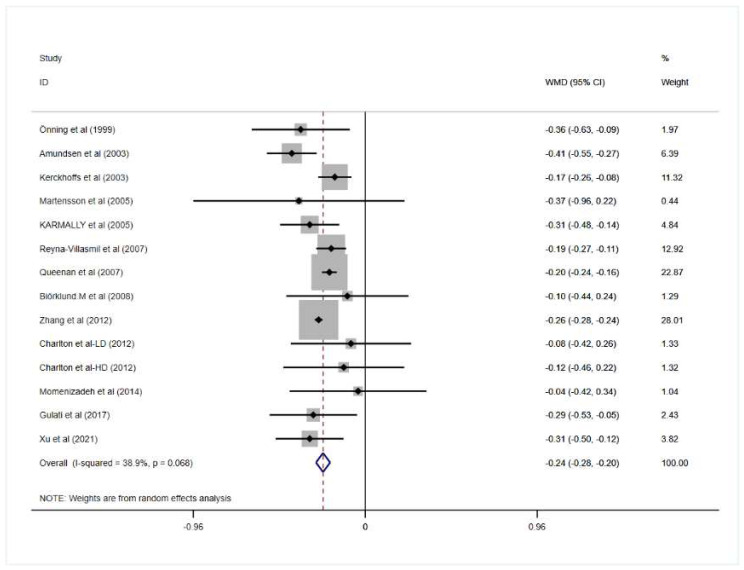
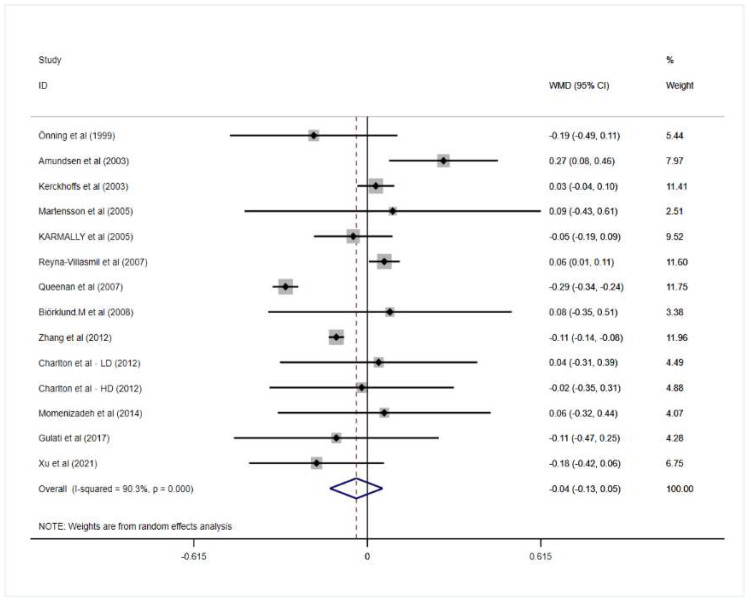
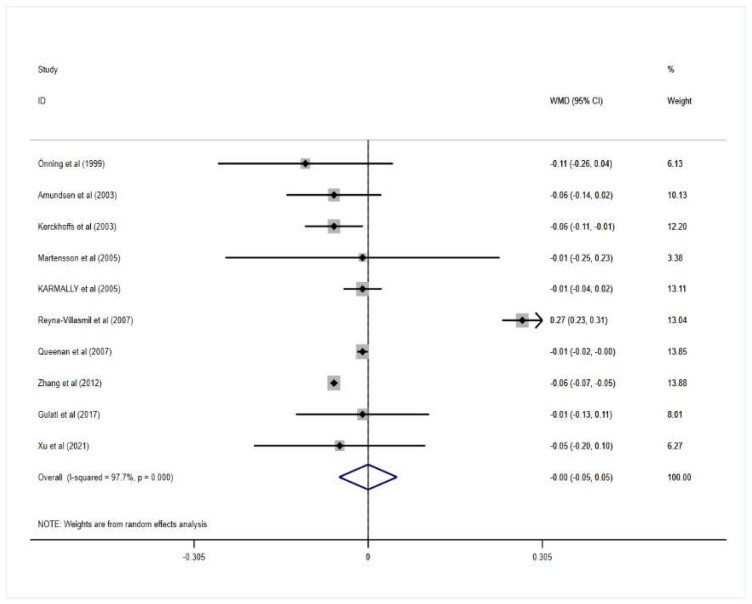
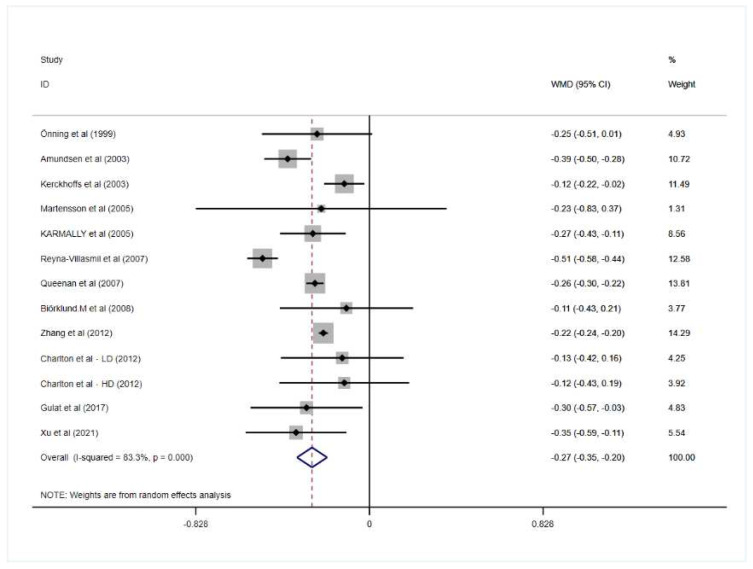
(1) Background: hyperlipidemia is one of the cardiovascular diseases which becomes a great threat to the health of people worldwide. Oat beta-glucan is reported to have a beneficial effect on lowering blood lipids. To probe the effect of oat beta-glucan consumption on serum lipid profiles (total cholesterol, total triglyceride, high-density lipoprotein-cholesterol, and low-density lipoprotein-cholesterol), we carried out a systematic search on randomized controlled trials of oat beta-glucan intervention on hypercholesterolemic individuals. (2) Methods: the pieces of literature were obtained from PubMed, Scopus, Cochrane Library, Web of Science, and the Embase from inception to 28 February 2022. The results were presented with the weighted mean difference (WMD) with a 95% CI. The random-effects or fixed-effects model was applied according to the heterogeneity. The subgroup analysis and meta-regression were used to identify the source of heterogeneity. (3) Results: thirteen trials with 927 participants were included in our meta-analysis. Overall, oat beta-glucan supplementation significantly reduced levels of TC (pooled WMD = -0.24 mmol/L; 95%CI: -0.28 to -0.20 mmol/L), LDL-c (pooled WMD = -0.27 mmol/L; 95%CI: -0.35 to -0.20 mmol/L). Furthermore, beta-glucan consumption did not show significant effects on TG (pooled WMD = -0.04 mmol/L; 95%CI: -0.13 to 0.05 mmol/L), HDL-c (pooled WMD = 0.00 mmol/L; 95%CI: -0.05 to 0.05 mmol/L). Subgroup analysis indicated that critical factors, such as disease severity of participants, the daily intervention of oat beta-glucan, source of oat beta-glucan, and duration of intervention had impacts on outcomes. (4) Conclusions: oat beta-glucan intake may significantly decrease the level of TC and LDL-c while no significant changes in TG and HDL-c were observed. This meta-analysis supports the health benefits of oat beta-glucan, especially for its cholesterol-lowering features, although it has some inevitable limitations.
(1)背景:高脂血症是心血管疾病之一,对全球人民的健康构成了巨大威胁。燕麦β-葡聚糖据称对降低血脂有有益作用。为了探究燕麦β-葡聚糖的摄入对血清脂质谱(总胆固醇、总甘油三酯、高密度脂蛋白胆固醇和低密度脂蛋白胆固醇)的影响,我们对燕麦β-葡聚糖干预高胆固醇血症个体的随机对照试验进行了系统检索。
(2)方法:文献从 PubMed、Scopus、Cochrane 图书馆、Web of Science 和 Embase 数据库中检索,检索时间截至 2022 年 2 月 28 日。结果以加权均数差(WMD)和 95%置信区间(CI)表示。根据异质性情况,采用随机效应或固定效应模型。采用亚组分析和 meta 回归来确定异质性的来源。
(3)结果:纳入了 13 项试验,共 927 名参与者。总体而言,燕麦β-葡聚糖补充剂显著降低了 TC(汇总 WMD = -0.24mmol/L;95%CI:-0.28 至 -0.20mmol/L)和 LDL-c(汇总 WMD = -0.27mmol/L;95%CI:-0.35 至 -0.20mmol/L)水平。此外,β-葡聚糖的摄入对 TG(汇总 WMD = -0.04mmol/L;95%CI:-0.13 至 0.05mmol/L)和 HDL-c(汇总 WMD = 0.00mmol/L;95%CI:-0.05 至 0.05mmol/L)没有显著影响。亚组分析表明,参与者疾病严重程度、燕麦β-葡聚糖的每日干预、燕麦β-葡聚糖的来源以及干预时间等关键因素对结果有影响。
(4)结论:摄入燕麦β-葡聚糖可能显著降低 TC 和 LDL-c 水平,而 TG 和 HDL-c 水平没有显著变化。尽管本 meta 分析存在一些不可避免的局限性,但支持了燕麦β-葡聚糖的健康益处,尤其是其降低胆固醇的特征。