Diagnosis and Treatment Division, Nagura Orthopedic Clinic, Chuo, Tokyo, Japan.
Department of Orthopaedic Surgery, Keio University School of Medicine, Shinjuku, Tokyo, Japan.
J Physiol Anthropol. 2022 Jan 3;41(1):1. doi: 10.1186/s40101-021-00275-9.
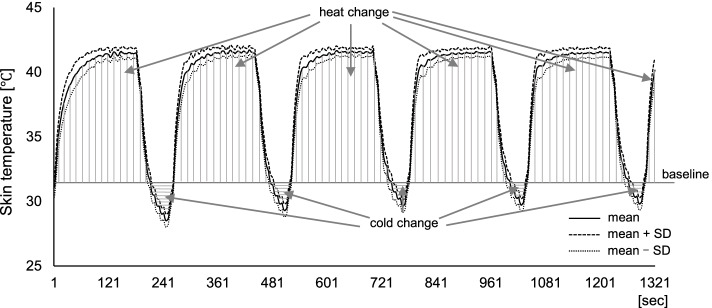
Technological innovations have allowed the use of miniature apparatus that can easily control and program heat and cold stimulations using Peltier elements. The wearable thermo-device has a potential to be applied to conventional contrast bath therapy. This study aimed to examine the effects of alternating heat and cold stimulation (HC) using a wearable thermo-device on subjective and objective improvement of shoulder stiffness.
Twenty healthy young male individuals (20.3 ± 0.6 years) participated in this study. The interventions were randomly conducted under four conditions, including HC, heat stimulation, cold stimulation, and no stimulation on their bilateral trapezius muscle, after a 30-min typing task. Each intervention was administered at least 1 week apart. The analyzed limb was the dominant arm. Muscle hardness was assessed using a portable muscle hardness meter, as well as the skin temperature over the stimulated area. After each condition, the participants were asked for feedback regarding subjective improvement in refreshed feelings, muscle stiffness, and muscle fatigue using an 11-point numerical rating scale.
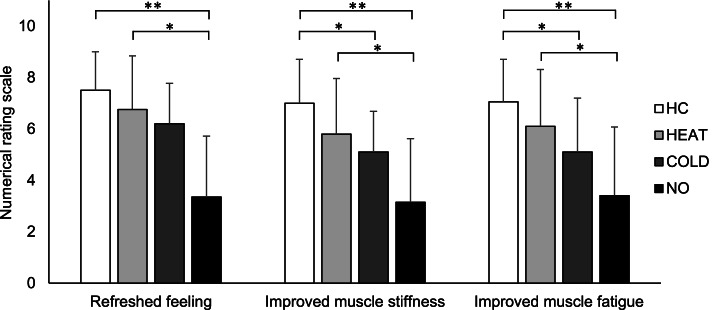
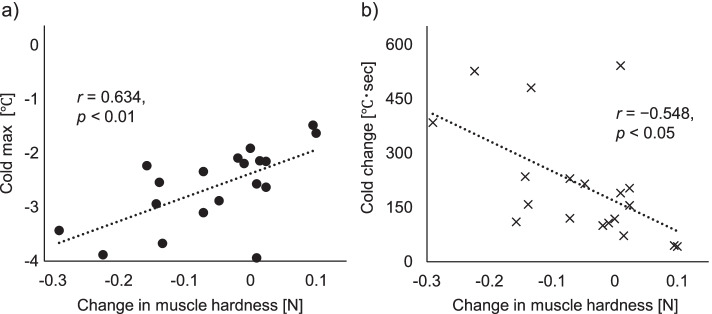
With regard to muscle hardness, only the HC condition significantly decreased from 1.43 N to 1.37 N (d = 0.44, p < 0.05). Additionally, reduced muscle hardness in HC condition was associated with the degree of skin cooling during the intervention (cold max: r = 0.634, p < 0.01; cold change: r = -0.548, p < 0.05). Subjective improvement in refreshed feelings, muscle stiffness, and muscle fatigue was determined in the HC and heat stimulation conditions compared with the no stimulation condition (p < 0.01 and p < 0.05, respectively). Moreover, the HC condition showed significantly greater improvements in muscle stiffness and fatigue compared to the cold stimulation condition (p < 0.05).
The current study demonstrated that HC promoted not only better subjective symptoms, such as muscle stiffness and fatigue, but also lesser muscle hardness. Furthermore, an association was observed between the degree of skin temperature cooling and reduced muscle hardness during HC. Further investigations on the ratio and intensity of cooling should be conducted in the future to establish the optimal HC protocol for muscle stiffness or fatigue.
UMIN000040620 . Registered 1 June 2020.
技术创新使得使用 Peltier 元件来控制和编程热和冷刺激变得更加容易,这使得微型设备得以应用。可穿戴热设备有可能应用于传统的对比浴疗法。本研究旨在探讨使用可穿戴热设备进行交替热冷刺激(HC)对肩部僵硬的主观和客观改善的影响。
20 名健康的年轻男性(20.3±0.6 岁)参与了这项研究。在 30 分钟打字任务后,随机对他们的双侧斜方肌进行 HC、热刺激、冷刺激和无刺激四种干预,每种干预至少间隔 1 周。分析的肢体是优势臂。使用便携式肌肉硬度计评估肌肉硬度,以及刺激区域的皮肤温度。在每种情况下后,参与者使用 11 点数字评分量表对刷新感、肌肉僵硬和肌肉疲劳的主观改善进行反馈。
就肌肉硬度而言,只有 HC 组从 1.43N 显著降低到 1.37N(d=0.44,p<0.05)。此外,HC 组肌肉硬度的降低与干预过程中的皮肤冷却程度有关(冷最大值:r=0.634,p<0.01;冷变化:r=-0.548,p<0.05)。与无刺激条件相比,HC 和热刺激条件下的刷新感、肌肉僵硬和肌肉疲劳的主观改善更明显(p<0.01 和 p<0.05)。此外,与冷刺激条件相比,HC 条件下肌肉僵硬和疲劳的改善更为显著(p<0.05)。
本研究表明,HC 不仅能改善肌肉僵硬和疲劳等主观症状,而且还能降低肌肉硬度。此外,在 HC 过程中观察到皮肤温度冷却程度与肌肉硬度降低之间存在关联。未来应进一步研究冷却的比例和强度,以建立用于肌肉僵硬或疲劳的最佳 HC 方案。
UMIN000040620。2020 年 6 月 1 日注册。