Leibniz Institute of Photonic Technology Jena (a Member of Leibniz Health Technologies), Albert-Einstein-Straße 9, 07745, Jena, Germany.
Institute of Physical Chemistry and Abbe Center of Photonics, Friedrich Schiller University, Helmholtzweg 4, 07743, Jena, Germany.
Anal Bioanal Chem. 2022 Feb;414(4):1481-1492. doi: 10.1007/s00216-021-03800-y. Epub 2022 Jan 4.
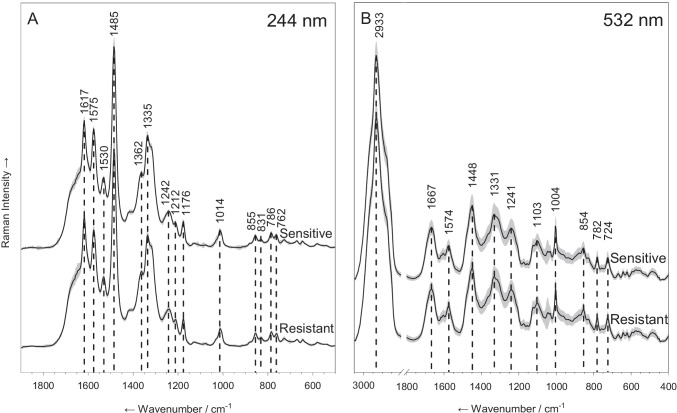
In recent years, we have seen a steady rise in the prevalence of antibiotic-resistant bacteria. This creates many challenges in treating patients who carry these infections, as well as stopping and preventing outbreaks. Identifying these resistant bacteria is critical for treatment decisions and epidemiological studies. However, current methods for identification of resistance either require long cultivation steps or expensive reagents. Raman spectroscopy has been shown in the past to enable the rapid identification of bacterial strains from single cells and cultures. In this study, Raman spectroscopy was applied for the differentiation of resistant and sensitive strains of Escherichia coli. Our focus was on clinical multi-resistant (extended-spectrum β-lactam and carbapenem-resistant) bacteria from hospital patients. The spectra were collected using both UV resonance Raman spectroscopy in bulk and single-cell Raman microspectroscopy, without exposure to antibiotics. We found resistant strains have a higher nucleic acid/protein ratio, and used the spectra to train a machine learning model that differentiates resistant and sensitive strains. In addition, we applied a majority of voting system to both improve the accuracy of our models and make them more applicable for a clinical setting. This method could allow rapid and accurate identification of antibiotic resistant bacteria, and thus improve public health.
近年来,我们看到抗生素耐药菌的患病率稳步上升。这给治疗携带这些感染的患者以及阻止和预防疫情爆发带来了许多挑战。识别这些耐药菌对于治疗决策和流行病学研究至关重要。然而,目前识别耐药性的方法要么需要长时间的培养步骤,要么需要昂贵的试剂。拉曼光谱过去已经证明能够从单个细胞和培养物中快速识别细菌株。在这项研究中,拉曼光谱被应用于区分大肠杆菌的耐药和敏感菌株。我们的重点是来自医院患者的临床多耐药(广谱β-内酰胺和碳青霉烯耐药)细菌。使用紫外线共振拉曼光谱在体和单细胞拉曼微光谱学收集光谱,而不接触抗生素。我们发现耐药菌株的核酸/蛋白质比例更高,并使用光谱来训练机器学习模型,以区分耐药和敏感菌株。此外,我们应用了多数投票系统,以提高我们模型的准确性,并使它们更适用于临床环境。这种方法可以快速准确地识别抗生素耐药菌,从而改善公共卫生。