Dopp Alex R, Gilbert Marylou, Silovsky Jane, Ringel Jeanne S, Schmidt Susan, Funderburk Beverly, Jorgensen Ashley, Powell Byron J, Luke Douglas A, Mandell David, Edwards Daniel, Blythe Mellicent, Hagele Dana
Department of Behavioral and Policy Sciences, RAND Corporation, 1776 Main Street, Santa Monica, CA, 90401, USA.
Department of Pediatrics, Division of Developmental and Behavioral Pediatrics, University of Oklahoma Health Sciences Center, 940 NE 13th Street Suite 4900, Oklahoma City, OK, 73104, USA.
Implement Sci Commun. 2022 Jan 4;3(1):1. doi: 10.1186/s43058-021-00234-6.
Sustained delivery of evidence-based treatments (EBTs) is essential to addressing the public health and economic impacts of youth mental health problems, but is complicated by the limited and fragmented funding available to youth mental health service agencies (hereafter, "service agencies"). Strategic planning tools are needed that can guide these service agencies in their coordination of sustainable funding for EBTs. This protocol describes a mixed-methods research project designed to (1) develop and (2) evaluate our novel fiscal mapping process that guides strategic planning efforts to finance the sustainment of EBTs in youth mental health services.
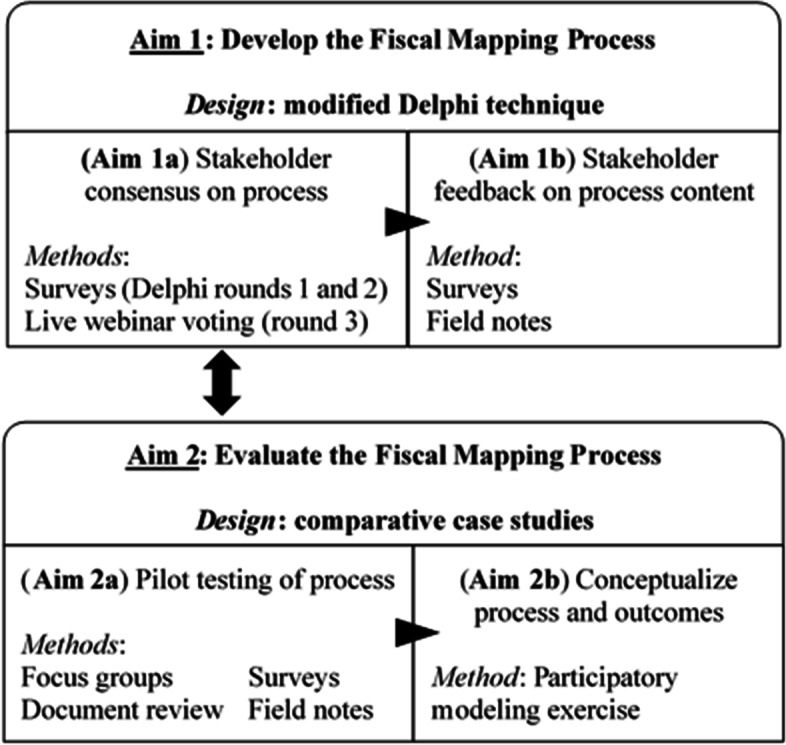
Participants will be 48 expert stakeholder participants, including representatives from ten service agencies and their partners from funding agencies (various public and private sources) and intermediary organizations (which provide guidance and support on the delivery of specific EBTs). Aim 1 is to develop the fiscal mapping process: a multi-step, structured tool that guides service agencies in selecting the optimal combination of strategies for financing their EBT sustainment efforts. We will adapt the fiscal mapping process from an established intervention mapping process and will incorporate an existing compilation of 23 financing strategies. We will then engage participants in a modified Delphi exercise to achieve consensus on the fiscal mapping process steps and gather information that can inform the selection of strategies. Aim 2 is to evaluate preliminary impacts of the fiscal mapping process on service agencies' EBT sustainment capacities (i.e., structures and processes that support sustainment) and outcomes (e.g., intentions to sustain). The ten agencies will pilot test the fiscal mapping process. We will evaluate how the fiscal mapping process impacts EBT sustainment capacities and outcomes using a comparative case study approach, incorporating data from focus groups and document review. After pilot testing, the stakeholder participants will conceptualize the process and outcomes of fiscal mapping in a participatory modeling exercise to help inform future use and evaluation of the tool.
This project will generate the fiscal mapping process, which will facilitate the coordination of an array of financing strategies to sustain EBTs in community youth mental health services. This tool will promote the sustainment of youth-focused EBTs.
持续提供循证治疗(EBTs)对于应对青少年心理健康问题对公众健康和经济的影响至关重要,但青少年心理健康服务机构(以下简称“服务机构”)可用资金有限且分散,这使得情况变得复杂。需要战略规划工具来指导这些服务机构协调EBTs的可持续资金。本方案描述了一个混合方法研究项目,旨在(1)开发并(2)评估我们新颖的财政映射过程,该过程指导战略规划工作,为青少年心理健康服务中EBTs的持续提供提供资金支持。
参与者将包括48名专家利益相关者,其中有来自十个服务机构的代表,以及来自资助机构(各种公共和私人来源)和中介组织(为特定EBTs的提供提供指导和支持)的合作伙伴。目标1是开发财政映射过程:一种多步骤、结构化的工具,指导服务机构选择为其EBTs持续提供工作融资的最佳策略组合。我们将从既定的干预映射过程中改编财政映射过程,并纳入现有的23种融资策略汇编。然后,我们将让参与者参与改进的德尔菲法练习,以就财政映射过程步骤达成共识,并收集可为策略选择提供信息的资料。目标2是评估财政映射过程对服务机构EBTs持续提供能力(即支持持续提供的结构和流程)和结果(如持续提供的意图)的初步影响。这十个机构将对财政映射过程进行试点测试。我们将使用比较案例研究方法评估财政映射过程如何影响EBTs持续提供能力和结果,纳入焦点小组和文件审查的数据。试点测试后,利益相关者参与者将在参与式建模练习中对财政映射的过程和结果进行概念化,以帮助为该工具的未来使用和评估提供信息。
本项目将产生财政映射过程,这将有助于协调一系列融资策略,以维持社区青少年心理健康服务中的EBTs。该工具将促进以青少年为重点的EBTs的持续提供。