Aarons Gregory A, Green Amy E, Willging Cathleen E, Ehrhart Mark G, Roesch Scott C, Hecht Debra B, Chaffin Mark J
Department of Psychiatry, University of California, La Jolla, San Diego, CA, USA.
Pacific Institute for Research and Evaluation, Albuquerque, NM, USA.
Implement Sci. 2014 Dec 10;9:183. doi: 10.1186/s13012-014-0183-z.
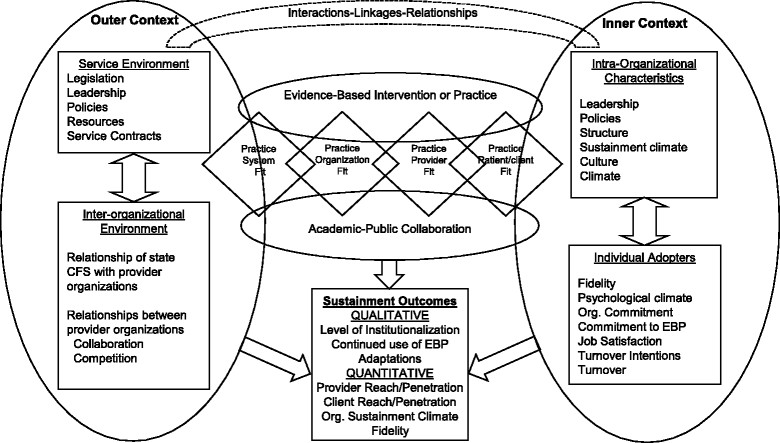
This study examines sustainment of an EBI implemented in 11 United States service systems across two states, and delivered in 87 counties. The aims are to 1) determine the impact of state and county policies and contracting on EBI provision and sustainment; 2) investigate the role of public, private, and academic relationships and collaboration in long-term EBI sustainment; 3) assess organizational and provider factors that affect EBI reach/penetration, fidelity, and organizational sustainment climate; and 4) integrate findings through a collaborative process involving the investigative team, consultants, and system and community-based organization (CBO) stakeholders in order to further develop and refine a conceptual model of sustainment to guide future research and provide a resource for service systems to prepare for sustainment as the ultimate goal of the implementation process.
A mixed-method prospective and retrospective design will be used. Semi-structured individual and group interviews will be used to collect information regarding influences on EBI sustainment including policies, attitudes, and practices; organizational factors and external policies affecting model implementation; involvement of or collaboration with other stakeholders; and outer- and inner-contextual supports that facilitate ongoing EBI sustainment. Document review (e.g., legislation, executive orders, regulations, monitoring data, annual reports, agendas and meeting minutes) will be used to examine the roles of state, county, and local policies in EBI sustainment. Quantitative measures will be collected via administrative data and web surveys to assess EBI reach/penetration, staff turnover, EBI model fidelity, organizational culture and climate, work attitudes, implementation leadership, sustainment climate, attitudes toward EBIs, program sustainment, and level of institutionalization. Hierarchical linear modeling will be used for quantitative analyses. Qualitative analyses will be tailored to each of the qualitative methods (e.g., document review, interviews). Qualitative and quantitative approaches will be integrated through an inclusive process that values stakeholder perspectives.
The study of sustainment is critical to capitalizing on and benefiting from the time and fiscal investments in EBI implementation. Sustainment is also critical to realizing broad public health impact of EBI implementation. The present study takes a comprehensive mixed-method approach to understanding sustainment and refining a conceptual model of sustainment.
本研究考察了在两个州的11个美国服务系统中实施并覆盖87个县的循证干预措施(EBI)的持续性。目标如下:1)确定州和县级政策及合同对循证干预措施的提供和持续性的影响;2)调查公共、私人和学术关系与合作在循证干预措施长期持续性中的作用;3)评估影响循证干预措施覆盖范围/渗透率、保真度以及组织持续性氛围的组织和提供者因素;4)通过一个涉及调查团队、顾问以及系统和社区组织(CBO)利益相关者的协作过程整合研究结果,以便进一步开发和完善一个持续性概念模型,以指导未来研究,并为服务系统提供一种资源,将持续性作为实施过程的最终目标来进行准备。
将采用混合方法的前瞻性和回顾性设计。使用半结构化的个人和小组访谈来收集有关循证干预措施持续性影响的信息,包括政策、态度和实践;影响模型实施的组织因素和外部政策;与其他利益相关者的参与或合作;以及促进循证干预措施持续实施的外部和内部背景支持。文件审查(例如,立法、行政命令、法规、监测数据、年度报告、议程和会议记录)将用于研究州、县和地方政策在循证干预措施持续性中的作用。将通过行政数据和网络调查收集定量指标,以评估循证干预措施的覆盖范围/渗透率、员工流动率、循证干预措施模型保真度、组织文化和氛围、工作态度、实施领导力、持续性氛围、对循证干预措施的态度、项目持续性以及制度化水平。将使用分层线性模型进行定量分析。定性分析将根据每种定性方法(例如,文件审查、访谈)进行调整。定性和定量方法将通过一个重视利益相关者观点的包容性过程进行整合。
持续性研究对于利用循证干预措施实施中的时间和财政投资并从中受益至关重要。持续性对于实现循证干预措施实施的广泛公共卫生影响也至关重要。本研究采用全面的混合方法来理解持续性并完善持续性概念模型。