Department of Radiotherapy, Changzhou Second People's Hospital, Nanjing Medical University, Changzhou, China.
Laboratory of Medical Physics Center, Nanjing Medical University, Jiangning District, Nanjing, China.
J Appl Clin Med Phys. 2022 Mar;23(3):e13516. doi: 10.1002/acm2.13516. Epub 2022 Jan 5.
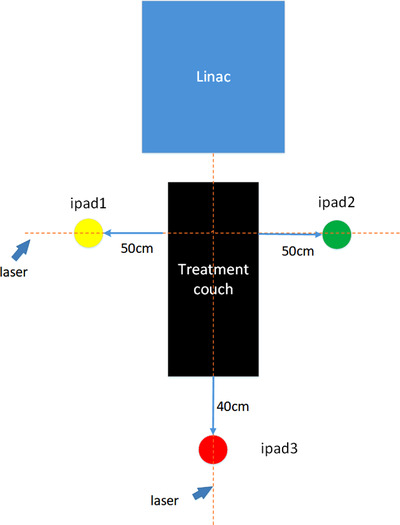
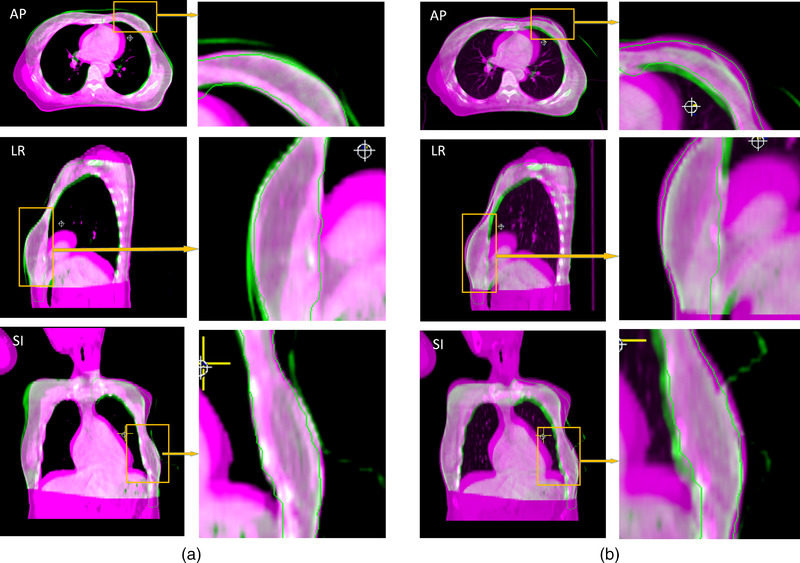
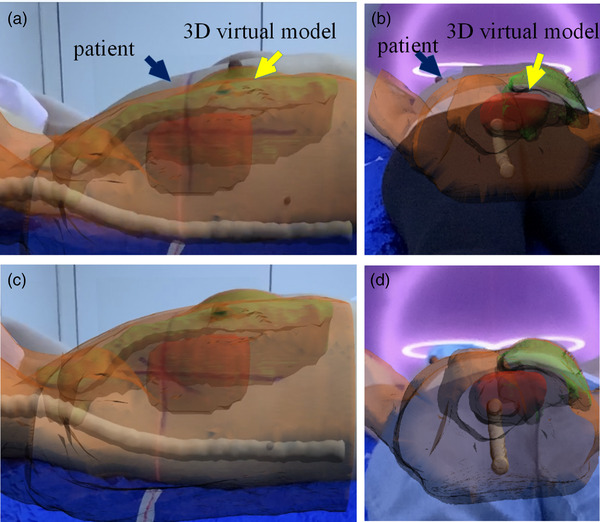
In modern radiotherapy, error reduction in the patients' daily setup error is important for achieving accuracy. In our study, we proposed a new approach for the development of an assist system for the radiotherapy position setup by using augmented reality (AR). We aimed to improve the accuracy of the position setup of patients undergoing radiotherapy and to evaluate the error of the position setup of patients who were diagnosed with head and neck cancer, and that of patients diagnosed with chest and abdomen cancer. We acquired the patient's simulation CT data for the three-dimensional (3D) reconstruction of the external surface and organs. The AR tracking software detected the calibration module and loaded the 3D virtual model. The calibration module was aligned with the Linac isocenter by using room lasers. And then aligned the virtual cube with the calibration module to complete the calibration of the 3D virtual model and Linac isocenter. Then, the patient position setup was carried out, and point cloud registration was performed between the patient and the 3D virtual model, such the patient's posture was consistent with the 3D virtual model. Twenty patients diagnosed with head and neck cancer and 20 patients diagnosed with chest and abdomen cancer in the supine position setup were analyzed for the residual errors of the conventional laser and AR-guided position setup. Results show that for patients diagnosed with head and neck cancer, the difference between the two positioning methods was not statistically significant (P > 0.05). For patients diagnosed with chest and abdomen cancer, the residual errors of the two positioning methods in the superior and inferior direction and anterior and posterior direction were statistically significant (t = -5.80, -4.98, P < 0.05). The residual errors in the three rotation directions were statistically significant (t = -2.29 to -3.22, P < 0.05). The experimental results showed that the AR technology can effectively assist in the position setup of patients undergoing radiotherapy, significantly reduce the position setup errors in patients diagnosed with chest and abdomen cancer, and improve the accuracy of radiotherapy.
在现代放射治疗中,减少患者日常摆位误差对于实现准确性非常重要。在我们的研究中,我们提出了一种利用增强现实(AR)开发放射治疗摆位辅助系统的新方法。我们旨在提高接受放射治疗的患者的摆位准确性,并评估诊断为头颈部癌症和胸部及腹部癌症患者的摆位误差。我们获取了患者的模拟 CT 数据,以便对外部表面和器官进行三维(3D)重建。AR 跟踪软件检测校准模块并加载 3D 虚拟模型。使用房间激光将校准模块与直线加速器等中心对齐。然后将虚拟立方体与校准模块对齐,以完成 3D 虚拟模型和直线加速器等中心的校准。然后,进行患者摆位,并在患者和 3D 虚拟模型之间执行点云配准,使得患者的姿势与 3D 虚拟模型一致。对 20 例诊断为头颈部癌症的仰卧位患者和 20 例诊断为胸部及腹部癌症的仰卧位患者的常规激光和 AR 引导摆位的残余误差进行分析。结果表明,对于诊断为头颈部癌症的患者,两种定位方法的差异无统计学意义(P>0.05)。对于诊断为胸部及腹部癌症的患者,两种定位方法在上下方向和前后方向的残余误差有统计学意义(t=-5.80,-4.98,P<0.05)。三个旋转方向的残余误差有统计学意义(t=-2.29 至-3.22,P<0.05)。实验结果表明,AR 技术可以有效地辅助放射治疗患者的摆位,显著降低诊断为胸部及腹部癌症患者的摆位误差,提高放射治疗的准确性。