Department of Medicine, University of Alberta, Edmonton, AB, Canada.
Universitat Jaume I, Perinatal Epidemiology, Environmental Health and Clinical Research, School of Medicine, Castellon, Spain; ISGlobal Barcelona Institute for Global Health, Barcelona Biomedical Research Park, Barcelona, Spain; Environmental Research Group, MRC Centre for Environment and Health, Imperial College London, United Kingdom; Division of Environmental Health & Risk Management, School of Geography, Earth & Environmental Sciences, University of Birmingham, Birmingham, United Kingdom.
Sci Total Environ. 2022 Mar 25;814:152832. doi: 10.1016/j.scitotenv.2021.152832. Epub 2022 Jan 2.
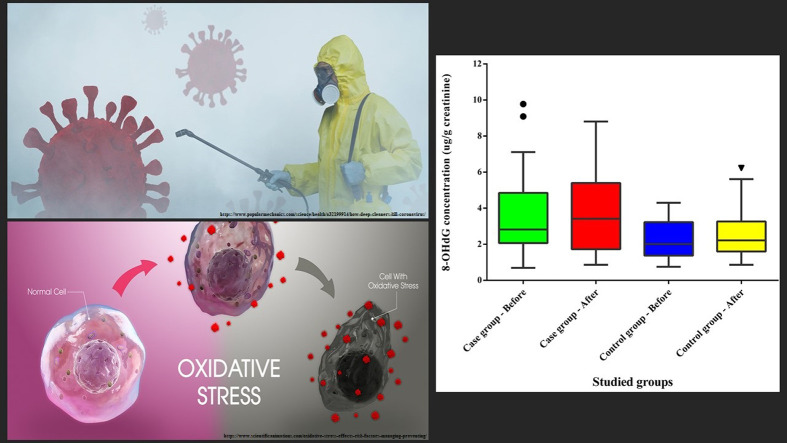
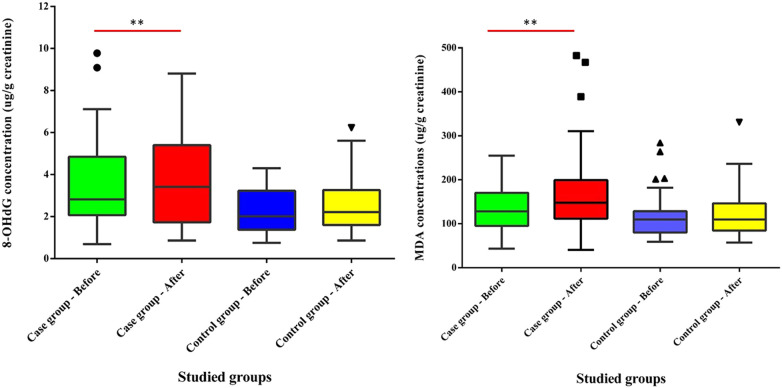
Individuals who get involved in the disinfection of public settings using sodium hypochlorite might suffer adverse health effects. However, scarce information is available on the potential oxidative stress damage caused at low concentrations typically used for disinfection. We aimed to assess whether exposure to sodium hypochlorite during the COVID-19 pandemic causes oxidative stress damage in workers engaged in disinfection tasks. 75 operators engaged in the disinfection of public places were recruited as the case group, and 60 individuals who were not exposed to disinfectant were chosen as the control group. Spot urine samples were collected before (BE) and after exposure (AE) to disinfectants in the case group. Likewise, controls provided two spot urine samples in the same way as the case group. Urinary malondialdehyde (MDA) levels were quantified by forming thiobarbituric acid reactive substances in the urine. In addition, the concentration of 8-hydroxy-2'-deoxyguanosine (8-OHdG) in the urine was determined using an ELISA kit. Results showed significant differences in the urinary levels of oxidative stress markers, where median 8-OHdG (AE case: 3.84 ± 2.89 μg/g creatinine vs AE control 2.54 ± 1.21 μg/g creatinine) and MDA (AE case: 169 ± 89 μg/g creatinine vs AE control 121 ± 47 μg/g creatinine) levels in case group AE samples were 1.55 and 1.35-times higher than the control group AE samples (P < 0.05), respectively. Besides, urinary levels of oxidative stress markers in AE samples of the case group were significantly higher than in BE samples (8-OHdG BE 3.40 ± 1.95 μg/g creatinine, MDA BE 136 ± 51.3 μg/g creatinine, P < 0.05). Our results indicated that exposure to even low levels of sodium hypochlorite used in disinfection practices might cause oxidative stress related damage. With this in mind, implementing robust protective measures, such as specific respirators, is crucial to reduce the health burdens of exposure to disinfectants.
从事次氯酸钠公共环境消毒工作的个体可能会遭受健康损害。然而,针对通常用于消毒的低浓度次氯酸钠可能导致的潜在氧化应激损伤,相关信息却十分有限。本研究旨在评估新冠疫情期间,从事消毒工作的个体接触次氯酸钠是否会导致氧化应激损伤。我们招募了 75 名从事公共场所消毒工作的操作人员作为病例组,并选择了 60 名未接触消毒剂的个体作为对照组。病例组在接触(AE)和未接触(BE)消毒剂前后采集尿样。同样,对照组也以与病例组相同的方式提供了两份尿样。通过尿液中形成的硫代巴比妥酸反应物来定量测定尿液中丙二醛(MDA)水平。此外,还使用 ELISA 试剂盒测定尿液中 8-羟基-2'-脱氧鸟苷(8-OHdG)的浓度。结果显示,氧化应激标志物的尿液水平存在显著差异,病例组 AE 样本中 8-OHdG(AE 病例:3.84±2.89μg/g 肌酐 vs AE 对照:2.54±1.21μg/g 肌酐)和 MDA(AE 病例:169±89μg/g 肌酐 vs AE 对照:121±47μg/g 肌酐)中位数水平分别是对照组 AE 样本的 1.55 倍和 1.35 倍(P<0.05)。此外,病例组 AE 样本的氧化应激标志物尿液水平显著高于 BE 样本(8-OHdG BE 3.40±1.95μg/g 肌酐,MDA BE 136±51.3μg/g 肌酐,P<0.05)。我们的研究结果表明,即使接触低水平的次氯酸钠用于消毒实践也可能导致与氧化应激相关的损伤。因此,实施强有力的防护措施,如专用呼吸防护器,对于减轻消毒剂暴露的健康负担至关重要。