Okella Hedmon, Ikiriza Hilda, Ochwo Sylvester, Ajayi Clement Olusoji, Ndekezi Christian, Nkamwesiga Joseph, Kaggwa Bruhan, Aber Jacqueline, Mtewa Andrew Glory, Koffi Tindo Kevin, Odongo Steven, Vertommen Didier, Kato Charles Drago, Ogwang Patrick Engeu
Pharm-Biotechnology and Traditional Medicine Centre, Mbarara University of Science and Technology, Mbarara, Uganda.
Department of Biotechnical and Diagnostic Sciences, College of Veterinary Medicine Animal Resources and Biosecurity, Makerere University, Kampala, Uganda.
Front Microbiol. 2021 Dec 20;12:794631. doi: 10.3389/fmicb.2021.794631. eCollection 2021.
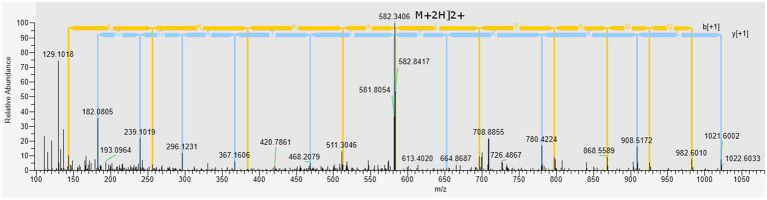
Antimicrobial peptides (AMPs) constitute a broad range of bioactive compounds in diverse organisms, including fish. They are effector molecules for the innate immune response, against pathogens, tissue damage and infections. Still, AMPs from African Catfish, , skin mucus are largely unexplored despite their possible therapeutic role in combating antimicrobial resistance. In this study, African Catfish Antimicrobial peptides (ACAPs) were identified from the skin mucus of African Catfish, . Native peptides were extracted from fish mucus scrapings in 10% acetic acid (v/v) and ultra-filtered using 5 kDa molecular weight cut-off membrane. The extract was purified using C Solid-Phase Extraction. The antibacterial activity was determined using the Agar Well Diffusion method and broth-dilution method utilizing (ATCC 25923) and (ATCC 25922). Thereafter, Sephadex G-25 gel filtration was further utilized in bio-guided isolation of the most active fractions prior to peptide identification using Orbitrap Fusion Lumos Tribrid Mass Spectrometry. The skin mucus extracted from African Catfish from all the three major lakes of Uganda exhibited antimicrobial activity on and . Lake Albert's demonstrated the best activity with the lowest MIC of 2.84 and 0.71 μg/ml on and , respectively. Sephadex G-25 peak I mass spectrometry analysis (Data are available ProteomeXchange with identifier PXD029193) alongside analysis revealed seven short peptides (11-16 amino acid residues) of high antimicrobial scores (0.561-0.905 units). In addition, these peptides had a low molecular weight (1005.57-1622.05 Da) and had percentage hydrophobicity above 54%. Up to four of these AMPs demonstrated α-helix structure conformation, rendering them amphipathic. The findings of this study indicate that novel AMPs can be sourced from the skin mucus of . Such AMPs are potential alternatives to the traditional antibiotics and can be of great application to food and pharmaceutical industries; however, further studies are still needed to establish their drug-likeness and safety profiles.
抗菌肽(AMPs)是包括鱼类在内的多种生物体内广泛存在的一类生物活性化合物。它们是先天性免疫反应的效应分子,可抵抗病原体、组织损伤和感染。尽管非洲鲶鱼皮肤黏液中的抗菌肽在对抗抗菌耐药性方面可能具有治疗作用,但在很大程度上仍未得到充分研究。在本研究中,从非洲鲶鱼的皮肤黏液中鉴定出了非洲鲶鱼抗菌肽(ACAPs)。将天然肽从鱼黏液刮取物中用10%乙酸(v/v)提取,并用截留分子量为5 kDa的膜进行超滤。提取物通过C18固相萃取进行纯化。使用琼脂孔扩散法和肉汤稀释法,以金黄色葡萄球菌(ATCC 25923)和大肠杆菌(ATCC 25922)测定抗菌活性。此后,在使用Orbitrap Fusion Lumos Tribrid质谱仪进行肽鉴定之前,进一步利用Sephadex G - 25凝胶过滤对活性最高的组分进行生物导向分离。从乌干达所有三个主要湖泊的非洲鲶鱼提取的皮肤黏液对金黄色葡萄球菌和大肠杆菌均表现出抗菌活性。阿尔伯特湖的提取物表现出最佳活性,对金黄色葡萄球菌和大肠杆菌的最低抑菌浓度分别为2.84和0.71μg/ml。Sephadex G - 25峰I质谱分析(数据可在ProteomeXchange上获取,标识符为PXD029193)以及串联质谱分析揭示了7种具有高抗菌分数(0.561 - 0.905单位)的短肽(11 - 16个氨基酸残基)。此外,这些肽分子量低(1005.57 - 1622.05 Da),疏水性百分比高于54%。其中多达四种抗菌肽呈现α - 螺旋结构构象,使其具有两亲性。本研究结果表明,可以从非洲鲶鱼的皮肤黏液中获取新型抗菌肽。此类抗菌肽是传统抗生素的潜在替代品,在食品和制药行业具有巨大应用潜力;然而,仍需要进一步研究以确定它们的类药性和安全性。