MOE Key Laboratory of High Performance Polymer Materials and Technology, Department of Polymer Science & Engineering, College of Chemistry & Chemical Engineering, Nanjing University, Nanjing, 210023, P. R. China.
Key Laboratory for Organic Electronics and Information Displays & Jiangsu Key Laboratory for Biosensors, Institute of Advanced Materials (IAM), Jiangsu National Synergetic Innovation Center for Advanced Materials (SICAM), Nanjing University of Posts & Telecommunications, Nanjing, 210023, P. R. China.
Adv Sci (Weinh). 2022 Feb;9(6):e2104125. doi: 10.1002/advs.202104125. Epub 2022 Jan 6.
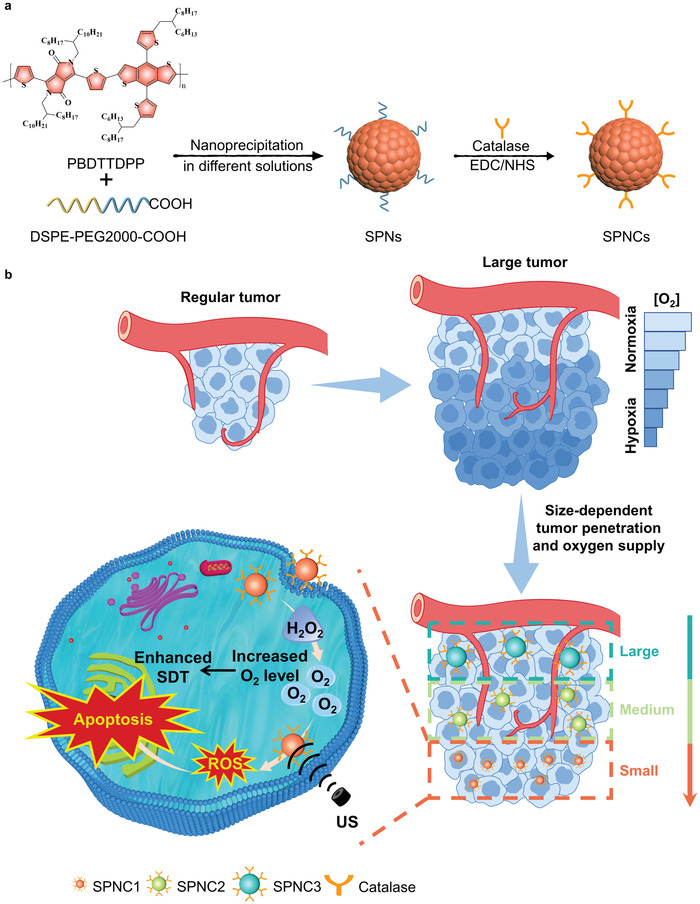
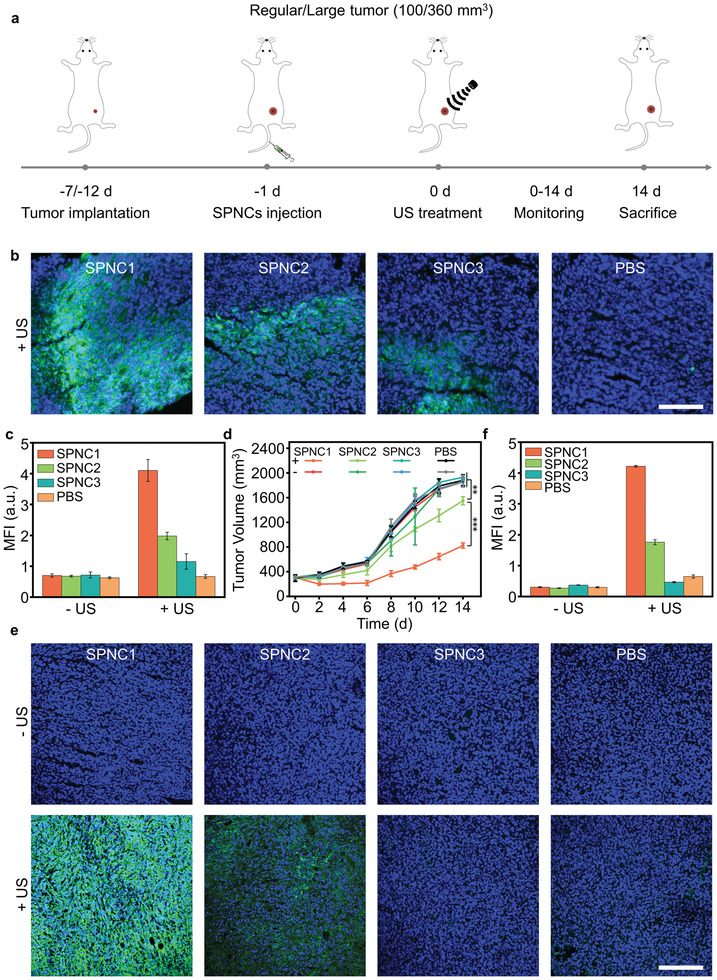
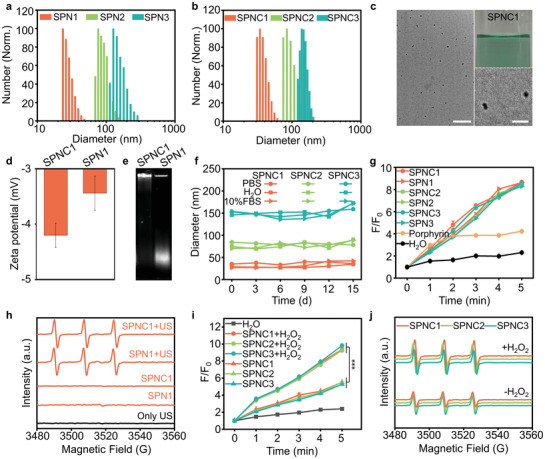
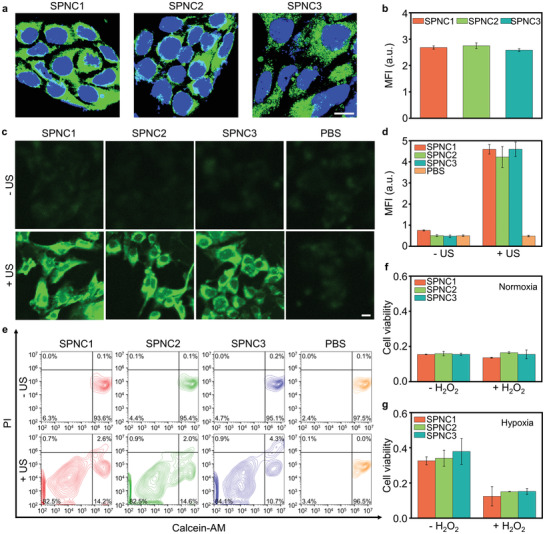
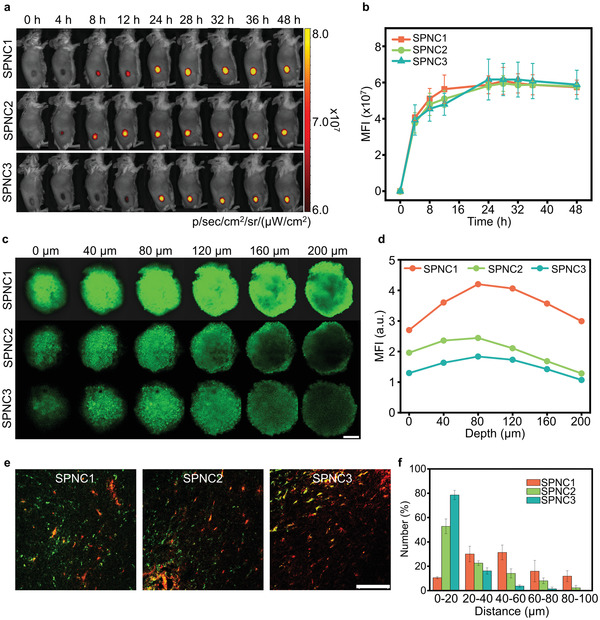
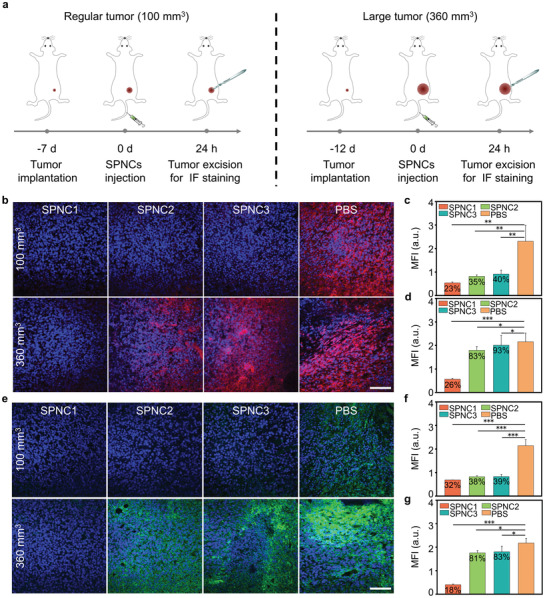
Sonodynamic therapy (SDT) holds growing promise in deep-seated or large solid tumor treatment owing to its high tissue penetration depth ability; however, its therapeutic efficacy is often compromised due to the hypopermeable and hypoxic characteristics in the tumor milieu. Herein, a semiconducting polymer nanoparticle (SPNC) that synergistically enhances tumor penetration and alleviates tumor hypoxia is reported for sonodynamic therapy of large solid tumors. SPNC comprises a semiconducting polymer nanoparticle core as a sonodynamic converter coated with a poly (ethylene glycol) corona. An oxygen-modulating enzyme, catalase, is efficiently conjugated to the surface of nanoparticles via the coupling reaction. Superior to its counterpart SPNCs (SPNC2 (84 nm) and SPNC3 (134 nm)), SPNC with the smallest size (SPNC1 (35 nm)) can efficiently penetrate throughout the tumor interstitium to alleviate whole tumor hypoxia in a large solid tumor model. Upon ultrasound (US) irradiation, SPNC1 can remotely generate sufficient singlet oxygen to eradicate tumor cells at a deep-tissue depth. Such a single treatment of SPNC1-medicated sonodynamic therapy effectively inhibits tumor growth in a large solid tumor mouse model. Therefore, this study provides a generalized strategy to synergistically overcome both poor penetration and hypoxia of large tumors for enhanced cancer treatment.
声动力学疗法(SDT)由于其具有较高的组织穿透深度能力,在深部或大型实体瘤治疗中具有广阔的应用前景;然而,由于肿瘤微环境中低通透性和缺氧的特点,其治疗效果往往受到影响。本文报道了一种半导体聚合物纳米粒子(SPNC),它可以协同增强肿瘤穿透性并缓解肿瘤缺氧,从而用于大型实体瘤的声动力学治疗。SPNC 由半导体聚合物纳米颗粒核作为声动力学转换器组成,表面包覆聚乙二醇冠。通过偶联反应,将氧调节酶过氧化氢酶有效地连接到纳米颗粒表面。与对照的 SPNC(SPNC2(84nm)和 SPNC3(134nm)相比)相比,尺寸最小的 SPNC(SPNC1(35nm))能够有效地穿透整个肿瘤间质,从而缓解大型实体瘤模型中的整个肿瘤缺氧。超声(US)照射后,SPNC1 可以远程产生足够的单线态氧来消灭深部组织中的肿瘤细胞。SPNC1 介导的声动力学治疗单次治疗就能有效抑制大型实体瘤小鼠模型中的肿瘤生长。因此,本研究为协同克服大型肿瘤的低通透性和缺氧提供了一种通用策略,以增强癌症治疗效果。