Department of Biostatistics, Institute of Basic Medical Sciences, University of Oslo, Oslo, Norway; Parasites and Microbes, Wellcome Sanger Institute, Cambridge, UK.
Department of Health Security, Finnish Institute for Health and Welfare (THL), Helsinki, Finland.
Vaccine. 2022 Feb 11;40(7):1054-1060. doi: 10.1016/j.vaccine.2021.10.046. Epub 2022 Jan 5.
Pneumococcal disease outbreaks of vaccine preventable serotype 4 sequence type (ST)801 in shipyards have been reported in several countries. We aimed to use genomics to establish any international links between them.
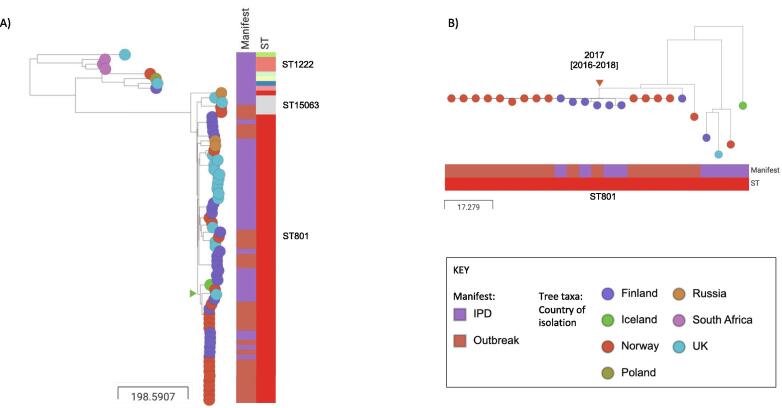
Sequence data from ST801-related outbreak isolates from Norway (n = 17), Finland (n = 11) and Northern Ireland (n = 2) were combined with invasive pneumococcal disease surveillance from the respective countries, and ST801-related genomes from an international collection (n = 41 of > 40,000), totalling 106 genomes. Raw data were mapped and recombination excluded before phylogenetic dating.
Outbreak isolates were relatively diverse, with up to 100 SNPs (single nucleotide polymorphisms) and a common ancestor estimated around the year 2000. However, 19 Norwegian and Finnish isolates were nearly indistinguishable (0-2 SNPs) with the common ancestor dated around 2017.
The total diversity of ST801 within the outbreaks could not be explained by recent transmission alone, suggesting that harsh environmental and associated living conditions reported in the shipyards may facilitate invasion of colonising pneumococci. However, near identical strains in the Norwegian and Finnish outbreaks does suggest that transmission between international shipyards also contributed to those outbreaks. This indicates the need for improved preventative measures in this working population including pneumococcal vaccination.
已在多个国家报告了船厂中可通过疫苗预防的血清型 4 序列型(ST)801 肺炎球菌病暴发。我们旨在使用基因组学方法确定它们之间是否存在任何国际联系。
将挪威(n=17)、芬兰(n=11)和北爱尔兰(n=2)与 ST801 相关的暴发分离株的序列数据与各自国家的侵袭性肺炎球菌病监测数据相结合,并将国际收集的与 ST801 相关的基因组(n=41/>40000)与 106 个基因组相结合。在进行系统发育定年之前,先对原始数据进行映射和排除重组。
暴发分离株具有相对多样性,最多有 100 个单核苷酸多态性(SNPs),共同祖先估计在 2000 年左右。然而,19 株挪威和芬兰的分离株几乎无法区分(0-2 个 SNPs),其共同祖先可追溯到 2017 年左右。
暴发中 ST801 的总多样性不能仅用近期传播来解释,这表明船厂中报道的恶劣环境和相关生活条件可能有助于定植肺炎球菌的侵袭。然而,在挪威和芬兰暴发中几乎相同的菌株确实表明,国际船厂之间的传播也促成了这些暴发。这表明需要为该工作人群(包括肺炎球菌疫苗接种)改进预防措施。