Faculty of Biology, Medicine and Health, The University of Manchester, Manchester, M13 9PT, UK.
Sci Rep. 2022 Jan 7;12(1):174. doi: 10.1038/s41598-021-03642-9.
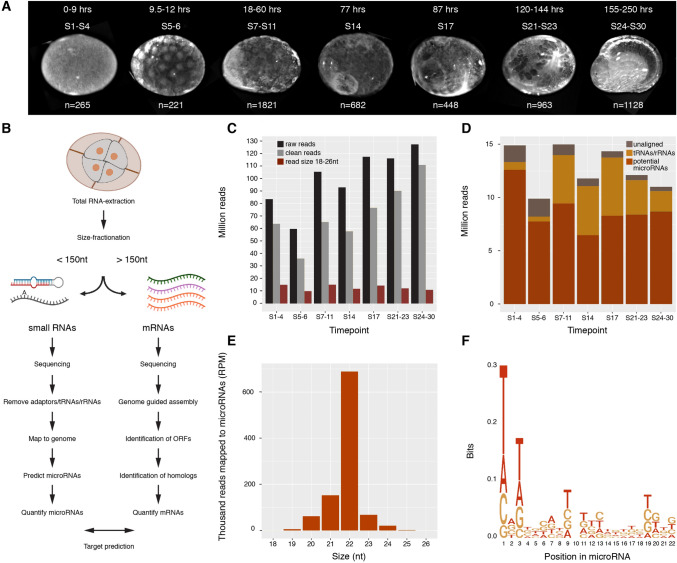
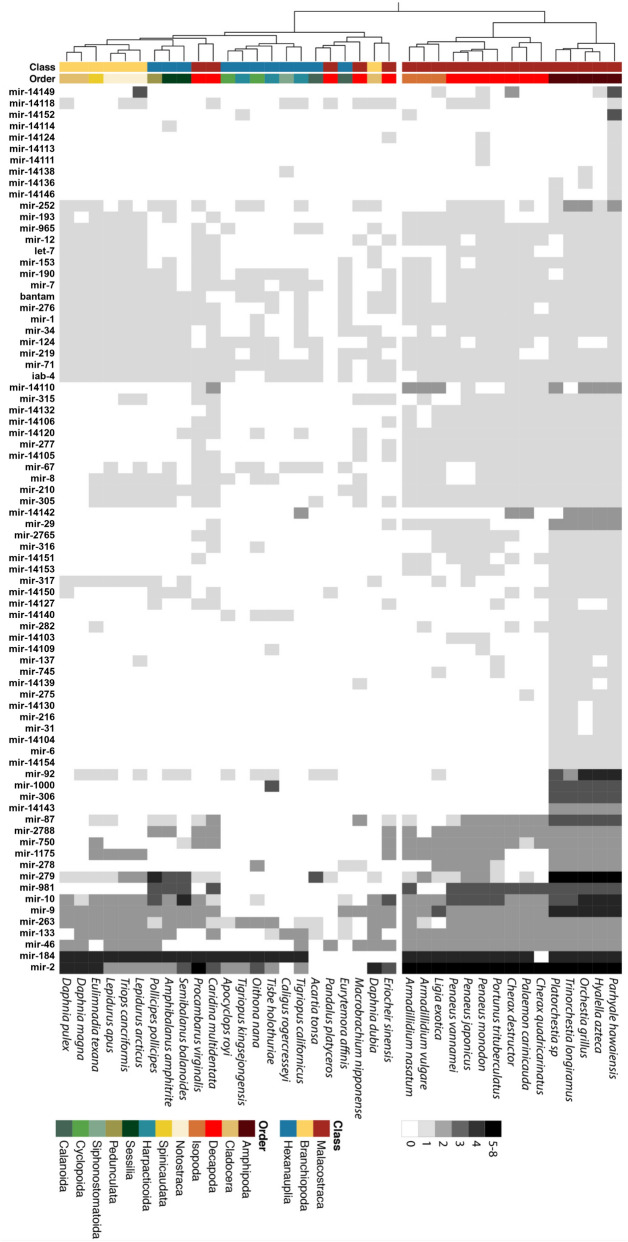
Parhyale hawaiensis has emerged as the crustacean model of choice due to its tractability, ease of imaging, sequenced genome, and development of CRISPR/Cas9 genome editing tools. However, transcriptomic datasets spanning embryonic development are lacking, and there is almost no annotation of non-protein-coding RNAs, including microRNAs. We have sequenced microRNAs, together with mRNAs and long non-coding RNAs, in Parhyale using paired size-selected RNA-seq libraries at seven time-points covering important transitions in embryonic development. Focussing on microRNAs, we annotate 175 loci in Parhyale, 88 of which have no known homologs. We use these data to annotate the microRNAome of 37 crustacean genomes, and suggest a core crustacean microRNA set of around 61 sequence families. We examine the dynamic expression of microRNAs and mRNAs during the maternal-zygotic transition. Our data suggest that zygotic genome activation occurs in two waves in Parhyale with microRNAs transcribed almost exclusively in the second wave. Contrary to findings in other arthropods, we do not predict a general role for microRNAs in clearing maternal transcripts. These data significantly expand the available transcriptomics resources for Parhyale, and facilitate its use as a model organism for the study of small RNAs in processes ranging from embryonic development to regeneration.
夏威夷等足目动物由于其易于处理、成像方便、基因组测序以及 CRISPR/Cas9 基因组编辑工具的发展,已成为甲壳类动物的首选模式生物。然而,缺乏涵盖胚胎发育的转录组数据集,几乎没有非编码 RNA(包括 microRNA)的注释。我们使用配对的大小选择 RNA-seq 文库,在七个时间点对 Parhyale 的 microRNA、mRNA 和长非编码 RNA 进行测序,这些时间点涵盖了胚胎发育中的重要转变。我们专注于 microRNA,在 Parhyale 中注释了 175 个基因座,其中 88 个没有已知的同源物。我们使用这些数据注释了 37 个甲壳类动物基因组的 microRNA 组,并提出了大约 61 个序列家族的核心甲壳类动物 microRNA 组。我们研究了 microRNAs 和 mRNAs 在母-合子过渡期间的动态表达。我们的数据表明,Parhyale 中的合子基因组激活分两波发生,microRNA 几乎仅在第二波中转录。与其他节肢动物的发现相反,我们不预测 microRNAs 在清除母体转录本方面的一般作用。这些数据极大地扩展了 Parhyale 可用的转录组学资源,并促进了其作为从小胚胎发育到再生等过程中小 RNA 研究模型的使用。