Li Xin, Li Hui-Yao, Yu Zi-Wei, Zhang Yi-Tong, Tong Xue-Wei, Gao Xin-Yuan
The First Affiliated Hospital of Harbin Medical University, Harbin, Heilongjiang, 150001, People's Republic of China.
Diabetes Metab Syndr Obes. 2021 Dec 29;14:4971-4979. doi: 10.2147/DMSO.S348195. eCollection 2021.
Obesity often coexists with diabetes, especially abdominal obesity, recognized as a risk factor for diabetic complications. Diabetic retinopathy (DR), as one of the most common microvascular complications of diabetes, may be associated with these indices. Lipid accumulation product (LAP) and Chinese visceral obesity index (CVAI) are novel visceral obesity indicators, which have been proven to be an influential factor predicting type 2 diabetes (T2DM). However, the correlation among LAP, CVAI, and DR still lacks systematic research in T2DM. The study aimed to explore the relationship among LAP, CVAI levels in different DR stages of T2DM patients and the diagnostic efficacy of LAP and CVAI for DR.
A total of 263 participants were recruited in this cross-sectional study. We enrolled 169 patients with T2DM, divided into the non-DR group (NDR, n = 61), non-proliferative DR group (NPDR, n = 55), and proliferative DR group (PDR, n = 53). And we also enrolled 94 healthy control participants. We collected demographic, anthropometric, and biochemical data on each subject. LAP and CVAI are calculated according to different formulas for men and women.
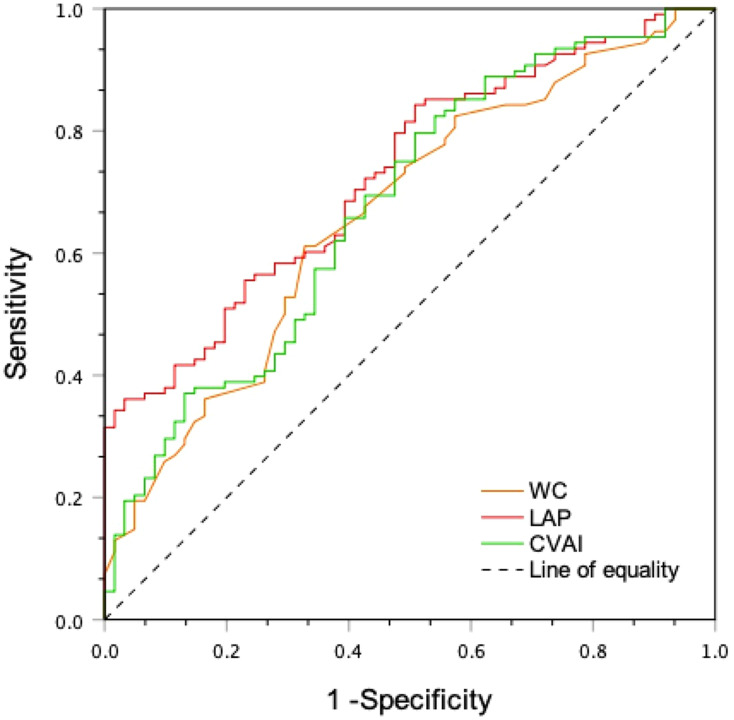
Compared with the control group, LAP and CVAI were significantly higher (P < 0.05). After adjusting for confounding factors, LAP (OR: 1.029, 95CI%: 1.010-1.049, P < 0.05), WC (OR: 1.073, 95CI%: 1.009-1.141, P < 0.05) and CVAI (OR: 1.017, 95CI%: 1.000-1.033, P < 0.05) were all associated with an increased risk of DR. Furthermore, increased LAP (OR: 1.020, 95% CI: 0.100-0.290) is associated with DR severity (P < 0.001). Moreover, the LAP had the most significant area under the receiver operating characteristics (ROC) curve (AUC) (AUC = 0.728, 95% CI: 0.653-0.804).
A high LAP is associated with an increased risk of DR in T2DM patients, and the LAP index appears to be a good predictor of DR risk and severity in patients with T2DM, compared with BMI, WC, and CVAI.
肥胖常与糖尿病并存,尤其是腹型肥胖,被认为是糖尿病并发症的危险因素。糖尿病视网膜病变(DR)作为糖尿病最常见的微血管并发症之一,可能与这些指标相关。脂质蓄积产物(LAP)和中国内脏肥胖指数(CVAI)是新的内脏肥胖指标,已被证明是预测2型糖尿病(T2DM)的一个影响因素。然而,LAP、CVAI与DR之间的相关性在T2DM中仍缺乏系统研究。本研究旨在探讨T2DM患者不同DR阶段的LAP、CVAI水平及其对DR的诊断效能之间的关系。
本横断面研究共纳入263名参与者。我们招募了169例T2DM患者,分为非DR组(NDR,n = 61)、非增殖性DR组(NPDR,n = 55)和增殖性DR组(PDR,n = 53)。我们还招募了94名健康对照参与者。我们收集了每个受试者的人口统计学、人体测量学和生化数据。LAP和CVAI根据不同的男女公式计算。
与对照组相比,LAP和CVAI显著更高(P < 0.05)。在调整混杂因素后,LAP(比值比:1.029,95%置信区间:1.010 - 1.049,P < 0.05)、腰围(比值比:1.073,95%置信区间:1.009 - 1.141,P < 0.05)和CVAI(比值比:1.017,95%置信区间:1.000 - 1.033,P < 0.05)均与DR风险增加相关。此外,LAP升高(比值比:1.020,95%置信区间:0.100 - 0.290)与DR严重程度相关(P < 0.001)。此外,LAP在受试者工作特征(ROC)曲线下面积(AUC)最大(AUC = 0.728,95%置信区间:0.653 - 0.804)。
高LAP与T2DM患者DR风险增加相关,与体重指数、腰围和CVAI相比,LAP指数似乎是T2DM患者DR风险和严重程度的良好预测指标。