Jian Zhongyu, Wang Menghua, Jin Xi, Wei Xin
Department of Urology, Institute of Urology (Laboratory of Reconstructive Urology), West China Hospital, Sichuan University, Chengdu, China.
West China Biomedical Big Data Center, Sichuan University, Chengdu, China.
Front Public Health. 2021 Dec 23;9:731962. doi: 10.3389/fpubh.2021.731962. eCollection 2021.
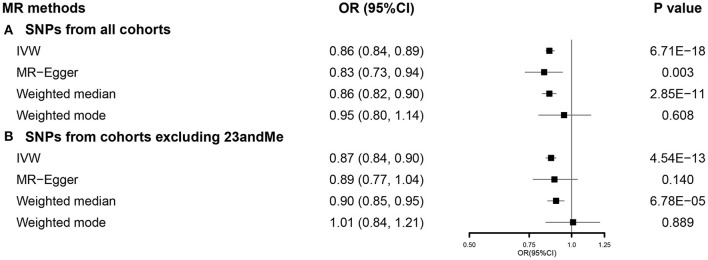
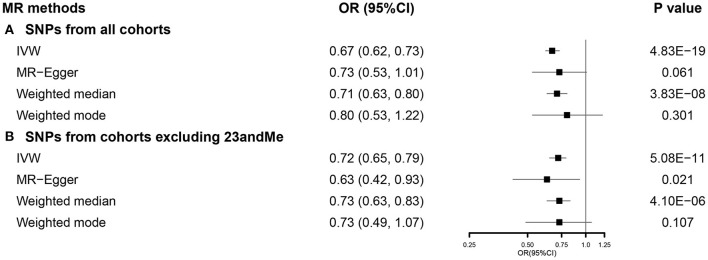
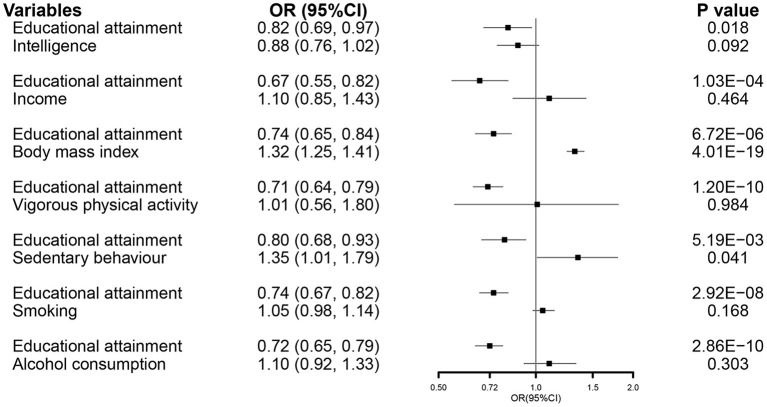
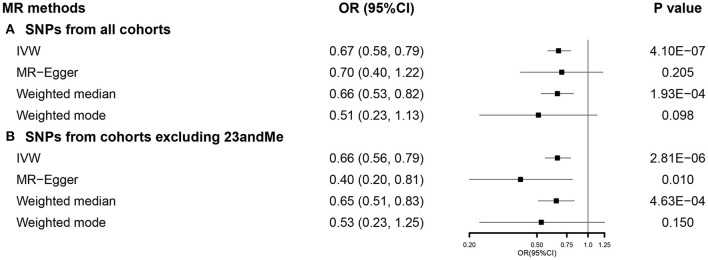
Prior observational studies indicated that lower educational attainment (EA) is associated with higher COVID-19 risk, while these findings were vulnerable to bias from confounding factors. We aimed to clarify the causal effect of EA on COVID-19 susceptibility, hospitalization, and severity using Mendelian randomization (MR). We identified genetic instruments for EA from a large genome-wide association study (GWAS) ( = 1,131,881). Summary statistics for COVID-19 susceptibility (112,612 cases and 2,474,079 controls), hospitalization (24,274 cases and 2,061,529 controls), and severity (8,779 cases and 1,001,875 controls) were obtained from the COVID-19 Host Genetics Initiative. We used the single-variable MR (SVMR) and the multivariable MR (MVMR) controlling intelligence, income, body mass index, vigorous physical activity, sedentary behavior, smoking, and alcohol consumption to estimate the total and direct effects of EA on COVID-19 outcomes. Inverse variance weighted was the primary analysis method. All the statistical analyses were performed using R software. Results from the SVMR showed that genetically predicted higher EA was correlated with a lower risk of COVID-19 susceptibility [odds ratio (OR) 0.86, 95% CI 0.84-0.89], hospitalization (OR 0.67, 95% CI 0.62-0.73), and severity (OR 0.67, 95% CI 0.58-0.79). EA still maintained its effects in most of the MVMR. Educational attainment is a predictor for susceptibility, hospitalization, and severity of COVID-19 disease. Population with lower EA should be provided with a higher prioritization to public health resources to decrease the morbidity and mortality of COVID-19.
先前的观察性研究表明,较低的教育程度与较高的新冠病毒疾病(COVID-19)风险相关,而这些发现容易受到混杂因素偏差的影响。我们旨在使用孟德尔随机化(MR)来阐明教育程度对COVID-19易感性、住院率和严重程度的因果效应。我们从一项大型全基因组关联研究(GWAS)(n = 1,131,881)中确定了教育程度的遗传工具变量。COVID-19易感性(112,612例病例和2,474,079例对照)、住院率(24,274例病例和2,061,529例对照)和严重程度(8,779例病例和1,001,875例对照)的汇总统计数据来自COVID-19宿主遗传学倡议。我们使用单变量MR(SVMR)和控制智力、收入、体重指数、剧烈体育活动、久坐行为、吸烟和饮酒的多变量MR(MVMR)来估计教育程度对COVID-19结局的总体和直接影响。逆方差加权是主要的分析方法。所有统计分析均使用R软件进行。SVMR的结果表明,遗传预测的较高教育程度与较低的COVID-19易感性风险[比值比(OR)0.86,95%置信区间(CI)0.84 - 0.89]、住院率(OR 0.67,95% CI 0.62 - 0.73)和严重程度(OR 0.67,95% CI 0.58 - 0.79)相关。在大多数MVMR中,教育程度仍然保持其效应。教育程度是COVID-19疾病易感性、住院率和严重程度的一个预测因素。应将较低教育程度人群列为公共卫生资源的更高优先对象,以降低COVID-19的发病率和死亡率。