Centre for Clinical Epidemiology Lady Davis Institute for Medical Research, Jewish General Hospital, McGill University, Montreal, QC, Canada.
Department of Epidemiology, Biostatistics and Occupational Health, McGill University, Montreal, QC, Canada.
Int J Epidemiol. 2021 Mar 3;50(1):75-86. doi: 10.1093/ije/dyaa229.
There has been uncertainty about the safety or benefit of angiotensin-converting enzyme (ACE) inhibitors during the COVID-19 pandemic. We used Mendelian randomization using genetic determinants of serum-ACE levels to test whether decreased ACE levels increase susceptibility to SARS-CoV-2 infection or COVID-19 severity, while reducing potential bias from confounding and reverse causation in observational studies.
Genetic variants strongly associated with ACE levels, which were nearby the ACE gene, were identified from the ORIGIN trial and a separate genome-wide association study (GWAS) of ACE levels from the AGES cohort. The ORIGIN trial included 4147 individuals of European and Latino ancestries. Sensitivity analyses were performed using a study of 3200 Icelanders. Cohorts from the COVID-19 Host Genetics Initiative GWAS of up to 960 186 individuals of European ancestry were used for COVID-19 susceptibility, hospitalization and severe-disease outcome.
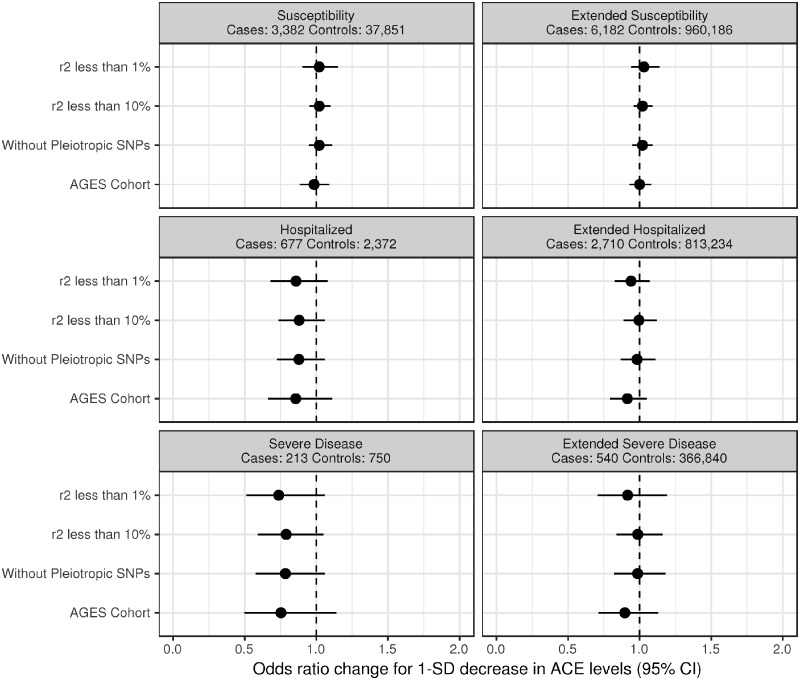
Genetic variants were identified that explain between 18% and 37% of variance in ACE levels. Using genetic variants from the ORIGIN trial, a standard-deviation decrease in ACE levels was not associated with an increase in COVID-19 susceptibility [odds ratio (OR): 1.02, 95% confidence interval (CI): 0.90, 1.15], hospitalization (OR: 0.86, 95% CI: 0.68, 1.08) or severe disease (OR: 0.74, 95% CI: 0.51, 1.06). Using genetic variants from the AGES cohort, the result was similar for susceptibility (OR: 0.98, 95% CI: 0.89, 1.09), hospitalization (OR: 0.86, 95% CI: 0.66, 1.11) and severity (OR: 0.75, 95% CI: 0.50, 1.14). Multiple-sensitivity analyses led to similar results.
Genetically decreased serum ACE levels were not associated with susceptibility to, or severity of, COVID-19 disease. These data suggest that individuals taking ACE inhibitors should not discontinue therapy during the COVID-19 pandemic.
在 COVID-19 大流行期间,血管紧张素转换酶(ACE)抑制剂的安全性或益处存在不确定性。我们使用基于血清 ACE 水平遗传决定因素的孟德尔随机化来检验 ACE 水平降低是否会增加对 SARS-CoV-2 感染或 COVID-19 严重程度的易感性,同时减少观察性研究中混杂和反向因果关系的潜在偏差。
从 ORIGIN 试验和 ACE 水平的独立全基因组关联研究(AGES 队列)中确定与 ACE 水平密切相关的 ACE 基因附近的遗传变异。ORIGIN 试验包括 4147 名欧洲和拉丁裔血统的个体。使用来自 COVID-19 宿主遗传学倡议的多达 960,186 名欧洲血统个体的 GWAS 进行敏感性分析。使用 COVID-19 易感性、住院和严重疾病结局的 COVID-19 宿主遗传学倡议 GWAS 的队列。
确定了可以解释 ACE 水平 18%至 37%差异的遗传变异。使用 ORIGIN 试验中的遗传变异,ACE 水平标准偏差降低与 COVID-19 易感性增加无关[比值比(OR):1.02,95%置信区间(CI):0.90,1.15]、住院(OR:0.86,95% CI:0.68,1.08)或严重疾病(OR:0.74,95% CI:0.51,1.06)。使用 AGES 队列中的遗传变异,结果在易感性(OR:0.98,95% CI:0.89,1.09)、住院(OR:0.86,95% CI:0.66,1.11)和严重程度(OR:0.75,95% CI:0.50,1.14)方面相似。多项敏感性分析得出了类似的结果。
遗传上降低的血清 ACE 水平与 COVID-19 疾病的易感性或严重程度无关。这些数据表明,在 COVID-19 大流行期间,服用 ACE 抑制剂的个体不应停止治疗。