Nguyen Thi H O, Cohen Carolyn A, Rowntree Louise C, Bull Maireid B, Hachim Asmaa, Kedzierska Katherine, Valkenburg Sophie A
Department of Microbiology and Immunology, The Peter Doherty Institute for Infection and Immunity, The University of Melbourne, Melbourne, VIC, Australia.
HKU-Pasteur Research Pole, Li Ka Shing Faculty of Medicine, School of Public Health, The University of Hong Kong, Pokfulam, Hong Kong SAR, China.
Front Med (Lausanne). 2021 Dec 24;8:793102. doi: 10.3389/fmed.2021.793102. eCollection 2021.
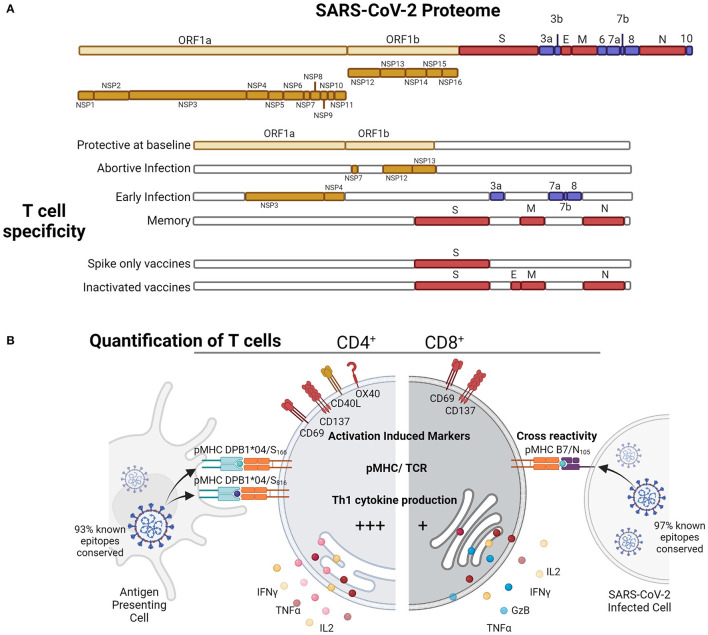
T cell responses are a key cornerstone to viral immunity to drive high-quality antibody responses, establishing memory for recall and for viral clearance. Inefficient recruitment of T cell responses plays a role in the development of severe COVID-19 and is also represented by reduced cellular responses in men, children, and diversity compared with other epitope-specific subsets and available T cell receptor diversity. SARS-CoV-2-specific T cell responses are elicited by multiple vaccine formats and augmented by prior infection for hybrid immunity. Epitope conservation is relatively well-maintained leading to T cell crossreactivity for variants of concern that have diminished serological responses.
T细胞反应是病毒免疫的关键基石,可驱动高质量的抗体反应,建立用于回忆和病毒清除的记忆。T细胞反应募集效率低下在重症COVID-19的发展中起作用,并且在男性、儿童中以及与其他表位特异性亚群和可用的T细胞受体多样性相比的多样性方面,细胞反应减少也体现了这一点。多种疫苗形式可引发针对严重急性呼吸综合征冠状病毒2(SARS-CoV-2)的T细胞反应,既往感染可增强T细胞反应以产生混合免疫。表位保守性相对良好地得以维持,导致对血清学反应减弱的关注变异株产生T细胞交叉反应。