McCarthy Anne Marie, Liu Yi, Ehsan Sarah, Guan Zoe, Liang Jane, Huang Theodore, Hughes Kevin, Semine Alan, Kontos Despina, Conant Emily, Lehman Constance, Armstrong Katrina, Braun Danielle, Parmigiani Giovanni, Chen Jinbo
Department of Biostatistics, Epidemiology & Informatics, University of Pennsylvania, Philadelphia, PA 19104, USA.
Department of Biostatistics, Harvard T. H. Chan School of Public Health, Harvard University, Boston, MA 02115, USA.
Cancers (Basel). 2021 Dec 23;14(1):45. doi: 10.3390/cancers14010045.
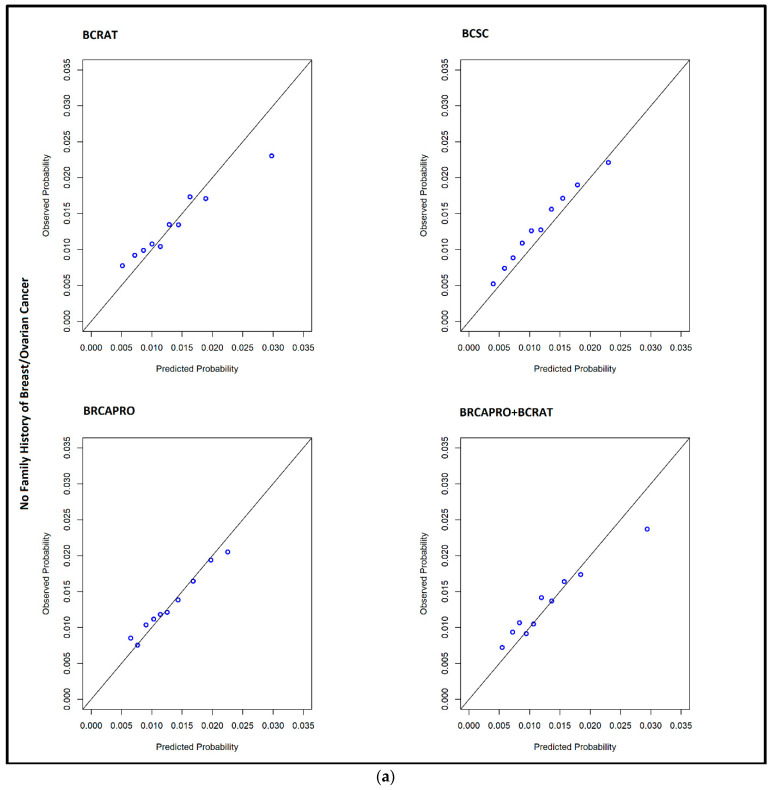
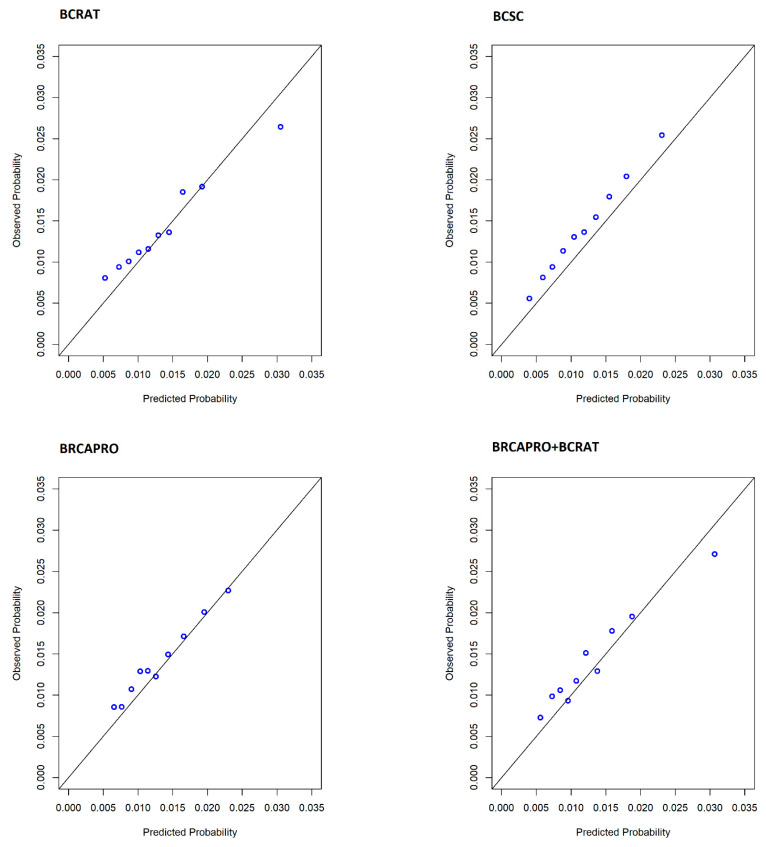
(1) Background: The purpose of this study is to compare the performance of four breast cancer risk prediction models by race, molecular subtype, family history of breast cancer, age, and BMI. (2) Methods: Using a cohort of women aged 40-84 without prior history of breast cancer who underwent screening mammography from 2006 to 2015, we generated breast cancer risk estimates using the Breast Cancer Risk Assessment tool (BCRAT), BRCAPRO, Breast Cancer Surveillance Consortium (BCSC) and combined BRCAPRO+BCRAT models. Model calibration and discrimination were compared using observed-to-expected ratios (O/E) and the area under the receiver operator curve (AUC) among patients with at least five years of follow-up. (3) Results: We observed comparable discrimination and calibration across models. There was no significant difference in model performance between Black and White women. Model discrimination was poorer for HER2+ and triple-negative subtypes compared with ER/PR+HER2-. The BRCAPRO+BCRAT model displayed improved calibration and discrimination compared to BRCAPRO among women with a family history of breast cancer. Across models, discriminatory accuracy was greater among obese than non-obese women. When defining high risk as a 5-year risk of 1.67% or greater, models demonstrated discordance in 2.9% to 19.7% of patients. (4) Conclusions: Our results can inform the implementation of risk assessment and risk-based screening among women undergoing screening mammography.
(1) 背景:本研究的目的是按种族、分子亚型、乳腺癌家族史、年龄和体重指数比较四种乳腺癌风险预测模型的性能。(2) 方法:我们使用了一组年龄在40 - 84岁、无乳腺癌病史且在2006年至2015年期间接受乳腺钼靶筛查的女性队列,采用乳腺癌风险评估工具(BCRAT)、BRCAPRO、乳腺癌监测协会(BCSC)以及BRCAPRO + BCRAT联合模型生成乳腺癌风险估计值。在至少有五年随访的患者中,使用观察与预期比率(O/E)和受试者操作特征曲线下面积(AUC)比较模型的校准和区分能力。(3) 结果:我们观察到各模型之间的区分能力和校准情况相当。黑人和白人女性在模型性能上没有显著差异。与ER/PR + HER2 - 亚型相比,HER2 + 和三阴性亚型的模型区分能力较差。在有乳腺癌家族史的女性中,BRCAPRO + BCRAT模型与BRCAPRO相比,校准和区分能力有所提高。在所有模型中,肥胖女性的区分准确性高于非肥胖女性。当将高风险定义为5年风险为1.67%或更高时,各模型在2.9%至19.7%的患者中显示出不一致性。(4) 结论:我们的结果可为接受乳腺钼靶筛查的女性实施风险评估和基于风险的筛查提供参考。