Morales Javier S, Valenzuela Pedro L, Velázquez-Díaz Daniel, Castillo-García Adrián, Jiménez-Pavón David, Lucia Alejandro, Fiuza-Luces Carmen
MOVE-IT Research Group, Department of Physical Education, Faculty of Education Sciences, Universidad de Cádiz, 11519 Cadiz, Spain.
Biomedical Research and Innovation Institute of Cádiz (INiBICA) Research Unit, Puerta del Mar University Hospital, University of Cádiz, 11009 Cadiz, Spain.
Cancers (Basel). 2021 Dec 24;14(1):82. doi: 10.3390/cancers14010082.
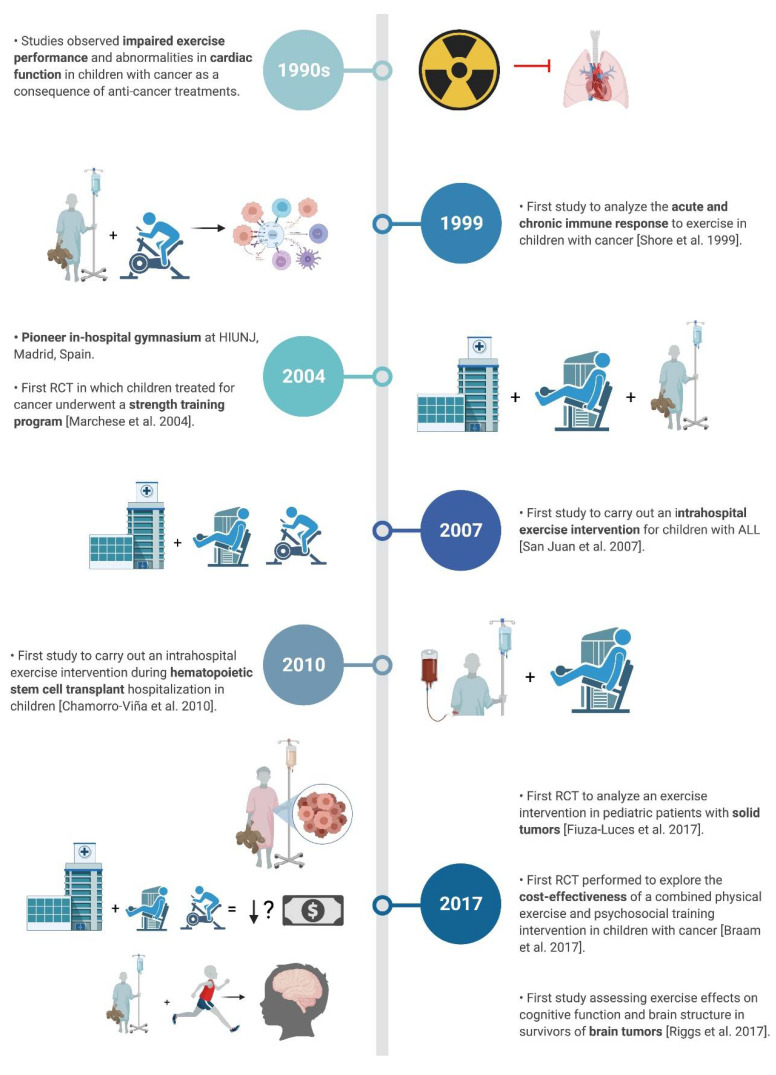
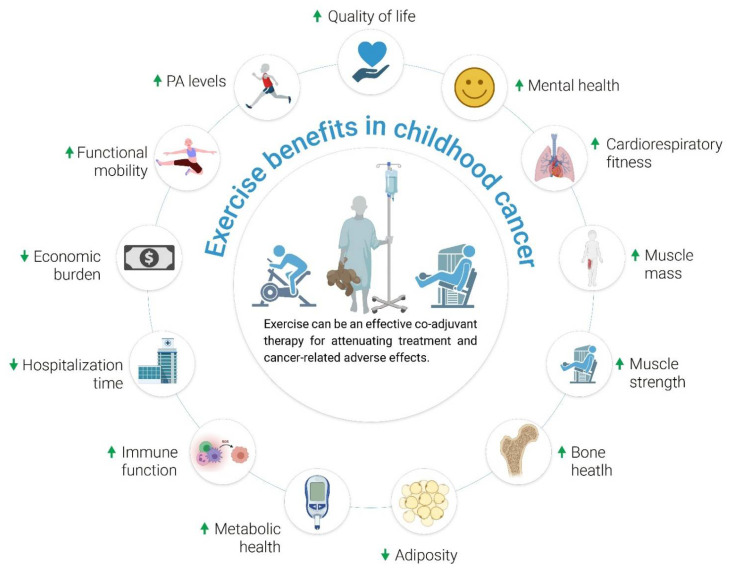
Childhood cancer survivors are at risk of developing important adverse effects, many of which persist for years after the end of treatment. The implementation of interventions aiming at attenuating tumor/treatment-associated adverse effects is therefore a major issue in pediatric oncology, and there is growing evidence that physical exercise could help in this regard. The present review aims to summarize the main milestones achieved in pediatric exercise oncology. For this purpose, we conducted a systematic review of relevant studies written in English in the electronic database PubMed (from inception to 14 August 2021). This review traces the field of pediatric exercise oncology throughout recent history based on three fundamental pillars: (i) exercise during childhood cancer treatment; (ii) exercise during/after hematopoietic stem cell transplantation; and (iii) exercise after childhood cancer treatment. Accumulating evidence--although still preliminary in many cases--supports the safety and potential benefits of regular exercise (with no major contraindications in general) in the childhood cancer continuum, even during the most aggressive phases of treatment. Exercise can indeed represent an effective coadjuvant therapy for attenuating cancer-related adverse effects.
儿童癌症幸存者有发生重要不良反应的风险,其中许多不良反应在治疗结束后会持续数年。因此,实施旨在减轻肿瘤/治疗相关不良反应的干预措施是儿科肿瘤学中的一个主要问题,并且越来越多的证据表明体育锻炼在这方面可能会有所帮助。本综述旨在总结儿科运动肿瘤学取得的主要里程碑。为此,我们在电子数据库PubMed中对英文撰写的相关研究进行了系统综述(从创刊到2021年8月14日)。本综述基于三个基本支柱追溯了儿科运动肿瘤学领域的近代历史:(i)儿童癌症治疗期间的运动;(ii)造血干细胞移植期间/后的运动;以及(iii)儿童癌症治疗后的运动。越来越多的证据——尽管在许多情况下仍然是初步的——支持在儿童癌症连续过程中进行规律运动(一般无重大禁忌证)的安全性和潜在益处,即使在最积极的治疗阶段也是如此。运动确实可以成为减轻癌症相关不良反应的一种有效的辅助治疗方法。