Laboratory of Alternative Energy Conversion Systems, Department of Mechanical Engineering, University of Thessaly, Pedion Areos, 38334 Volos, Greece.
Industrial Processes and Energy Systems Engineering, Institute of Mechanical Engineering, Sion, Ecole Polytechnique Fédérale de Lausanne, 1015 Lausanne, Switzerland.
Sensors (Basel). 2022 Jan 4;22(1):355. doi: 10.3390/s22010355.
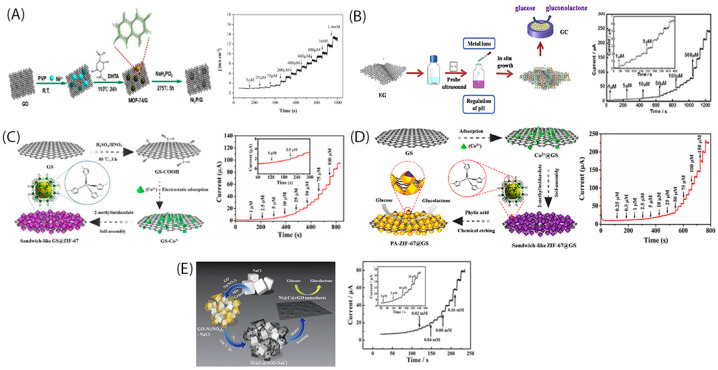
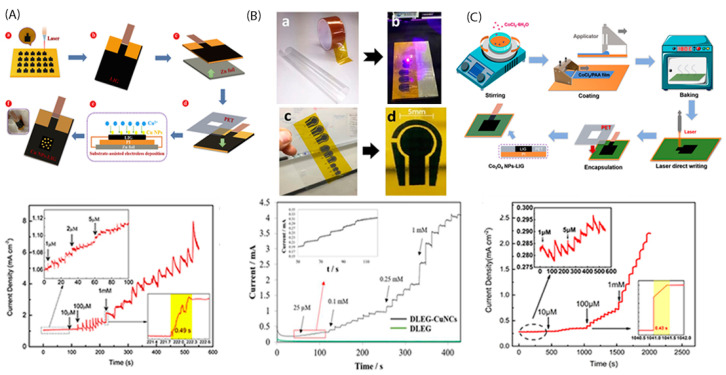
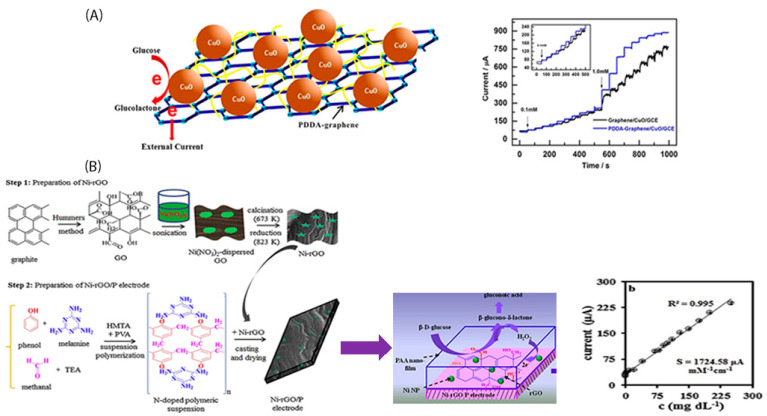
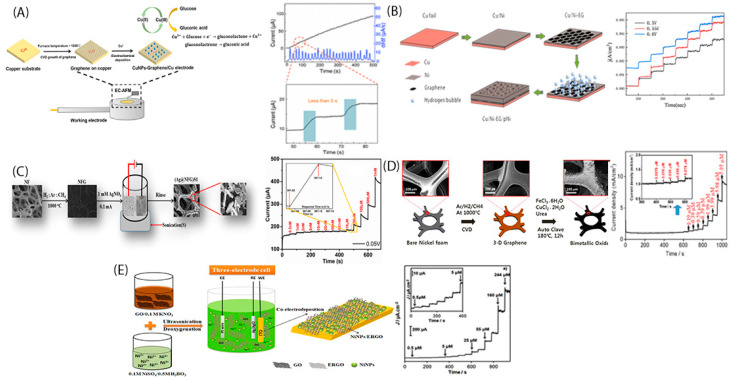
The high conductivity of graphene material (or its derivatives) and its very large surface area enhance the direct electron transfer, improving non-enzymatic electrochemical sensors sensitivity and its other characteristics. The offered large pores facilitate analyte transport enabling glucose detection even at very low concentration values. In the current review paper we classified the enzymeless graphene-based glucose electrocatalysts' synthesis methods that have been followed into the last few years into four main categories: (i) direct growth of graphene (or oxides) on metallic substrates, (ii) in-situ growth of metallic nanoparticles into graphene (or oxides) matrix, (iii) laser-induced graphene electrodes and (iv) polymer functionalized graphene (or oxides) electrodes. The increment of the specific surface area and the high degree reduction of the electrode internal resistance were recognized as their common targets. Analyzing glucose electrooxidation mechanism over Cu- Co- and Ni-(oxide)/graphene (or derivative) electrocatalysts, we deduced that glucose electrochemical sensing properties, such as sensitivity, detection limit and linear detection limit, totally depend on the route of the mass and charge transport between metal(II)/metal(III); and so both (specific area and internal resistance) should have the optimum values.
石墨烯材料(或其衍生物)的高导电性及其非常大的表面积增强了直接电子转移,提高了非酶电化学传感器的灵敏度及其它特性。提供的大孔有利于分析物的传输,使得即使在非常低的浓度值下也能够检测到葡萄糖。在当前的综述论文中,我们将过去几年中遵循的无酶基于石墨烯的葡萄糖电化学生物传感器的合成方法分为四大类:(i)在金属基底上直接生长石墨烯(或氧化物),(ii)将金属纳米粒子原位生长到石墨烯(或氧化物)基质中,(iii)激光诱导的石墨烯电极和(iv)聚合物功能化的石墨烯(或氧化物)电极。增加比表面积和降低电极内部电阻是其共同的目标。通过分析 Cu-Co- 和 Ni-(氧化物)/石墨烯(或衍生物)电催化剂上葡萄糖的电化学氧化机制,我们推断出葡萄糖电化学传感性能,如灵敏度、检测限和线性检测限,完全取决于金属(II)/金属(III)之间的质量和电荷传输途径;因此,(比表面积和内部电阻)都应该具有最佳值。