Washif Jad Adrian, Ammar Achraf, Trabelsi Khaled, Chamari Karim, Chong Christabelle Sheau Miin, Mohd Kassim Siti Fuzyma Ayu, Lew Philip Chun Foong, Farooq Abdulaziz, Pyne David B, James Carl
Sports Performance Division, Institut Sukan Negara Malaysia (National Sports Institute of Malaysia), National Sports Complex, Kuala Lumpur 57000, Malaysia.
Department of Training and Movement Science, Institute of Sport Science, Johannes Gutenberg-University Mainz, 55099 Mainz, Germany.
Int J Environ Res Public Health. 2021 Dec 30;19(1):402. doi: 10.3390/ijerph19010402.
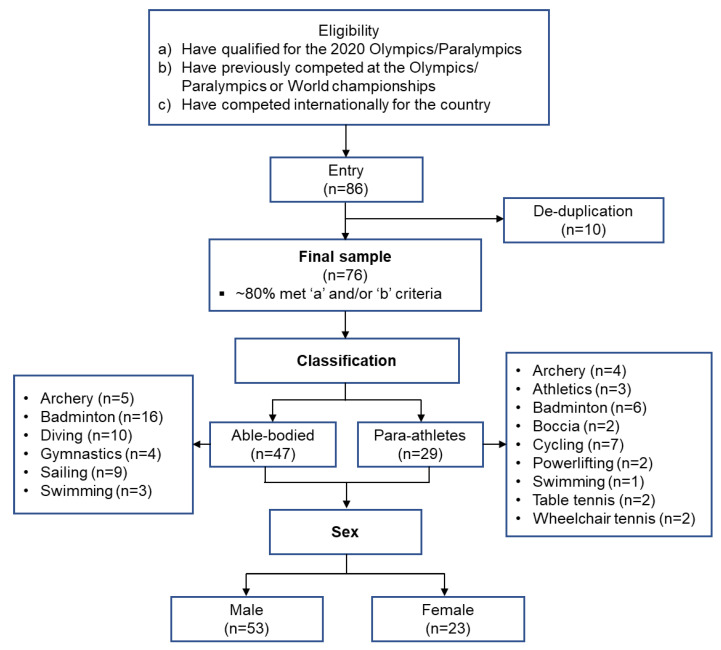
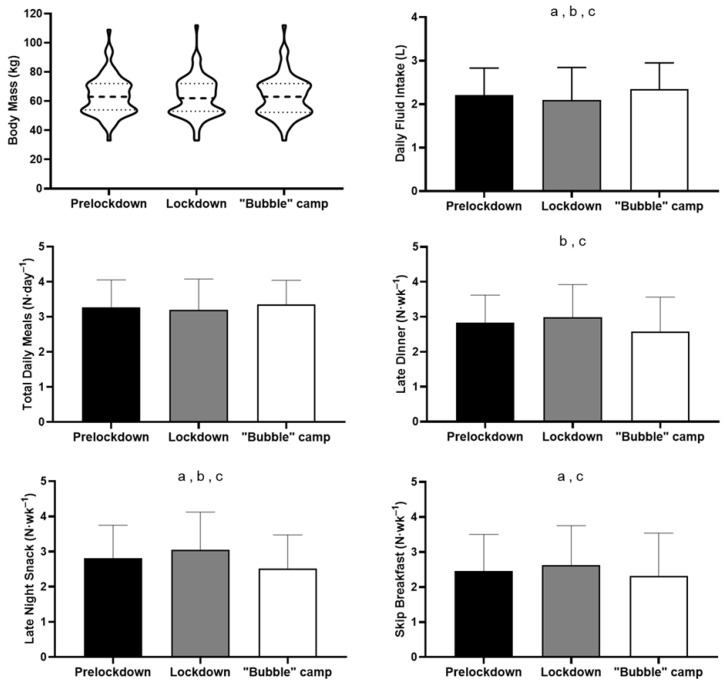
The COVID-19 pandemic has affected the lifestyles and training of elite athletes around the world. The detrimental effects of lockdown periods may vary among individuals, as well as among sports and sexes. This study investigated the changes in dietary habits, and the predictors of perceived stress during lockdown and a "bubble" training camp. This cross-sectional, online survey involved 76 elite and world-class athletes from six able-bodied sports and nine parasports, all of whom were involved in a 30-day "bubble" training camp. Questions were asked on socio-demographics, training routines and wellbeing, perceived stress, and dietary habits, pertaining to "normal" training (prelockdown), lockdown training, and "bubble" camp training periods. Changes in perceived stress were to during lockdown compared to "normal" training, and to during a "bubble" camp, compared to lockdown. Para-athletes, males, older athletes, less experienced athletes, married individuals, and specific ethnicities appeared to be more detrimentally affected (increased perceived stress) by lockdown. These negative experiences, however, were largely reversed during "bubble" camps. During lockdown, more athletes reported increased evening snack consumption (+8%), later meal-times (+6%), decreased fluid intake (-6%), and no breakfast (+7%). These changes were reversed during "bubble" camps (12-18% improvements). Sport classification accounted for 16% of the increased perceived stress ( = 0.001) during lockdown. Overall, socio-demographic factors, improvements in training routines, well-being, and dietary habits explained 28% of the decreased perceived stress during a "bubble" camp. In conclusion, better dietary habits, training routines and well-being have implications for reduced perceived stress. During lockdown, "bubble" camps may be beneficial, but this observation may be a case-by-case consideration, and short split "bubble" periods are recommended.
新冠疫情影响了世界各地精英运动员的生活方式和训练。封锁期的不利影响在个体之间、不同运动项目和不同性别之间可能有所不同。本研究调查了封锁期间和“封闭”训练营期间饮食习惯的变化以及感知压力的预测因素。这项横断面在线调查涉及来自六个健全人运动项目和九个残疾人运动项目的76名精英和世界级运动员,他们都参加了为期30天的“封闭”训练营。针对社会人口统计学、训练日常和健康状况、感知压力以及饮食习惯等方面提出了问题,涉及“正常”训练(封锁前)、封锁训练以及“封闭”训练营训练期间。与“正常”训练相比,封锁期间感知压力变化为[具体变化数值1],与封锁期间相比,“封闭”训练营期间感知压力变化为[具体变化数值2]。残疾运动员、男性、年龄较大的运动员、经验较少的运动员、已婚人士以及特定种族似乎受封锁的不利影响更大(感知压力增加)。然而,这些负面经历在“封闭”训练营期间大多得到了扭转。在封锁期间,更多运动员报告称夜间零食摄入量增加(+8%)、用餐时间推迟(+6%)、液体摄入量减少(-6%)以及不吃早餐的情况增多(+7%)。这些变化在“封闭”训练营期间得到了扭转(改善了12 - 18%)。运动项目分类在封锁期间感知压力增加中占16%(P = 0.001)。总体而言,社会人口统计学因素、训练日常、健康状况和饮食习惯的改善解释了“封闭”训练营期间感知压力降低的28%。总之,更好的饮食习惯、训练日常和健康状况有助于降低感知压力。在封锁期间,“封闭”训练营可能有益,但这一观察结果可能需视具体情况而定,建议采用较短的分段“封闭”期。