Institute of Aquaculture, Faculty of Natural Sciences, University of Stirling, Stirling FK9 4LA, UK.
Institute for Food Research and Nutrition, University of Reading, Agriculture Building, P.O. Box 2376, Earley Gate, Reading RG6 6AR, UK.
Nutrients. 2021 Dec 31;14(1):195. doi: 10.3390/nu14010195.
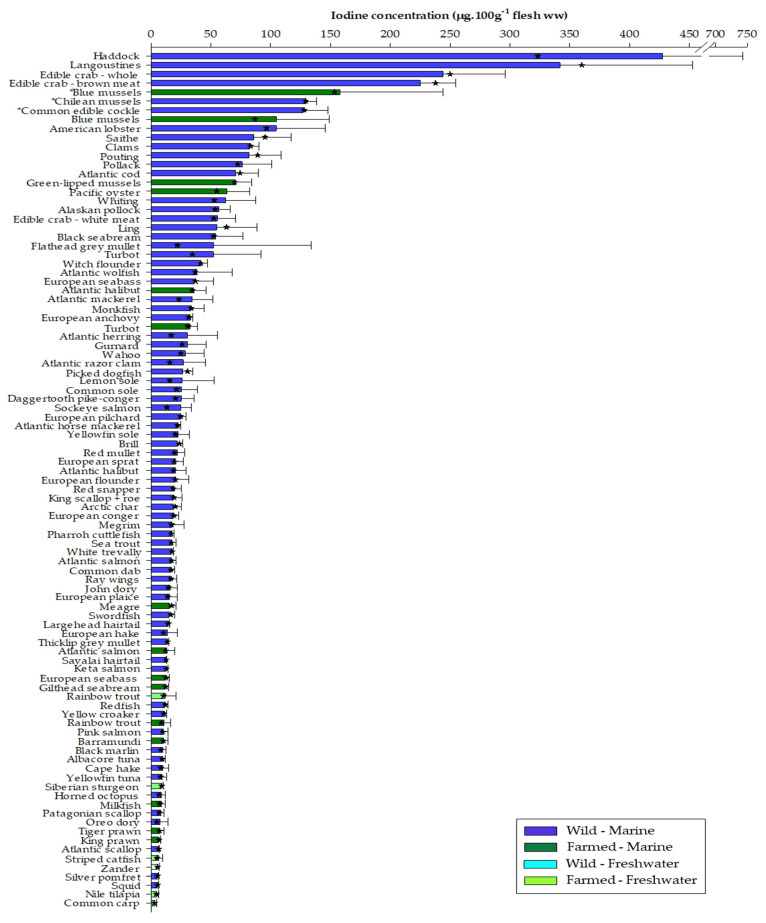
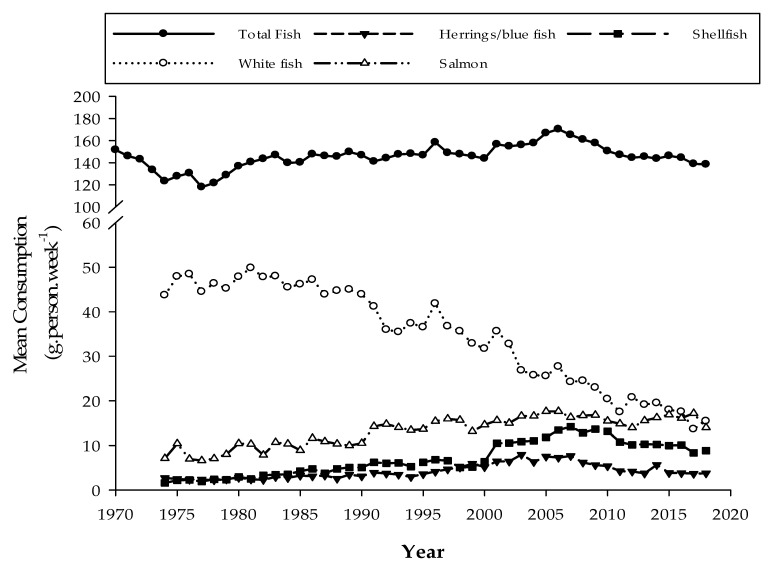
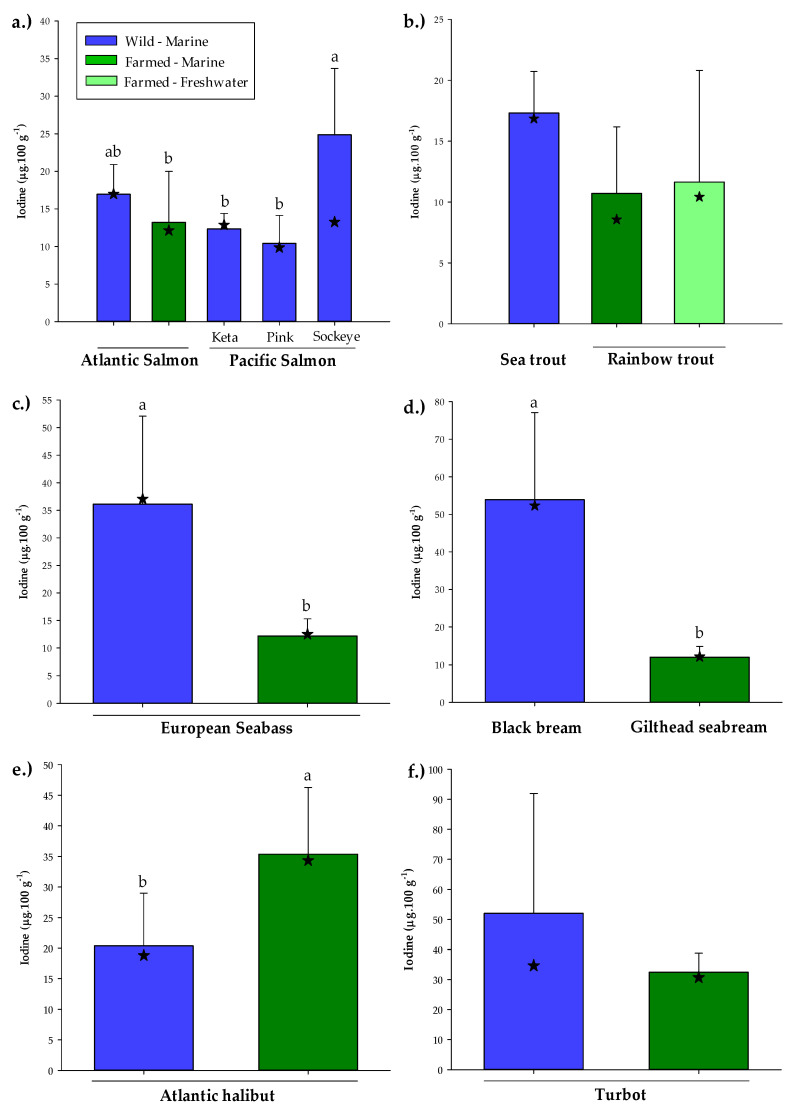
Iodine is an important nutrient for human health and development, with seafood widely acknowledged as a rich source. Demand from the increasing global population has resulted in the availability of a wider range of wild and farmed seafood. Increased aquaculture production, however, has resulted in changes to feed ingredients that affect the nutritional quality of the final product. The present study assessed the iodine contents of wild and farmed seafood available to UK consumers and evaluated its contribution to current dietary iodine intake. Ninety-five seafood types, encompassing marine and freshwater fish and shellfish, of wild and farmed origins, were purchased from UK retailers and analysed. Iodine contents ranged from 427.4 ± 316.1 to 3.0 ± 1.6 µg·100 g flesh wet weight (mean ± SD) in haddock () and common carp (), respectively, being in the order shellfish > marine fish > freshwater fish, with crustaceans, whitefish (Gadiformes) and bivalves contributing the greatest levels. Overall, wild fish tended to exhibit higher iodine concentrations than farmed fish, with the exception of non-fed aquaculture species (bivalves). However, no significant differences were observed between wild and farmed Atlantic salmon (), rainbow trout (), and turbot (). In contrast, farmed European seabass () and seabream () presented lower, and Atlantic halibut () higher, iodine levels than their wild counterparts, most likely due to the type and inclusion level of feed ingredients used. By following UK dietary guidelines for fish consumption, a portion of the highest oily (Atlantic mackerel, ) and lean (haddock) fish species would provide two-thirds of the weekly recommended iodine intake (980 µg). In contrast, actual iodine intake from seafood consumption is estimated at only 9.4-18.0% of the UK reference nutrient intake (140 µg·day) across different age groups and genders, with females obtaining less than their male equivalents.
碘是人体健康和发育的重要营养物质,海鲜被广泛认为是富含碘的食物来源。全球人口的增长需求导致了更广泛的野生和养殖海鲜的供应。然而,水产养殖产量的增加导致了饲料成分的变化,从而影响了最终产品的营养价值。本研究评估了英国消费者可获得的野生和养殖海鲜中的碘含量,并评估了其对当前膳食碘摄入量的贡献。从英国零售商处购买了 95 种海鲜,包括海洋和淡水鱼类和贝类,分别来自野生和养殖来源,并对其进行了分析。碘含量范围为 427.4±316.1 至 3.0±1.6μg·100g 鲜鱼肉(平均值±标准差),分别来自黑线鳕()和鲤鱼(),其顺序为贝类>海洋鱼类>淡水鱼类,甲壳类、白鱼(鲱形目)和双壳类贡献最大。总体而言,野生鱼的碘浓度往往高于养殖鱼,除了非投喂的养殖物种(双壳类)外。然而,野生和养殖大西洋三文鱼()、虹鳟()和大菱鲆()之间未观察到显著差异。相比之下,养殖欧洲海鲈()和真鲷()的碘含量较低,而大西洋比目鱼()的碘含量较高,这可能是由于所使用的饲料成分的类型和含量不同。按照英国鱼类消费的饮食指南,一部分最高含油量(大西洋鲭鱼,)和低含油量(黑线鳕)的鱼类品种将提供三分之二的每周推荐碘摄入量(980μg)。相比之下,不同年龄组和性别的人从海鲜消费中摄入的碘估计仅占英国参考营养素摄入量(140μg·天)的 9.4-18.0%,女性摄入的碘低于男性。