Food Engineering Department, Faculty of Engineering, Ondokuz Mayis University, Samsun 55139, Turkey.
VetAgro-Sup, Agronomic Campus, 63370 Clermont-Ferrand, France.
Molecules. 2021 Dec 27;27(1):134. doi: 10.3390/molecules27010134.
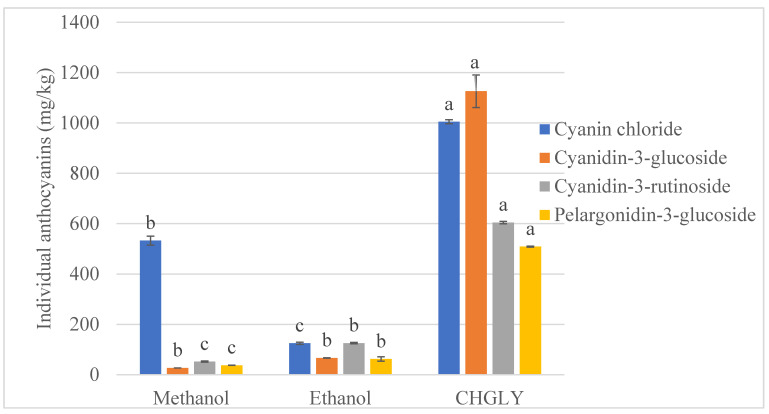
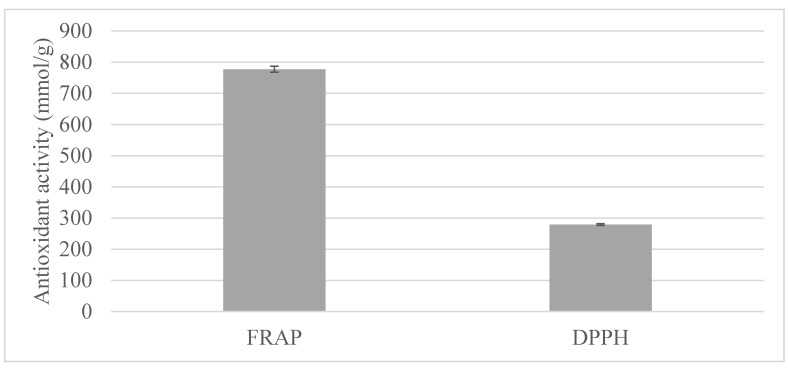
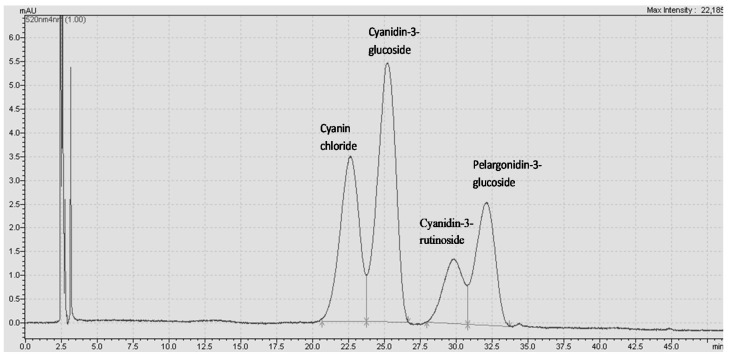
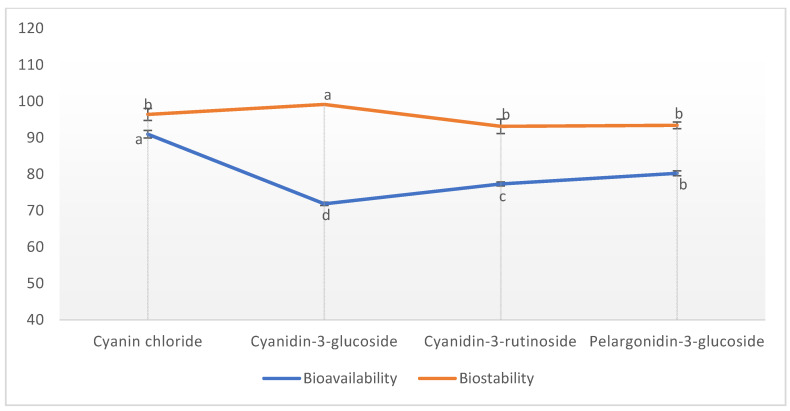
Borage flower (), an annual herb native to the Mediterranean region, is an excellent source of anthocyanins and is widely used in various forms due to its biological activities. In the present study, a choline chloride and glycerol (CHGLY)-based natural deep eutectic solvent (NADES) was applied in order to extract the anthocyanins from borage flowers. The traditional solvents, including water, methanol, and ethanol, were used to evaluate the efficiency of CHGLY. The results showed that CHGLY was highly efficient compared to the traditional solvents, providing the highest amounts of the total anthocyanin content (TAC), total phenolic content (TPC), total flavonoid content (TFC), individual anthocyanins, and antioxidant activity (DPPH radical scavenging (DPPH) and ferric-reducing antioxidant power (FRAP) assays). The most dominant anthocyanin found in studied borage was cyanidin-3-glucoside, followed by cyanin chloride, cyanidin-3-rutinoside, and pelargonidin-3-glucoside. The bioavailability % was 71.86 ± 0.47%, 77.29 ± 0.57%, 80.22 ± 0.65%, and 90.95 ± 1.01% for cyanidin-3-glucoside, cyanidin-3-rutinoside, by pelargonidin-3-glucoside and cyanin chloride, respectively. However, cyanidin-3-glucoside was the anthocyanin compound showing the highest stability (99.11 ± 1.66%) in the gastrointestinal environment. These results suggested that choline chloride and glycerol-based NADES is not only an efficient, eco-friendly solvent for the extraction of anthocyanins but can also be used to increase the bioavailability of anthocyanins.
琉璃苣花(Borago officinalis L.),一种原产于地中海地区的一年生草本植物,是花色苷的优质来源,由于其具有生物活性,因此以各种形式广泛使用。在本研究中,应用氯化胆碱和甘油(CHGLY)基天然深共晶溶剂(NADES)从琉璃苣花中提取花色苷。传统溶剂,包括水、甲醇和乙醇,用于评估 CHGLY 的效率。结果表明,CHGLY 比传统溶剂更高效,提供了最高量的总花色苷含量(TAC)、总酚含量(TPC)、总黄酮含量(TFC)、单个花色苷和抗氧化活性(DPPH 自由基清除(DPPH)和铁还原抗氧化能力(FRAP)测定)。在所研究的琉璃苣中发现的最主要花色苷是矢车菊素-3-葡萄糖苷,其次是飞燕草素氯,矢车菊素-3-芸香糖苷和天竺葵素-3-葡萄糖苷。生物利用度%分别为 71.86±0.47%、77.29±0.57%、80.22±0.65%和 90.95±1.01%,矢车菊素-3-葡萄糖苷、矢车菊素-3-芸香糖苷、天竺葵素-3-葡萄糖苷和飞燕草素氯。然而,矢车菊素-3-葡萄糖苷是在胃肠道环境中显示出最高稳定性(99.11±1.66%)的花色苷化合物。这些结果表明,基于氯化胆碱和甘油的 NADES 不仅是花色苷提取的有效、环保溶剂,还可以提高花色苷的生物利用度。