Al-Adawi Rana Moustafa, Prabhu Kirti Sathyananda, Stewart Derek, Ryan Cristin, Abdelaziz Hani, Eledrisi Mohsen, Ibrahim Mohamed Izham Mohamed, Uddin Shahab, Tonna Antonella Pia
Department of Pharmacy, Hamad General Hospital, Hamad Medical Corporation, Doha 3050, Qatar.
School of Pharmacy and Life Sciences, Robert Gordon University, Aberdeen AB10 7GJ, UK.
J Clin Med. 2021 Dec 22;11(1):34. doi: 10.3390/jcm11010034.
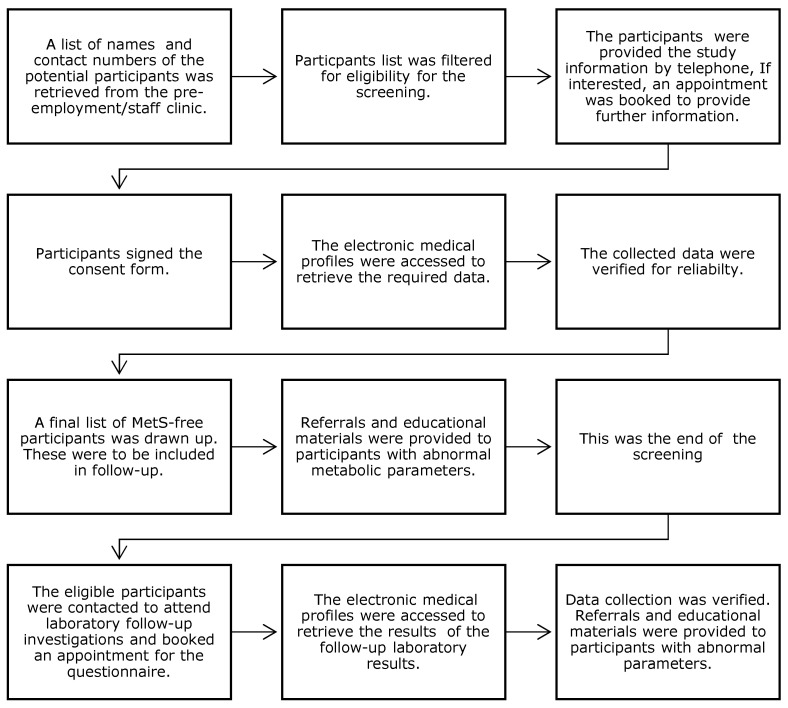
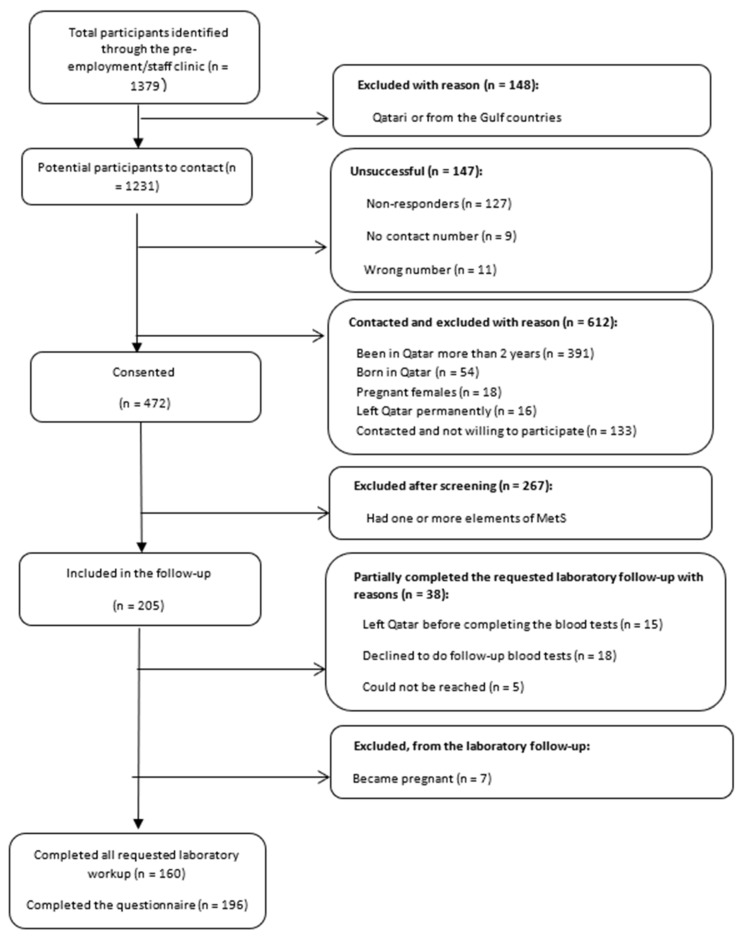
While there is some evidence that migration to Western countries increases metabolic syndrome (MetS) risk, there is a lack of data pertaining to migration to the Middle East. This study aimed to investigate the relationship between migration and MetS incidence following 24-months of residency in Qatar and identify possible MetS determinants. Migrants to Qatar employed at Hamad Medical Corporation (the national health service) aged 18-65 years were invited to participate. Baseline and follow-up screening for MetS included HbA1c, triglycerides, HDL-cholesterol, blood pressure, and waist circumference. MetS-free migrants were rescreened 24-months post-migration, and the World Health Organization STEPwise questionnaire was administered, assessing changes in lifestyle from baseline. Of 1095 migrants contacted, 472 consented to participate, 205 of whom had normal metabolic parameters at baseline; 160 completed follow-up screening. Most participants were males (74.6%, = 153) and Asian (81.0%, = 166/205), and two thirds (66.3%, = 136/205) were nurses. The incidence of new-onset MetS was 17.0% ( = 27/160, 95%CI; 11.0-23.0%), with 81.0% ( = 129/160, 95%CI; 73.8-86.0%) having at least one MetS element 24-months post-residency in Qatar. Male gender was a risk factor for MetS (adjusted odds ratio (AOR) = 3, = 0.116), as was consuming medication that could induce MetS (AOR = 6.3, < 0.001). There is merit in further research targeting these groups.
虽然有证据表明移民到西方国家会增加代谢综合征(MetS)的风险,但缺乏与移民到中东地区相关的数据。本研究旨在调查在卡塔尔居住24个月后移民与MetS发病率之间的关系,并确定可能的MetS决定因素。邀请了在哈马德医疗公司(国家医疗服务机构)工作的18 - 65岁的卡塔尔移民参与研究。对MetS的基线和随访筛查包括糖化血红蛋白、甘油三酯、高密度脂蛋白胆固醇、血压和腰围。无MetS的移民在移民后24个月进行重新筛查,并发放世界卫生组织逐步问卷,评估自基线以来生活方式的变化。在联系的1095名移民中,472人同意参与,其中205人在基线时代谢参数正常;160人完成了随访筛查。大多数参与者为男性(74.6%,n = 153)和亚洲人(81.0%,n = 166/205),三分之二(66.3%,n = 136/205)为护士。新发MetS的发病率为17.0%(n = 27/160,95%CI;11.0 - 23.0%),在卡塔尔居住24个月后,81.0%(n = 129/160,95%CI;73.8 - 86.0%)至少有一项MetS指标。男性性别是MetS的一个危险因素(调整后的优势比(AOR)= 3,P = 0.116),服用可能诱发MetS的药物也是危险因素(AOR = 6.3,P < 0.001)。针对这些群体进行进一步研究是有价值的。