Day Christopher W, Costi Kerry, Pannach Susan, Atkins Gerald J, Hofstaetter Jochen G, Callary Stuart A, Nelson Renjy, Howie Donald W, Solomon Lucian B
Department of Orthopaedics and Trauma, Royal Adelaide Hospital, Adelaide, SA 5000, Australia.
Centre for Orthopaedic and Trauma Research, Faculty of Health and Medical Sciences, The University of Adelaide, Adelaide, SA 5005, Australia.
J Clin Med. 2021 Dec 27;11(1):122. doi: 10.3390/jcm11010122.
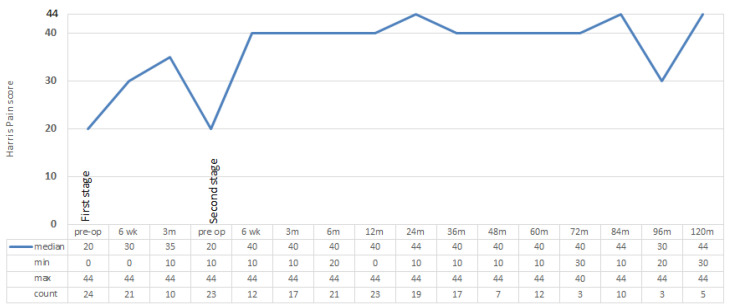
Periprosthetic joint infection (PJI) is a serious complication of total hip arthroplasty. Staged revision surgery is considered effective in eradicating PJI. We aimed to determine the rate of infection resolution after each stage of staged revision surgery (first stage, repeat first stage, second stage, excision arthroplasty, and reimplantation) and to assess functional outcomes and the mortality rate at ten years in a consecutive series of 30 chronic PJI of total hip arthroplasties. Infection resolution was defined as no clinical nor laboratory evidence of infection at 24 months after the last surgery and after a minimum of 12 months following cessation of antimicrobial treatment. Four patients died within 24 months of their final surgery. Nineteen patients, 73% (worst-case analysis (wca) 63%), were infection free after 1 surgery; 22 patients, 85% (wca 73%), were infection free after 2 surgeries; and 26 patients, 100% (wca 87%), were infection free after three and four surgeries. The median Harris Hip Score was 41 prior to first revision surgery and improved to 74 at twelve months and 76 at ten years after the final surgery. Thirteen patients died at a mean of 64 months from first revision, giving a mortality rate of 43% at ten years, which is approximately 25% higher than that of an age-matched general population. The results show that with repeated aggressive surgical treatment, most PJIs of the hip are curable. Ten years after successful treatment of PJI, functional outcomes and pain are improved and maintained compared to before initial surgery, but this must be balanced against the high 10-year mortality. Level of evidence: cohort studies.
人工关节周围感染(PJI)是全髋关节置换术的一种严重并发症。分期翻修手术被认为对根除PJI有效。我们旨在确定分期翻修手术各阶段(第一阶段、重复第一阶段、第二阶段、关节切除成形术和再植入)后的感染清除率,并评估连续30例全髋关节置换术慢性PJI患者在10年时的功能结局和死亡率。感染清除定义为最后一次手术后24个月且抗菌治疗停止至少12个月后无感染的临床及实验室证据。4例患者在最后一次手术后24个月内死亡。19例患者(73%,最差情况分析(wca)为63%)在1次手术后无感染;22例患者(85%,wca为73%)在2次手术后无感染;26例患者(100%,wca为87%)在3次和4次手术后无感染。首次翻修手术前Harris髋关节评分中位数为41分,最后一次手术后12个月时提高到74分,10年时提高到76分。13例患者在首次翻修后平均64个月死亡,10年死亡率为43%,比年龄匹配的普通人群高约25%。结果表明,通过反复积极的手术治疗,大多数髋关节PJI是可治愈的。成功治疗PJI 10年后,与初次手术前相比,功能结局和疼痛得到改善并得以维持,但这必须与较高的10年死亡率相权衡。证据水平:队列研究。