Department of Orthopaedics and Trauma, Royal Adelaide Hospital, Adelaide, 5000, Australia.
Centre for Orthopaedic and Trauma Research, University of Adelaide, Adelaide, 5000, Australia.
Nutr J. 2024 Oct 25;23(1):132. doi: 10.1186/s12937-024-01034-z.
Prosthetic Joint Infection (PJI) is the most devastating complication of arthroplasty surgery and affects 1-5% of patients. Despite strict adherence to aseptic protocols and preventive measures, infection is the most common reason for revision arthroplasty, and the incidence is increasing. Treatment of PJI is challenging and often requires repeated major surgeries with sequentially poor results. The continued occurrence of PJI, and persistence after treatment, brings into question the current treatment paradigm. Preclinical evidence suggests a link between altered gut health and the risk of PJI in arthroplasty patients. Resistant starches helps to restore gut physiology by enhancing the beneficial microbiome and producing short-chain fatty acids, which have several health-conferring properties. The primary aim of this study is to investigate the effect of a commercially available prebiotic fibre formulation on the gut microbiome in PJI patients planned for a two-stage revision surgery.
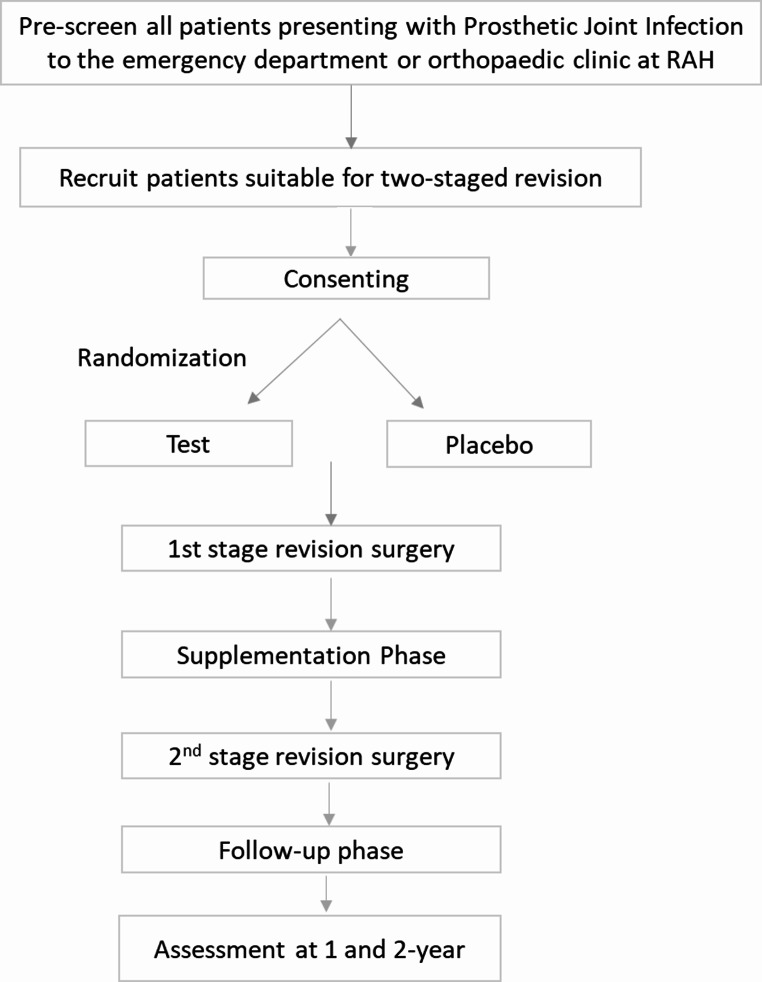
A double-blind placebo-controlled trial will assess the effect of 8-week supplementation of a commercially available prebiotic supplement in patients presenting with first-time PJI undergoing two-stage revision surgery. The supplementation phase will start after the first stage revision, and 80 patients will be randomised to receive either a test product (34 g of resistant starch) or a placebo (custard powder) daily for eight weeks. Stool and blood specimens will be collected at baseline, four weeks and eight weeks after the first-stage surgery and once at second-stage surgery. Gut microbiome profile, inflammatory cytokines and gut permeability biomarkers will be measured. Tissue specimens will be collected intra-operatively during first and second-stage surgeries. Baseline dietary patterns and gut symptoms will be recorded using validated questionnaires. Treatment outcomes will be reported for both cohorts using the Delphi criterion at one and two years after second-stage surgery.
This will be the first study to investigate the relationship between gut health optimisation and preventing PJI recurrence in arthroplasty patients. If supplementation with resistant starch improves gut health and reduces systemic inflammation, optimising the gut microbiome will be a recommended preoperative management strategy for arthroplasty patients.
ACTRN12623001273673.
人工关节感染(PJI)是关节置换术后最具破坏性的并发症,影响 1-5%的患者。尽管严格遵守无菌协议和预防措施,感染仍是关节翻修的最常见原因,且发病率呈上升趋势。PJI 的治疗具有挑战性,通常需要反复进行主要手术,且效果逐渐变差。PJI 的持续发生和治疗后的持续存在,使当前的治疗模式受到质疑。临床前证据表明,肠道健康的改变与关节置换患者发生 PJI 的风险之间存在关联。抗性淀粉有助于通过增强有益微生物组和产生短链脂肪酸来恢复肠道生理学,这些短链脂肪酸具有多种健康赋予特性。本研究的主要目的是研究一种市售的益生元纤维配方对计划进行两阶段翻修手术的 PJI 患者肠道微生物组的影响。
一项双盲安慰剂对照试验将评估在首次发生 PJI 并接受两阶段翻修手术的患者中,8 周补充市售益生元补充剂的效果。补充阶段将在第一阶段翻修后开始,80 名患者将随机分为试验组(34 克抗性淀粉)或对照组(奶油粉),每天服用 8 周。在第一阶段手术后 4 周和 8 周以及第二阶段手术后采集粪便和血液标本。测量肠道微生物组谱、炎症细胞因子和肠道通透性生物标志物。在第一和第二阶段手术期间收集术中组织标本。使用经过验证的问卷记录基线时的饮食模式和肠道症状。使用 Delphi 标准在第二阶段手术后 1 年和 2 年报告两组的治疗结果。
这将是第一项研究肠道健康优化与预防关节置换患者 PJI 复发之间关系的研究。如果补充抗性淀粉可改善肠道健康并降低全身炎症,优化肠道微生物组将成为关节置换患者术前管理策略的推荐方法。
ACTRN12623001273673。